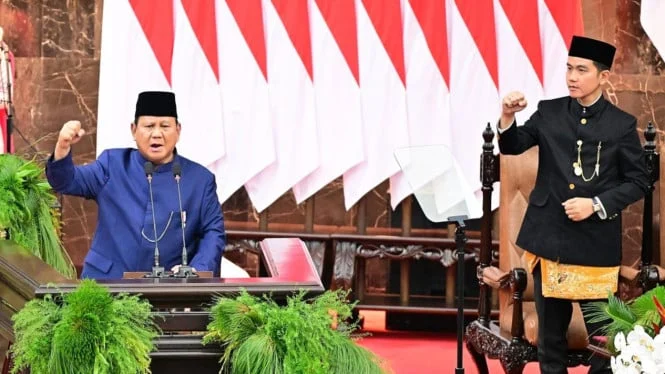
Jakarta – The administration led by President Prabowo Subianto and Vice President Gibran Rakabuming Raka has achieved a remarkably high level of public confidence, according to the latest nationwide survey released by Poltracking Indonesia. The comprehensive evaluation, which coincides with the administration’s one-year milestone, indicates that overall public trust in the executive branch stands at an impressive 81.5 percent.
The findings were unveiled by Poltracking Indonesia Executive Director Hanta Yuda Rasyid during a virtual presentation broadcasted live on the organization’s official YouTube channel, Poltracking TV. The data reflects a comprehensive nationwide sentiment assessment regarding the trajectory of the government’s policies, leadership efficacy, and departmental performance during its foundational first year in office.
The survey provides a granular look into how Indonesian citizens perceive the current executive leadership, highlighting robust approval ratings across multiple governance sectors, specific demographic drivers, and the underlying reasons for the administration’s strong standing among the electorate.
Sectoral Performance: Education, Health, and Defense Lead the Way
A closer examination of the polling data reveals that the high general trust in the Prabowo-Gibran administration is directly underpinned by strong public satisfaction across critical public service sectors. Citizens overwhelmingly expressed contentment with government interventions in education, healthcare, and national security.
Topping the sectoral evaluations is the education sector, which garnered a stellar 79.0 percent public satisfaction rating. This is followed closely by the health sector at 76.6 percent, reflecting positive public sentiment toward healthcare accessibility and service delivery improvements over the past year. Meanwhile, the defense and security sector—a domain historically familiar to President Prabowo given his background as a former Minister of Defense—secured a robust 75.5 percent approval rating.
These figures indicate that structural policies and ongoing budgetary allocations directed toward human capital development and national stability are resonating effectively with the general population. Analysts note that maintaining high satisfaction in these three core areas is typically vital for ensuring long-term sociopolitical stability in Indonesia.

Core Drivers of Public Appreciation for President Prabowo Subianto
Beyond institutional evaluations, President Prabowo Subianto’s personal approval rating as head of state stands at 78.3 percent. The survey meticulously mapped out the primary factors contributing to this substantial backing, categorizing the motivations behind public appreciation into five distinct pillars.
According to the data presented by Hanta Yuda Rasyid, leadership style and character attributes form the single largest block of positive sentiment. Approximately 22.9 percent of respondents specifically cited Prabowo’s perceived decisiveness and courage as the primary reason for their approval.
Social assistance programs (Bantuan Sosial or Bansos) emerged as the second-most prominent driver, cited by 13.4 percent of respondents who acknowledged the tangible benefits of these welfare safety nets in cushioning economic pressures. Close behind, 11.4 percent of citizens praised the President’s perceived proximity to the populace and his consistent advocacy for the interests of ordinary citizens and grassroots communities.
Furthermore, ongoing efforts in legal reform and law enforcement accounted for 9.2 percent of the appreciative responses. Rounding out the top five reasons is the flagship Makan Bergizi Gratis (MBG) program—focused on providing nutritious meals to students—which captured 8.5 percent of positive public recognition.
Vice President Gibran Rakabuming Raka Maintains Strong Approval
In tandem with the President’s strong performance metrics, Vice President Gibran Rakabuming Raka also secured a solid approval rating from the Indonesian public. The Poltracking survey revealed that public satisfaction with Gibran’s performance stands at 71.4 percent.
The high approval rating for the Vice President underscores a relatively smooth executive partnership during their inaugural year. Observers note that Gibran’s appeal often bridges generational divides, appealing heavily to younger demographics while complementing President Prabowo’s broader statecraft and military-diplomatic experience.
Methodology and Survey Parameters
To ensure statistical rigor and reliability, Poltracking Indonesia executed the nationwide survey using a strict empirical framework. The data collection phase took place from October 3 to October 10, 2025, capturing contemporary sociopolitical dynamics.

The survey deployed a multi-stage random sampling method, encompassing a total of 1,220 respondents across various provinces in Indonesia. Data was gathered primarily through direct, face-to-face interviews conducted by trained field researchers. The resulting dataset maintains a margin of error of approximately 2.9 percent at a 95 percent confidence level, making the findings statistically representative of the broader Indonesian electorate.
Broader Implications and Political Landscape
The release of these Poltracking survey results carries significant implications for the political and economic landscape of Indonesia as the administration looks toward its subsequent years in power. An approval and trust rating exceeding 80 percent provides the executive branch with substantial political capital.
With this high degree of public backing, the Prabowo-Gibran administration possesses a strong mandate to accelerate structural economic reforms, infrastructural projects, and large-scale social welfare initiatives—such as the aforementioned Makan Bergizi Gratis program—without facing immediate or debilitating legislative gridlock or widespread public pushback.
Political analysts suggest that while honeymoon periods for newly elected governments often experience gradual erosion over time, the proactive rollout of visible social assistance and targeted investments in health and education have successfully cushioned the administration against early skepticism. However, maintaining these figures will heavily depend on the government’s ability to navigate global macroeconomic headwinds, control inflation, and ensure stringent transparency in public spending moving forward.
As the Prabowo-Gibran administration enters its second year, the focus will likely shift from foundational policy establishment to measurable long-term economic dividends. For now, however, independent polling data confirms that the executive leadership retains a solid foundation of trust and legitimacy among the vast majority of Indonesian citizens.