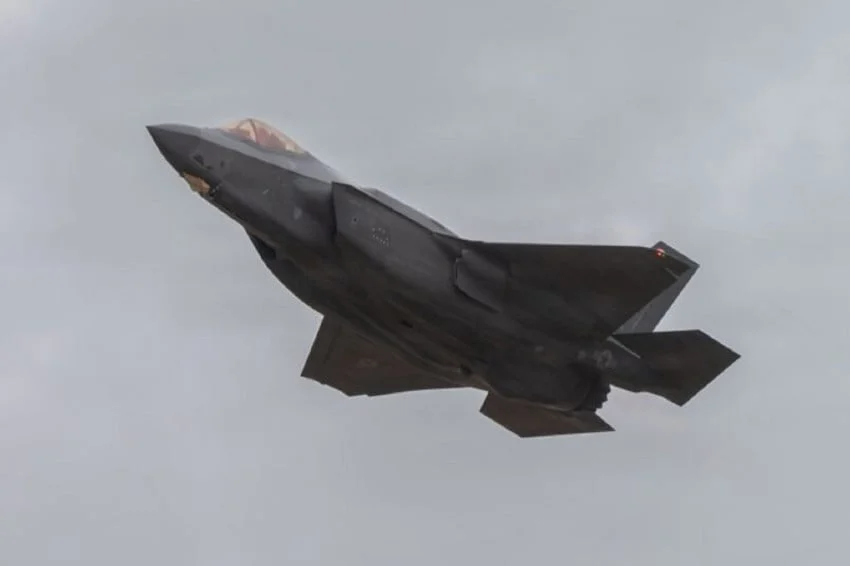
WASHINGTON — In a monumental geopolitical development that reshapes the military balance in the Middle East, the United States government has officially approved the proposed foreign military sale of 48 advanced F-35 Lightning II stealth fighter jets to the Kingdom of Saudi Arabia. Announced on Thursday by United States defense and Treasury officials, the colossal transaction is valued at an estimated $24.3 billion, encompassing not only the fifth-generation aircraft but also comprehensive maintenance packages, logistics support, advanced weaponry, and specialized training for Royal Saudi Air Force personnel.
While the historic arms agreement marks a significant deepening of strategic defense ties between Washington and Riyadh, it has laid bare a profound internal fissure within the United States government. Intelligence agencies across Washington have raised urgent, high-level alarms, warning that the deployment of sophisticated American stealth technology to the Gulf kingdom carries substantial risks. Specifically, intelligence analysts caution that pervasive commercial and technological cooperation between Riyadh and Beijing could provide the People’s Republic of China with unprecedented access to sensitive F-35 telemetry, radar signatures, and avionics software through targeted espionage.
The transaction represents one of the most substantial military procurement deals in the modern history of the Middle East, arriving at a delicate and volatile time for regional security following recent military escalations involving Iran, the United States, and Israel.
Financial Scope and Comprehensive Defense Package
The $24.3 billion price tag reflects the sheer complexity and technological superiority of the F-35 Lightning II, manufactured by American defense giant Lockheed Martin. Beyond the delivery of 48 twin-engine-capable, single-seat stealth fighters, the comprehensive letter of transmittal submitted to the United States Congress outlines an extensive auxiliary support framework.
This multi-billion-dollar package includes state-of-the-art Pratt & Whitney F135 engines, electronic warfare systems, command and control architecture, precision-guided munitions, cryptographic devices, and long-term contractor engineering and technical support. The integration of these systems is designed to seamlessly merge Saudi air defense infrastructure with existing United States military networks deployed throughout the region.
Financial analysts note that the sheer scale of the contract places it among the largest single foreign military sales authorizations processed by the Department of State in recent years, rivaling major defense pacts with traditional Indo-Pacific and European allies.
Strategic Context and Regional Dynamics
The greenlighting of the F-35 sale to Riyadh is the culmination of years of diplomatic maneuvering, lobbying, and shifting regional alliances. For decades, Saudi Arabia has sought to acquire Washington’s most prized aerial combat asset to modernize an aging fleet currently anchored by Eurofighter Typhoons and legacy Boeing F-15SA Strike Eagles.
However, the path to acquisition has been fiercely contested, primarily due to the United States’ strict adherence to maintaining Israel’s Qualitative Military Edge (QME) in the Middle East. Under United States law, Washington is legally mandated to ensure that any arms sales to regional actors do not degrade Israel’s military superiority. Until recently, Israel remained the exclusive operator of the F-35 in the Middle East, utilizing the platform—locally designated as the "Adir"—to project power and deter adversaries across contested airspaces.
The renewed momentum behind the Saudi procurement bid has occurred parallel to broader diplomatic discussions regarding the potential normalization of diplomatic relations between Riyadh and Jerusalem. Although Israeli officials have historically voiced sharp reservations regarding the introduction of stealth technology to neighboring Arab states, evolving threat perceptions—particularly concerning the persistent ballistic missile, cruise missile, and drone proliferation by Iran and its regional proxy network—have prompted a reevaluation of security architectures in Washington and allied capitals.
The Intelligence Dilemma: The China Factor
Despite the strategic rationale favoring enhanced defense interoperability with Riyadh, the decision has drawn intense scrutiny from the United States intelligence community. Agencies including the Central Intelligence Agency (CIA) and the Defense Intelligence Agency (DIA) have long expressed deep-seated anxieties regarding Saudi Arabia’s robust and deepening economic, technological, and infrastructure partnerships with China.
In recent years, Beijing has made significant inroads into the Gulf Cooperation Council (GCC) economies, partnering with Saudi enterprises on telecommunications infrastructure, including 5G rollouts, artificial intelligence research, and critical mineral extraction. United States intelligence officials harbor persistent fears that Chinese intelligence services could exploit commercial vulnerabilities, joint ventures, or shared military facilities to compromise the highly classified operational software, sensor fusion capabilities, and radar-absorbent materials of the F-35.
The F-35 program relies on the ODIN (Operational Data Integrated Network) cloud-based logistics and maintenance system, which continuously transmits vast quantities of diagnostic and performance data back to maintenance hubs in the United States. Counterintelligence experts within Washington have warned that safeguarding this data stream within an environment where Chinese commercial and engineering personnel maintain a significant footprint presents an extraordinarily complex security challenge. To mitigate these risks, the Pentagon is expected to mandate stringent security protocols, physical access restrictions, and dedicated segregated facilities for any F-35 squadrons stationed on Saudi soil.
Official Justifications and Legislative Roadmap
In its formal notification to Capitol Hill, the Department of State emphasized the defensive and stabilizing nature of the proposed acquisition.
"The proposed sale will improve Saudi Arabia’s capability to meet current and future threats by bolstering its homeland defense and enhancing interoperability with United States forces," the State Department stated in its official release. The agency further underscored that the acquisition would expand the operational capacity of the Royal Saudi Air Force, substantially upgrading its air-to-air interception and precision air-to-ground strike capabilities in an increasingly contested regional environment.
The Department of State has formally notified Congress of the pending transaction, initiating a statutory review period. Under United States law, members of Congress possess the authority to review the sale and introduce a joint resolution of disapproval, though successfully blocking a major foreign military sale requires a bipartisan veto-proof majority. While several progressive and defense-conscious lawmakers are expected to raise concerns regarding human rights records, regional stability, and the aforementioned technology transfer risks, Capitol Hill insiders suggest the deal faces a challenging but navigable path through the legislative branch.
As Washington has yet to release a definitive delivery schedule for the aircraft, defense analysts project that training, infrastructure development, and manufacturing lead times mean the first operational F-35s will likely not touch down in Saudi Arabia until late in the decade. The coming months will witness intense scrutiny from congressional committees as lawmakers weigh the imperative of cementing strategic alliances in the Middle East against the profound technological risks posed by great-power competition with China.