
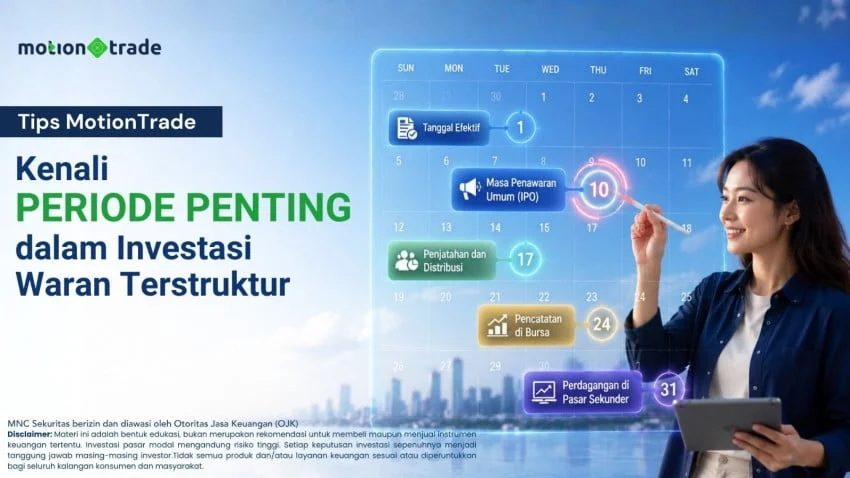
The Indonesian capital market continues to evolve with the introduction of sophisticated financial instruments designed to provide retail and institutional investors with diverse avenues for capital appreciation. Among these instruments, Structured Warrants (SW) have emerged as a prominent choice for those seeking leveraged exposure to blue-chip stocks with a relatively lower capital outlay. However, the complexity of these derivatives necessitates a deep understanding of their lifecycle. To address this need, MotionTrade, a leading trading platform under MNC Sekuritas, has released a comprehensive guide detailing the critical timeframes and phases of structured warrant investment. By mastering these periods, investors can better synchronize their entry and exit strategies, thereby maximizing potential gains while mitigating the inherent risks associated with derivative trading.
Structured warrants are transferable securities issued by a third-party financial institution—typically a securities firm—rather than the underlying company itself. They grant the holder the right, but not the obligation, to buy (Call Warrant) or sell (Put Warrant) an underlying asset at a predetermined price within a specific timeframe. In the Indonesian context, the Indonesia Stock Exchange (IDX) has actively promoted these instruments to increase market liquidity and provide investors with tools to profit in both bullish and bearish market conditions. MotionTrade’s recent educational initiative highlights that timing is not merely a tactical advantage but a fundamental requirement for success in this high-stakes environment.
The Significance of the Effective Date in Regulatory Compliance
The journey of a structured warrant begins long before it appears on an investor’s trading screen. The first critical milestone identified by MotionTrade is the Effective Date. This date marks the official commencement of the offering period for a specific series of structured warrants. It is the point at which the Indonesian Financial Services Authority (OJK) declares the registration statement effective, allowing the issuer to proceed with the public offering.
For investors, the Effective Date is a signal to scrutinize the prospectus. The prospectus contains vital information, including the identity of the underlying stock, the exercise price, the conversion ratio, and the expiration date. Understanding the Effective Date is crucial because it sets the legal and operational framework for the instrument. It provides a window for investors to perform fundamental and technical analysis on the underlying asset to determine if the structured warrant aligns with their portfolio objectives. By tracking this date, proactive investors can prepare their capital and strategies ahead of the crowd, ensuring they are ready when the subscription period opens.
Navigating the Initial Public Offering (IPO) Phase
Following the Effective Date is the Masa Penawaran Umum, or the Initial Public Offering (IPO) period. This is a specialized window, typically lasting between one to five business days, depending on the specific series and the issuer’s policy. During this phase, investors have the unique opportunity to purchase structured warrants directly from the issuer at the primary market price.
Participating in the IPO of a structured warrant offers several strategic advantages. First, it allows investors to acquire the instrument without the bid-ask spread typically found in the secondary market. Second, it ensures that the investor can secure a specific volume of warrants that might be harder to accumulate once trading becomes highly volatile on the exchange. MotionTrade emphasizes that during this period, investors must submit their orders through authorized participants or the issuing securities firm. This stage is particularly attractive for those who have a strong conviction regarding the short-to-medium-term performance of the underlying blue-chip stock and wish to establish a position at the earliest possible juncture.
Transition to the Secondary Market and the Role of Liquidity Providers
Once the IPO period concludes, the structured warrants are listed on the Indonesia Stock Exchange, entering the secondary market phase. This is where the majority of retail activity occurs. Unlike the primary market, where the price is fixed by the issuer, the secondary market price fluctuates based on the movement of the underlying asset, time decay, and market volatility.
A defining characteristic of structured warrants in the Indonesian market is the presence of a Liquidity Provider (LP). The issuer acts as the LP, ensuring that there are always buy and sell orders available in the order book. This mechanism is vital for maintaining a fair and orderly market, allowing investors to enter or exit their positions with ease. MotionTrade notes that understanding the secondary market phase involves monitoring the "Greeks"—delta, gamma, theta, and vega—which measure how the warrant’s price responds to various market factors. For instance, as the warrant approaches its expiration date, "time decay" (theta) accelerates, potentially reducing the value of the warrant even if the underlying stock price remains stagnant.
The Final Frontier: Expiration and Cash Settlement
The final and perhaps most critical phase in the lifecycle of a structured warrant is the Expiration Date. Unlike traditional stocks, which can be held indefinitely, structured warrants have a finite lifespan. In Indonesia, structured warrants are generally "European style," meaning they can only be exercised on the expiration date, and they are typically settled in cash rather than the physical delivery of shares.
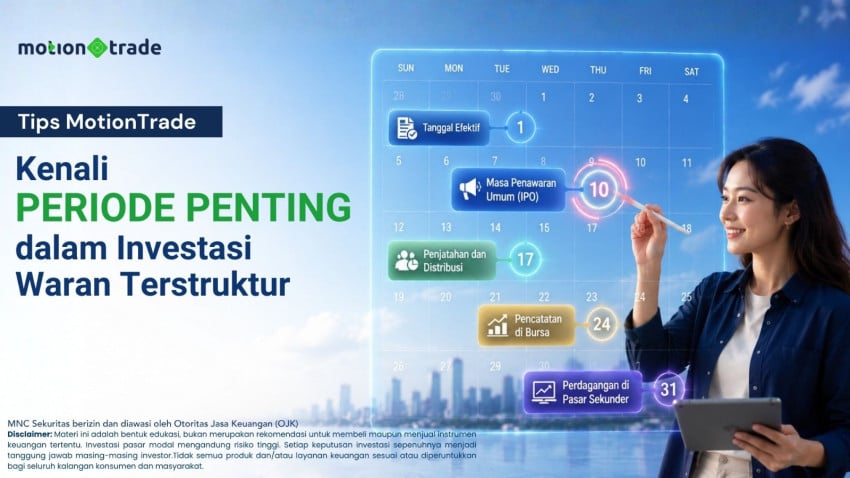
As the expiration date approaches, the "time value" of the warrant diminishes, leaving only the "intrinsic value." If the underlying stock price is above the exercise price for a Call Warrant (in-the-money), the holder will receive a cash payment representing the difference. If the warrant is out-of-the-money at expiration, it expires worthless, and the investor loses the entire premium paid. MotionTrade advises investors to be acutely aware of this "all-or-nothing" nature. Strategic investors often choose to sell their warrants in the secondary market days or weeks before expiration to capture remaining time value and avoid the risks associated with last-minute price fluctuations.
Supporting Data: The Growth of Structured Warrants in Indonesia
Since the debut of structured warrants on the IDX in late 2022, the instrument has seen significant growth. Data from the Indonesia Stock Exchange indicates that the number of series issued has expanded from a handful of initial offerings to dozens of series covering the most liquid stocks in the LQ45 index. The daily trading value of structured warrants has also shown an upward trajectory, reflecting increased familiarity among retail investors.
The rise in popularity is partly attributed to the low barrier to entry. While purchasing 100 shares (1 lot) of a high-priced blue-chip stock like Bank Central Asia (BBCA) or Telkom Indonesia (TLKM) may require millions of rupiah, a structured warrant on the same underlying asset can be purchased for a fraction of that cost. This "leverage" effect allows investors to control a larger position with less capital, though it also magnifies potential losses. The involvement of major firms like MNC Sekuritas in providing educational tools like MotionTrade is a response to this growing demand for sophisticated yet accessible trading options.
Institutional Perspective and Financial Literacy Efforts
The push for better education regarding structured warrants is part of a broader movement to enhance financial literacy in Indonesia. Recently, MNC Bank partnered with MNC Sekuritas to target the younger generation, specifically Gen Z, who are increasingly entering the capital market through digital platforms. This demographic is known for its appetite for high-growth instruments but often lacks the technical knowledge to navigate complex derivatives.
Statements from industry experts suggest that the long-term success of the structured warrant market depends on investor education. "We are committed to providing not just the platform, but the knowledge required to use these tools responsibly," a representative from MNC Sekuritas noted during a recent financial literacy seminar. By explaining the importance of the Effective Date, IPO period, and Expiration Date, MotionTrade aims to transform retail traders into informed investors who can contribute to a more stable and mature market ecosystem.
Risk Analysis and Strategic Implications
While the potential for high returns is attractive, the risks of structured warrants cannot be overstated. The most significant risk is the total loss of capital if the warrant expires out-of-the-money. Furthermore, because structured warrants are issued by financial institutions, there is a theoretical counterparty risk, although this is mitigated by strict OJK regulations and the requirement for issuers to have high credit standings and sufficient capital.
The leverage inherent in structured warrants also means that price movements are amplified. A 1% move in the underlying stock could result in a 10% or 20% move in the warrant price. This volatility requires investors to have a disciplined approach to risk management, such as setting stop-loss orders and only allocating a small percentage of their total portfolio to derivatives. MotionTrade’s focus on the "periods of investment" serves as a structural risk management tool; by knowing exactly when a warrant will expire or when a new one will be offered, investors can avoid being caught in "liquidity traps" or the rapid acceleration of time decay.
Conclusion: The Path Forward for Investors
The evolution of the Indonesian capital market is providing investors with more sophisticated tools than ever before. Structured warrants represent a significant milestone in this journey, offering a bridge between traditional equity investing and advanced derivative trading. However, the path to profitability is paved with the need for technical expertise and a disciplined understanding of market cycles.
MotionTrade’s breakdown of the investment periods—from the Effective Date and the IPO phase to secondary market trading and eventual expiration—provides a roadmap for navigating this complex landscape. For the modern investor, success is no longer just about picking the right stock; it is about picking the right instrument, at the right time, with a clear understanding of the regulatory and operational phases that govern its value. As financial literacy continues to improve and more series of structured warrants are introduced, these instruments are set to become a staple in the diversified portfolios of Indonesian investors, driving the nation’s capital market toward a more dynamic and inclusive future.
