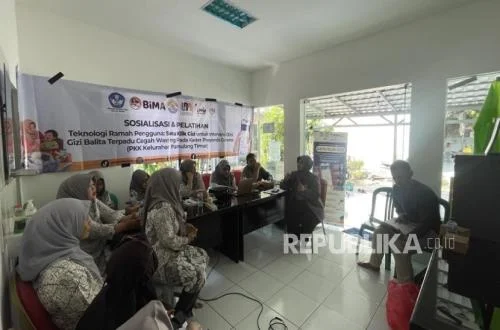
Universitas Nusa Mandiri (UNM), recognized for its institutional identity as a Digital Business Campus, has reaffirmed its commitment to social responsibility and technological advancement by launching a specialized digital health initiative in South Tangerang. On Thursday, July 16, 2026, a dedicated team of lecturers and students from UNM’s Information Systems and Informatics programs conducted an intensive socialization and training session for the "Satu Klik Gizi" (One Click Nutrition) application. This program, targeted at PKK (Family Welfare Movement) and Posyandu (Integrated Healthcare Center) cadres, took place at Posyandu Gurame, located in the RW 011 neighborhood of Pamulang Timur, South Tangerang. The initiative is a direct implementation of the 2026 Community Service Grant provided by the Directorate of Research, Technology, and Community Service (DPPM) under the Ministry of Higher Education, Science, and Technology (Kemdiktisaintek).
The primary objective of this project is to facilitate a digital transformation within the grassroots healthcare sector, specifically focusing on the early detection of "wasting"—a condition characterized by low weight-for-height that indicates acute malnutrition in toddlers. By providing community health volunteers with accessible, data-driven technology, the program aims to bridge the gap between traditional manual health monitoring and modern digital health standards. This initiative reflects a broader national strategy to utilize Fourth Industrial Revolution technologies to improve public health outcomes at the municipal and village levels.
Contextual Background: The Challenge of Toddler Malnutrition in Indonesia
To understand the significance of the "Satu Klik Gizi" application, one must look at the broader landscape of public health in Indonesia. For decades, the Indonesian government has prioritized the reduction of stunting and wasting among children under five. According to the Indonesia Health Survey (SKI) and previous longitudinal data, while stunting rates have shown a gradual decline, the prevalence of wasting remains a critical concern due to its immediate impact on child mortality and its potential to transition into chronic stunting.
In urban and peri-urban areas like South Tangerang, the challenge is not always a lack of resources, but rather the efficiency of data collection and the speed of intervention. Traditionally, Posyandu cadres—who are mostly community volunteers—record toddler growth data in physical registers known as "Buku KIA" or large paper logs. This manual process is prone to human error, particularly in calculating nutritional status based on complex anthropometric indices. There is often a significant time lag between the identification of a child at risk and the official response from health centers (Puskesmas).
The "Satu Klik Gizi" application addresses these systemic bottlenecks by automating the analysis of nutritional data. By entering simple measurements such as age, weight, and height, the application immediately calculates the child’s status, allowing for "real-time" detection of wasting. This shift from paper to digital is essential for South Tangerang, a city that is rapidly positioning itself as a "Smart City" with a high level of smartphone penetration among its residents.
Chronology and Development of the Initiative
The journey of the "Satu Klik Gizi" project began in early 2026 when the Information Systems Program at Universitas Nusa Mandiri identified a need for more localized digital health tools. While national-level apps like "Asik" (Aplikasi Sehat Indonesiaku) exist, there was a perceived need for a more simplified, user-friendly interface tailored specifically for the workflow of local Posyandu cadres.
Following the approval of the DPPM Kemdiktisaintek grant, the university formed an interdisciplinary team to ensure the project’s success. Dr. Sukmawati Anggraeni Putri, a prominent lecturer from the Information Systems Program, was appointed as the Chairperson of the Community Service Program. Recognizing that software development requires both system logic and technical engineering, she collaborated with colleagues from the Informatics Program, including Duwi Cahya Putri Buani and Syaifur Rahmatulloh.
The development phase spanned several months, involving field observations at various Posyandu locations in Pamulang to understand the digital literacy levels of the cadres. The team also recruited two students from the Information Systems Program, Dimas Ikhsan Ali and Rifqy Tsanaya, to assist in the UI/UX (User Interface/User Experience) design and to prepare educational materials. The actual implementation on July 16, 2026, served as the culmination of this rigorous preparation, transitioning the project from a lab-based innovation to a field-tested solution.
Technical Synergy: Information Systems Meets Informatics
A unique aspect of this program is the synergy between two distinct yet related academic disciplines. The Information Systems Program provided the framework for data management, ensuring that the information collected by the cadres could be organized into meaningful reports for health officials. Meanwhile, the Informatics Program focused on the technical robustness of the application, ensuring it could run smoothly on various mobile devices with minimal latency.
During the training at Posyandu Gurame, the UNM team explained how these two disciplines work together to create a seamless user experience. The "Satu Klik Gizi" app was built with a "mobile-first" philosophy, acknowledging that most cadres use mid-range smartphones. The backend of the application is designed to store data securely while allowing for future integration with wider municipal health databases.
The training session itself was divided into four comprehensive modules:
- Theoretical Foundation: An education session on the importance of the first 1,000 days of life and the specific clinical markers of wasting and stunting.
- Practical Anthropometry: A refresher on how to accurately measure a toddler’s height and weight using standardized equipment.
- Digital Literacy & App Navigation: A step-by-step walkthrough of the "Satu Klik Gizi" interface, from logging in to data entry.
- Simulation and Troubleshooting: A hands-on workshop where cadres used the app to record data for mock profiles, learning how to interpret the color-coded alerts (e.g., red for high risk, green for healthy).
Official Responses and Community Engagement
Dr. Sukmawati Anggraeni Putri emphasized that the success of technological innovation in the public sector depends heavily on its usability. "Collaboration across disciplines is the key factor in producing innovations that are truly beneficial for the community," she stated in a press release following the event. She further explained that by combining the strengths of Information Systems and Informatics, the university was able to deliver a tool that is technologically sophisticated yet simple enough for users with varying degrees of digital literacy.
The response from the cadres at Posyandu Gurame was overwhelmingly positive. Many participants noted that the manual calculation of Z-scores (a statistical measure used to determine nutritional status) was previously the most daunting part of their monthly duties. With the "Satu Klik Gizi" app, these calculations are performed instantly by the software’s algorithm.
Local community leaders in Pamulang Timur expressed their gratitude for the university’s involvement. While official government digital tools are being rolled out, the localized support and direct training provided by UNM fill a critical gap in technical assistance. Observers of the program noted that the involvement of students (Dimas Ikhsan Ali and Rifqy Tsanaya) was particularly effective, as they provided one-on-one "bedside" technical support to the cadres during the simulation phase, ensuring that no participant was left behind due to a lack of familiarity with smartphone apps.
Broader Implications: Toward a Data-Driven Healthcare Future
The implementation of the "Satu Klik Gizi" application at the neighborhood level has significant implications for public health policy. When data is digitized at the source, it becomes possible to create "heat maps" of nutritional risks within a city. If several toddlers in one specific RW (neighborhood unit) are flagged for wasting, health officials can immediately investigate local factors, such as water quality or economic shifts, rather than waiting for a quarterly report to be compiled manually.
Furthermore, this program serves as a model for the "Tri Dharma Perguruan Tinggi" (the Three Pillars of Higher Education), which mandates that universities engage in teaching, research, and community service. By moving beyond the classroom and into the Posyandu, UNM is demonstrating how academic research can solve real-world problems.
As South Tangerang continues to grow as a residential and commercial hub, the pressure on its public health infrastructure will increase. Digital solutions like "Satu Klik Gizi" offer a scalable way to maintain high standards of care without necessarily requiring a massive increase in professional medical staff at the ground level. Instead, it empowers the existing network of dedicated volunteers—the cadres—to work more effectively.
Analysis of Sustainability and Scalability
For the "Satu Klik Gizi" application to have a lasting impact, the focus must now shift toward sustainability. The 2026 grant provided the initial momentum, but the long-term success will depend on continued technical support and potential adoption by the South Tangerang Health Office (Dinas Kesehatan).
The evaluation conducted by the UNM team after the training showed a marked increase in the cadres’ confidence and technical proficiency. However, digital tools require regular updates to remain compatible with new mobile operating systems and to incorporate updated nutritional guidelines from the World Health Organization (WHO) or the Indonesian Ministry of Health.
The vision shared by Dr. Sukmawati and her team is for "Satu Klik Gizi" to become a sustainable solution that supports a more modern, effective, and data-based Posyandu service. By integrating digital literacy into the standard training for health volunteers, the program is not just introducing an app; it is fostering a culture of data-driven decision-making at the most local level of Indonesian society.
In conclusion, the socialization and training of the "Satu Klik Gizi" application by Universitas Nusa Mandiri represents a vital step in Indonesia’s journey toward digital health equity. By empowering local cadres in Pamulang Timur with the tools to detect wasting early, UNM is directly contributing to the health and well-being of the next generation. This initiative proves that when academia, government grants, and community spirit converge, the result is a tangible improvement in public service delivery that can serve as a blueprint for other regions across the archipelago.