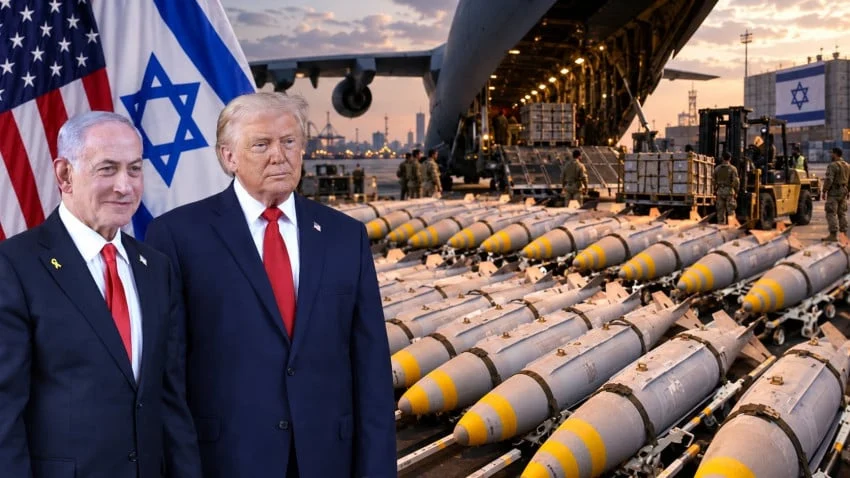
WASHINGTON — In a monumental move that has sent shockwaves through international diplomatic and defense circles, the administration of United States President Donald Trump is reportedly preparing a massive military aid package to supply Israel with 40.000 heavy-duty bombs. Valued at approximately USD 2.8 billion, or roughly IDR 49 trillion, this unprecedented arms transfer stands out as potentially the largest conventional explosive shipment from the United States to Israel in modern history. The development has immediately drawn intense global scrutiny, reopening fiery debates regarding the nature of American foreign policy, military assistance frameworks, and the broader geopolitical stability of the Middle East.
According to reports originating from prominent investigative journalism published by The Washington Post, citing anonymous U.S. officials familiar with the discussions, the proposed defense package encompasses an extraordinary inventory of ordinance. Specifically, the transfer includes 20.000 MK-84 general-purpose bombs, 20.000 BLU-117 precision-guided or standard utility bombs, and an additional 20.000 I-2000 penetrator warheads. Weighing an average of 2.000 pounds each, these munitions represent some of the most destructive conventional tactical weapons in the United States military inventory, designed primarily to pierce heavily fortified structures, underground bunkers, and complex subterranean networks.
Despite the technical categorization of the arrangement as a commercial foreign military sale, the financial mechanism behind the transaction reveals a familiar dynamic of American patronage. The procurement is set to be heavily financed through the United States Foreign Military Financing (FMF) program. Under this established legislative framework, Washington allocates billions of dollars annually to foreign allies, funds which are subsequently funneled back into the domestic American defense manufacturing sector to purchase advanced weaponry and military hardware. Consequently, while framed as a purchase agreement, the financial burden is ultimately borne by U.S. taxpayers, a point that frequently anchors domestic political contention.
The informal notification phase of this monumental transfer has already commenced. Representatives of the Trump administration have reportedly approached key committees within the United States Congress, strongly urging congressional leaders and lawmakers to expedite and approve the transaction without prolonged procedural delays. Although the executive branch holds significant authority in matters of foreign arms sales, congressional oversight committees retain the legal capacity to review and challenge such multi-billion-dollar military transfers, setting the stage for intense legislative debates in Washington.
Unprecedented Scale and Historical Context
The sheer volume of the proposed munitions package has stunned defense analysts and foreign policy experts alike. To contextualize the scale, military historians note that supplying 40.000 heavy-duty 2.000-pound bombs in a single transaction surpasses standard annual resupply thresholds, pointing to an extraordinary strategic intent. The gravity of the situation was underscored by prominent conservative political commentator and media figure Tucker Carlson, who took to the social media platform X to voice his astonishment and critique regarding the massive scale of the operation.
"Это tampaknya merupakan transfer amunisi peledak konvensional terbesar dari Amerika Serikat dalam sejarah modern," Carlson wrote, translating to his observation that this appears to be the largest conventional explosive ammunition transfer from the United States in modern history. Carlson’s remarks highlighted a growing discomfort among certain factions within the American political landscape, particularly among populist and isolationist commentators who question the sustainability and strategic wisdom of fueling protracted foreign conflicts with endless streams of heavy offensive hardware.
The historical backdrop of U.S. military aid to Israel is deeply rooted in decades of bipartisan strategic partnership, intelligence sharing, and mutual defense agreements. Since the mid-20th century, Washington has maintained a steadfast commitment to ensuring Israel’s qualitative military edge (QME) in the region. However, the delivery of 40.000 high-payload, 2.000-pound munitions touches upon deep-seated concerns regarding humanitarian impacts, international law, and the proportionality of military force in densely populated urban environments. Munitions of this class, particularly the MK-84 and heavy penetrator warheads, possess a lethal blast radius and structural destruction capability that can cause catastrophic collateral damage, making them a focal point for human rights organizations globally.
Financial Mechanics and Congressional Dynamics
A closer examination of the financial architecture underpinning the USD 2.8 billion (IDR 49 trillion) package illuminates the complex interplay between U.S. domestic economic interests and foreign military commitments. The Foreign Military Financing program functions essentially as a subsidy for the American military-industrial complex. By providing foreign governments with designated financial grants that must be spent exclusively on U.S.-manufactured defense articles, the program ensures steady, lucrative revenue streams for major American defense contractors such as Lockheed Martin, Boeing, and General Dynamics.
The involvement of congressional committees is a critical hurdle that the Trump administration must navigate. While traditional partisan alignments have historically favored robust military assistance to Israel, the unprecedented magnitude of this specific package—coupled with mounting pressure from humanitarian advocates and progressive lawmakers—may introduce notable friction during the informal and formal review periods. Lawmakers sympathetic to humanitarian concerns are expected to scrutinize the specific deployment intentions behind the 20.000 penetrator warheads and 20.000 general-purpose bombs, questioning whether such offensive capabilities align with long-term American strategic interests in regional de-escalation.
Strategic Implications and Geopolitical Aftershocks
The announcement of this historic arms transfer arrives at a uniquely volatile juncture in Middle Eastern geopolitics. The region remains gripped by multi-front tensions, ongoing armed conflicts, and delicate ceasefires involving various state and non-state actors. Introducing tens of thousands of high-yield munitions into this theater signals a clear, uncompromising signal of steadfast military backing from Washington to Tel Aviv, potentially altering the strategic calculations of rival regional powers.
Defense strategists point out that an infusion of 40.000 heavy bombs significantly replenishes Israel’s strategic reserves, which may have experienced depletion amid sustained high-intensity operational tempos. This replenishment ensures that the Israeli military maintains a robust deterrent posture and sustained operational capability against asymmetric threats, entrenched underground adversaries, and hostile regional state actors. Conversely, critics and regional adversaries argue that such massive military inflows actively undermine diplomatic pathways, embolden hawkish military strategies, and exacerbate humanitarian crises by enabling continued large-scale aerial campaigns.
Furthermore, the international community has closely monitored the diplomatic fallout of continuous heavy weapons supplies. Allies of the United States, particularly within Europe, have frequently expressed anxiety over the protracted nature of Middle Eastern conflicts and the humanitarian toll exacted by modern aerial bombardment campaigns utilizing heavy ordnance. The formal approval and eventual physical transfer of this USD 2.8 billion package will likely draw sharp diplomatic rebukes from international bodies and human rights organizations, who continuously advocate for arms embargoes and stricter accountability mechanisms regarding the end-use of exported weaponry.
Conclusion and Outlook
As the Trump administration pushes forward with its legislative outreach to secure congressional approval, the fate of this historic military package hangs in the balance of domestic American politics and shifting geopolitical realities. Whether the transaction proceeds smoothly through congressional review or faces fierce legislative roadblocks, the initiative has already cemented its place in contemporary history as a defining moment in U.S.-Israel defense relations. The supply of 40.000 bombs valued at IDR 49 trillion is not merely a commercial transaction or a standard military resupply; it is a profound strategic statement that underscores the enduring, complex, and highly controversial alliance binding Washington and Tel Aviv in an era of profound global uncertainty.