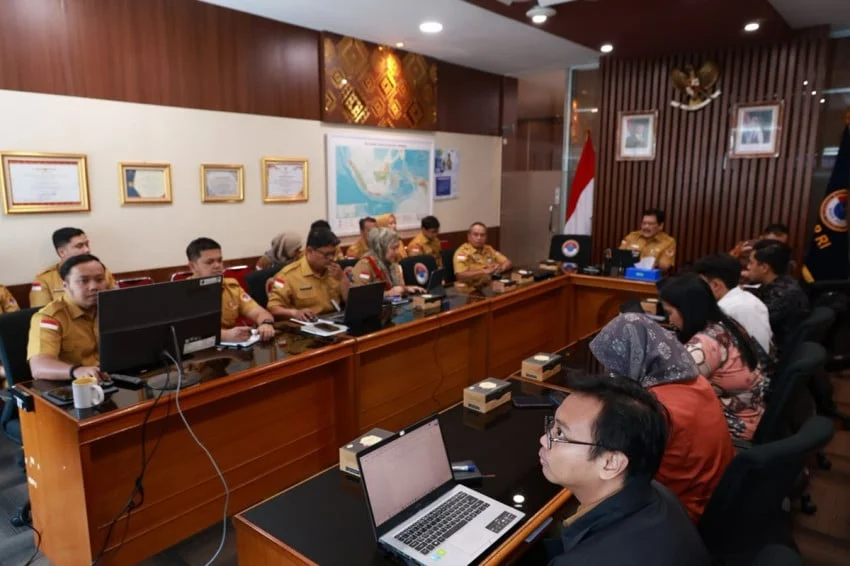
The National Border Management Agency of the Republic of Indonesia, operating under the auspices of the Ministry of Home Affairs, has engaged in strategic high-level discussions with the Coordinating Ministry for People’s Empowerment to accelerate the holistic development of the Entikong border region and the Sekayam Transmigration Area, both situated within Sanggau Regency, West Kalimantan Province. The strategic meeting, held on Tuesday, September 22, 2026, at the permanent secretariat office of the BNPP in Jakarta, marks a significant milestone in Indonesia’s ongoing commitment to transforming peripheral regions into robust economic hubs and secure national outposts.
The high-stakes collaborative forum focused heavily on the synchronization of infrastructure development, spatial planning harmonization, economic activity stimulation, and targeted community empowerment programs. By fostering deeper synergy between national agencies and coordinating ministries, the Indonesian government aims to unlock the vast economic, social, and geopolitical potential inherent in the Entikong-Sekayam corridor, ensuring that border communities experience equitable development that mirrors progress in the nation’s urban centers.
Chronology and Leadership of the Strategic Audiensi
The working meeting was convened at the Permanent Secretariat Office of the BNPP RI in central Jakarta, drawing key policymakers and technical experts from multiple government branches. The proceedings were jointly led by senior officials from the BNPP, including Harris Fadhly, who serves as the Assistant Deputy for Economic Infrastructure and Community Welfare, and Ismawan Harijono, the Assistant Deputy for Border Region Spatial Planning. Representing the Coordinating Ministry for People’s Empowerment was Amin Mudzakir, the Assistant Deputy for the Empowerment of People in Specific Regions.
The dialogue began with a comprehensive technical presentation by BNPP officials detailing the current developmental bottlenecks, spatial constraints, and prospective economic opportunities in Sanggau Regency. This was followed by a strategic response from the Coordinating Ministry for People’s Empowerment, focusing on how social safety nets, livelihood enhancement programs, and community-based enterprises can be effectively integrated into the overarching spatial framework. The convergence of infrastructure planning and social empowerment during this session underscores a deliberate shift in national policy: moving away from security-only border management toward a prosperity-oriented approach.
Spatial Planning and the Dual-Core Strategy of Entikong and Sekayam
A central pillar of the discussions revolved around the rigorous implementation of the Detailed Spatial Plan (Rencana Detail Tata Ruang – RDTR) established for the National Strategic Activity Center (Pusat Kegiatan Strategis Nasional – PKSN) of Entikong. According to data presented during the forum by Harris Fadhly, the Entikong and Sekayam regions operate under a complementary functional division designed to optimize land use and regional productivity.
Under this framework, Entikong is officially designated as the Primary Service Center. Given its status as home to one of Indonesia’s most vital Cross-Border Post (PLBN) facilities, Entikong acts as the primary gateway for international trade, logistics, and diplomatic exchange with neighboring Malaysia. Its developmental trajectory emphasizes high-capacity transport infrastructure, customs and immigration efficiency, and commercial services that facilitate smooth cross-border commerce.
Conversely, the adjacent Sekayam Transmigration Area functions as the Secondary Buffer Service Center. The developmental direction for Sekayam is multi-dimensional, explicitly encompassing national defense and security, economic diversification, and regional food self-sufficiency. By positioning Sekayam as a buffer, planners intend to establish a robust agricultural and agro-industrial hinterland that can supply both local consumption needs and export demands, thereby stabilizing the regional economy and preventing over-reliance on external supply chains.
Economic Catalysts: Integrating the Cross-Border Post with Local Industry
A recurring theme throughout the Jakarta meeting was the imperative to transition the Cross-Border Post (PLBN) from a mere administrative checkpoint into a vibrant, self-sustaining center of regional economic growth. Historical analyses of border regions in Southeast Asia indicate that transboundary posts often experience high volumes of transit traffic without generating sustainable local wealth. To counter this, the BNPP and the Coordinating Ministry for People’s Empowerment are championing an integrated development model.
This model mandates that the immediate surrounding areas of the PLBN—often referred to as the border zone hinterlands—must be cultivated to capture the spillover economic activity generated by international trade. This includes the establishment of localized logistics hubs, warehousing facilities, commercial retail zones, and specialized agro-processing units. By aligning these commercial zones with the established zoning laws of the RDTR, the government hopes to encourage small and medium-sized enterprises (SMEs) owned by local residents to participate directly in cross-border supply chains.
Furthermore, the integration of the Sekayam Transmigration Area into this economic matrix provides a vital domestic supply source. Transmigration areas historically possess strong agricultural foundations; however, logistical isolation and lack of market access have frequently stymied their growth. By connecting Sekayam’s agricultural output directly to the commercial channels operating out of Entikong, planners aim to create a closed-loop regional economy where border trade directly benefits transmigrant farmers and indigenous communities alike.
Broader Context: The Evolution of Indonesia’s Border Policy
The September 2026 meeting does not occur in a vacuum; it represents the continuation of a long-term strategic evolution in Indonesia’s border governance. Over the past decade, under successive national administrations, Indonesia has fundamentally recalibrated its geopolitical posture toward its international land and maritime borders. Historically viewed through a security-centric lens—focused primarily on territorial defense, smuggling prevention, and illegal migration—border regions were frequently neglected in terms of infrastructural and economic investment.
The establishment of the BNPP was a watershed moment in this policy shift, institutionalizing a dedicated agency tasked with formulating and implementing master plans for border development. Recent legislative and strategic frameworks have consistently emphasized that national sovereignty is best maintained not merely through military presence, but through prosperous, populous, and economically resilient border communities.
The involvement of the Coordinating Ministry for People’s Empowerment in the Entikong-Sekayam discussions highlights the social dimension of this philosophy. Infrastructure roads, bridges, and customs posts alone cannot secure a border if the local population lacks access to quality education, healthcare, employment, and sustainable livelihoods. By synchronizing physical infrastructure with human capital development, the government seeks to reverse the historical trend of out-migration from border regions, encouraging younger generations to remain in Sanggau Regency and contribute to its local economy.
Challenges and Implementation Hurdles
Despite the optimistic tone of the high-level talks, policy analysts and regional development experts emphasize that translating these ambitious blueprints into on-the-ground realities will present significant challenges. Coordinating across multiple bureaucratic layers—ranging from central ministries in Jakarta to the West Kalimantan Provincial Government and the Sanggau Regency administration—requires meticulous administrative synchronization.
Key challenges identified in similar regional development projects include bureaucratic friction, land acquisition complexities, and budgetary constraints. The Entikong-Sekayam corridor requires substantial capital expenditure to upgrade rural road networks, expand electrical grid capacities, and establish reliable digital connectivity. Without these foundational inputs, attracting private sector investment into agro-industry and local manufacturing will remain difficult.
Moreover, environmental considerations must be meticulously balanced against agricultural expansion in the Sekayam Transmigration Area. Sustainable land-use practices are vital to prevent deforestation, soil degradation, and potential conflicts over customary (adat) lands. Ensuring the active participation of indigenous communities and local stakeholders in the planning process will be critical to mitigating social friction and securing long-term project viability.
Socio-Economic Implications for Sanggau Regency and West Kalimantan
The strategic cooperation between the BNPP and the Coordinating Ministry for People’s Empowerment holds profound implications for the socio-economic landscape of Sanggau Regency and the broader West Kalimantan province. By deliberately linking the border trade dynamism of Entikong with the agricultural productivity of Sekayam, the government is laying the groundwork for inclusive regional growth.
For local farmers and agricultural cooperatives in Sekayam, the integration offers guaranteed market pathways for commodities such as palm oil derivatives, rubber, horticulture, and food crops. Reduced transport costs, achieved through infrastructure synchronization, will directly enhance profit margins for rural producers. Additionally, the emphasis on agro-industrial development means that raw agricultural products can be processed locally within Sanggau Regency before export, generating higher-value employment opportunities and retaining capital within the local economy.
For the broader population of West Kalimantan, a flourishing Entikong-Sekayam economic zone serves as a psychological and economic anchor, projecting national presence and pride along the international border with East Malaysia (Sarawak). It transforms the border region from an isolated periphery into a dynamic frontline of national development, trade, and cultural exchange.
Future Outlook and Next Steps
As the consultative meeting concluded, participating officials outlined several priority follow-up actions designed to maintain momentum. Technical working groups from both the BNPP and the Coordinating Ministry for People’s Empowerment have been tasked with drafting an actionable roadmap detailing specific infrastructural projects, budgetary allocations, and implementation timelines for the Entikong-Sekayam corridor through the remainder of 2026 and into 2027.
Subsequent phases of the initiative will involve localized public consultations with community leaders, business associations, and local government officials in Sanggau Regency to ensure that community feedback is incorporated into the final master plan. As Indonesia continues to prioritize the development of its outer islands and border territories, the Entikong-Sekayam synergy stands as a test case for integrated, prosperity-driven border management in the modern era.