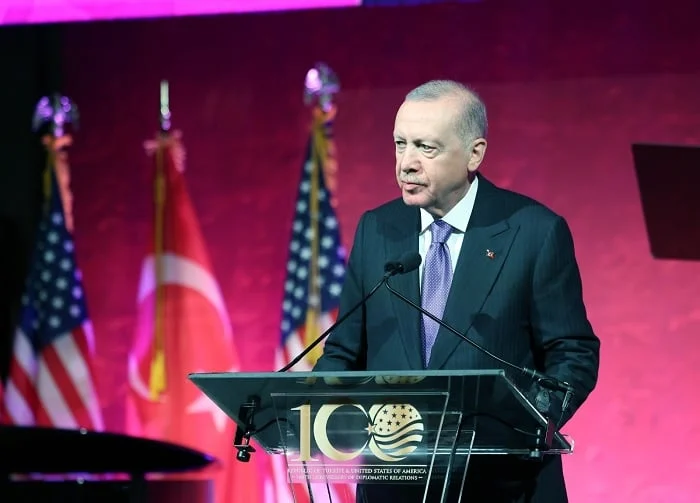
Turkish President Recep Tayyip Erdogan has reignited a fierce global debate regarding the architectural framework of the United Nations, issuing a direct and forceful call for the total abolition of the veto power held by the five permanent members of the UN Security Council (UNSC). Speaking to journalists in New York on the sidelines of high-level diplomatic engagements, Erdogan characterized the current decision-making apparatus as fundamentally unjust, outdated, and incapable of securing global peace or stability. His remarks come at a time of profound geopolitical friction, marked by paralyzing stalemates within the international body over major contemporary conflicts, including the devastating war in Gaza, the protracted conflict in Ukraine, and escalating maritime tensions in the strategic Strait of Hormuz.
The longstanding debate over the structure of the UN Security Council highlights deep-seated frustrations among nations excluded from the elite tier of decision-making. The demand to dismantle the veto system is not entirely new; however, the urgency with which it is being articulated reflects a growing perception that multilateral institutions are losing their efficacy in the face of modern geopolitical crises. As the international community grapples with humanitarian catastrophes and escalating security threats, the question of whether the United Nations can reform itself from within has become a central dilemma of 21st-century diplomacy.
Understanding the Mechanics of the UN Security Council Veto
To fully comprehend the weight of President Erdogan’s critique, it is necessary to examine the mechanics of the United Nations Security Council as it has functioned since the conclusion of the Second World War. The UNSC is composed of 15 members: 10 non-permanent members elected by the General Assembly for two-year terms, and five permanent members—often referred to as the P5—consisting of the United States, the United Kingdom, France, Russia, and China.
This exclusive group of five nations wields a formidable prerogative known as the right of veto. Under Article 27 of the UN Charter, any substantive resolution brought before the Security Council requires the affirmative votes of nine members, provided that none of the P5 cast a negative vote. In practice, this means that even if fourteen out of the fifteen members of the Council vote overwhelmingly in favor of a resolution, a single negative vote from just one permanent member is sufficient to veto and completely defeat the measure.
This design was originally conceived in 1945 during the San Francisco Conference as a pragmatic mechanism to ensure that the major powers of the post-war era remained engaged in the newly formed international organization. The framers of the Charter believed that the United Nations could not function effectively if it attempted to enforce decisions against the vital security interests of any major military power. Consequently, the veto was established as a pragmatic safeguard to prevent the organization from taking actions that might trigger a direct military confrontation among the globe’s premier nuclear-armed states.
Chronology of Paralysis: How the Veto Blocks Global Consensus
Over the decades, however, this institutional safeguard has frequently devolved into a tool of political obstruction, neutralizing the UN’s primary mandate to maintain international peace and security. In recent years, the frequency and impact of veto usage have intensified, drawing sharp criticism from non-aligned nations, regional organizations, and developing economies.
The paralysis of the Security Council has been particularly stark in the context of the Middle East and Eastern Europe. Over the past three years, the United States—a staunch ally of Israel—has utilized its veto power on multiple occasions to block resolutions concerning the Israeli-Palestinian conflict. This includes casting vetoes on at least five separate resolutions that explicitly called for an immediate, unconditional, and permanent ceasefire in Gaza, alongside demands for unhindered humanitarian access. Washington has consistently defended its actions by arguing that the proposed resolutions failed to adequately condemn terrorist organizations or did not sufficiently account for Israel’s inherent right to self-defense. Nonetheless, these repeated vetoes have drawn widespread international condemnation and deepened the diplomatic isolation of the United States on the issue.
Simultaneously, the war in Ukraine has exposed an identical structural flaw involving another permanent member. Russia, facing intense international condemnation for its military intervention in Ukraine, has routinely exercised its veto power to block any substantive or binding resolutions condemning its actions, demanding the withdrawal of its troops, or establishing accountability mechanisms for violations of international law. Because Moscow holds a permanent seat and veto authority, the Security Council has been legally and operationally constrained from taking direct enforcement action to halt the conflict, forcing member states to rely instead on the largely non-binding resolutions of the UN General Assembly.
Erdogan’s Blueprint for Comprehensive UN Reform
In his recent public statements and an opinion piece published in major international media outlets, President Erdogan outlined a comprehensive blueprint aimed at restructuring the United Nations to reflect the realities of the modern geopolitical landscape. His proposal centers on four primary pillars of institutional overhaul.
First, Erdogan demands the total elimination of the current veto mechanism. He argues that the existing model, which was forged in the aftermath of World War II, is fundamentally anachronistic and no longer meets the complex needs of a multipolar world. In his address in New York, he emphasized a shift away from a system that protects the narrow interests of five capitals toward a truly inclusive mechanism. "Biarlah mekanisme veto dihapuskan… Mari kita beralih dari model PBB yang hanya melindungi lima anggota menuju mekanisme yang mencakup seluruh anggota," Erdogan stated, calling for a system that genuinely represents the collective will of the international community.
Second, the Turkish leader advocates for the complete dismantling of the permanent member status. In his published writings, Erdogan argued that a structure that allows a single state to unilaterally override and nullify the consensus of the broader international community is inherently flawed. He noted that relying on the political will of a mere handful of nations to manage and resolve global crises is incompatible with contemporary principles of international democracy and equity.
Third, Erdogan proposes shifting substantial authority away from the Security Council and toward the United Nations General Assembly (UNGA). Under his proposed framework, the General Assembly would be empowered to elect all members of the Security Council for defined terms, ensuring that states wishing to sit on the council must continually earn and maintain the trust of the broader global community through democratic elections. This change, proponents of reform argue, would infuse the Security Council with greater legitimacy and accountability.
Finally, Turkey has actively sought to galvanize international support for this reform agenda, raising the issue repeatedly at high-level diplomatic forums, including the annual gathering of world leaders at the UN General Assembly. Erdogan has continually stressed that a system where the collective will of more than 190 sovereign nations can be held hostage by the political calculations of just five countries is neither morally defensible nor practically sustainable.
Legal Realities and the Path to Amending the UN Charter
While the political arguments for reforming the UN Security Council resonate strongly across the Global South and among nations frustrated by great power politics, the legal and procedural hurdles to achieving such a transformation are exceptionally formidable.
Formally abolishing the veto power or restructuring the composition of the Security Council requires a formal amendment to the Charter of the United Nations. According to Article 108 of the Charter, any amendment must be adopted by a vote of two-thirds of the members of the General Assembly and subsequently ratified by two-thirds of the members of the United Nations, including all five permanent members of the Security Council.
This creates an insurmountable institutional paradox: any amendment to strip the P5 of their veto power must first receive the explicit concurrence and ratification of the very same five nations whose special privileges would be revoked. Given that none of the permanent members—the United States, Russia, China, France, and the United Kingdom—have shown any willingness to voluntarily surrender their veto authority, the prospect of achieving structural reform through traditional legal channels remains remarkably low.
Broader Implications and the Future of Multilateralism
The persistent deadlock within the UN Security Council carries profound implications for the future of global governance and the credibility of the international rules-based order. When institutional mechanisms fail to address humanitarian crises, prevent armed conflict, or hold aggressors accountable, affected populations suffer the immediate consequences, while regional stability deteriorates.
Furthermore, the perceived ineffectiveness of the United Nations risks accelerating a trend toward fractured, plurilateral diplomacy. Frustrated by the paralysis of the UN, regional organizations, coalitions of the willing, and middle-power nations are increasingly taking matters into their own hands, forging alternative security arrangements and economic partnerships outside the traditional multilateral framework. This fragmentation could dilute the central coordinating role of the United Nations, potentially leading to a more anarchic and unpredictable international system.
Despite the monumental legal and political barriers standing in the way of reform, the persistent critique voiced by leaders like President Erdogan serves to keep the issue at the forefront of international discourse. As global power dynamics continue to shift away from the post-1945 consensus toward a multipolar reality featuring rising economic and military powerhouses, the pressure on the permanent members of the Security Council to demonstrate flexibility and accountability will only intensify. Whether the United Nations can evolve to meet these demands, or whether it risks sliding into irrelevance, remains one of the defining questions of modern international relations.