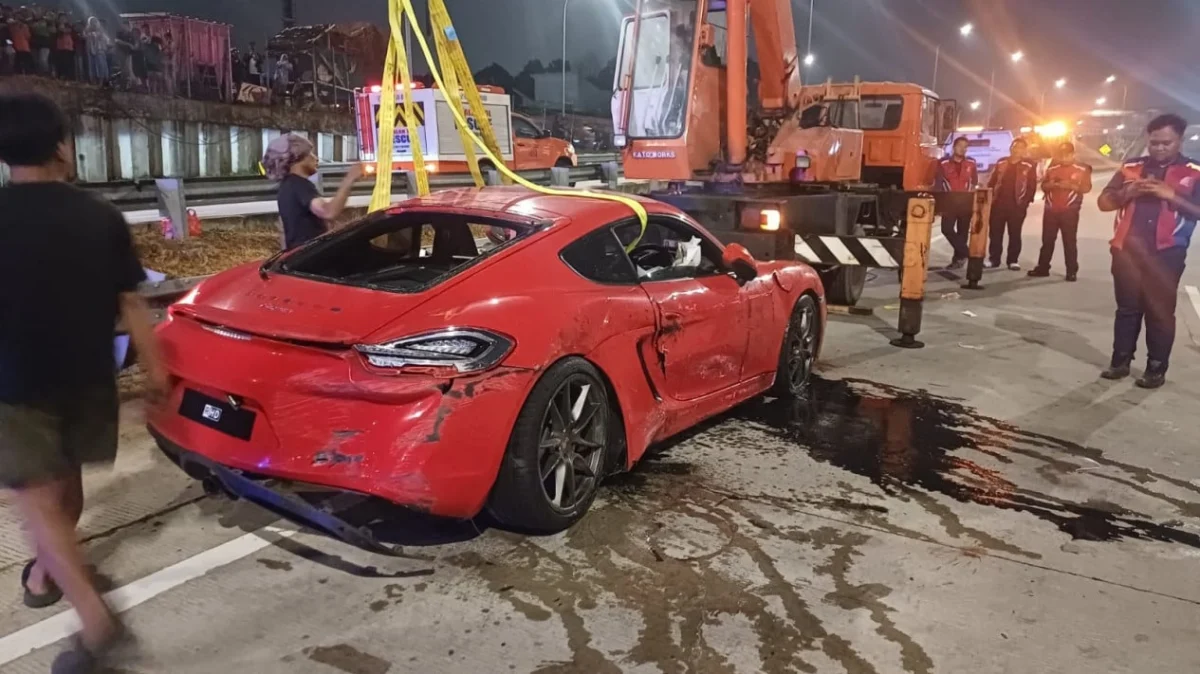
A high-performance Porsche Cayman 2.7 AT was involved in a dramatic single-vehicle accident on the Depok-Antasari (Desari) Toll Road on Saturday evening, September 19, 2026. The incident, which occurred at approximately 18:45 WIB at kilometer 4+200 in the direction of Sawangan to Antasari, saw the red sports car lose traction, collide with the roadside guardrail, and ultimately come to a halt in a drainage ditch alongside the highway. Despite the severity of the impact and the significant structural damage sustained by the vehicle, authorities have confirmed that there were no fatalities or injuries reported among the occupants.
Chronology of the Incident
The accident took place under challenging weather conditions, with reports indicating that a localized downpour had created hazardous driving environments across sections of the Depok-Antasari Toll Road. Preliminary investigations by traffic authorities suggest that the driver of the Porsche lost control of the vehicle after encountering a patch of standing water, commonly known as hydroplaning.
According to witness accounts and initial police reports, the vehicle began to slide uncontrollably after hitting the water, veering off the main traffic lane. The momentum of the sports car carried it into the steel guardrail. The impact was significant enough to compromise the integrity of the barrier before the vehicle slid off the embankment and into the concrete drainage channel adjacent to the toll road.
Emergency response teams were dispatched immediately following the distress calls. Upon arrival, responders focused on securing the area to prevent secondary accidents and ensuring the safety of the vehicle’s occupants. Once the passengers were confirmed to be unharmed, efforts shifted toward the complex task of extracting the vehicle from the ditch. The extraction process required specialized heavy-duty towing equipment, given the position of the car and the extent of the damage to its front, sides, and roof.
Vehicle Specifications and Performance Profile
The vehicle involved, a 2013 Porsche Cayman 2.7 AT, is a high-performance machine engineered for precision handling. It is powered by a 2,706 cc flat-six boxer engine located in a mid-ship configuration, a design choice synonymous with Porsche’s commitment to optimal weight distribution.
From a performance standpoint, the 2013 iteration of the Cayman 2.7 is capable of producing 275 horsepower and 290 Nm of torque. Power is delivered to the rear wheels via Porsche’s proprietary seven-speed Doppelkupplung (PDK) transmission. This setup allows the car to sprint from 0 to 100 kilometers per hour in approximately 5.5 seconds, with a top speed reaching roughly 266 km/h.

The mid-engine architecture, while offering superior cornering capabilities on dry surfaces, presents a different set of challenges when traction is compromised. High-performance tires on such vehicles are typically wide to maximize grip, which paradoxically increases the risk of hydroplaning when moving at high speeds over standing water. The combination of rear-wheel drive and a mid-engine balance means that when the tires lose contact with the asphalt, the driver has a very narrow window to regain control before the vehicle’s momentum takes over.
Economic and Administrative Context
The financial data associated with the vehicle provides a glimpse into the luxury car market in Indonesia. According to tax registration data for the DKI Jakarta region, the Porsche Cayman 2.7 AT 2013 is valued at approximately IDR 899 million for tax assessment purposes. However, experts in the automotive industry emphasize that this figure does not reflect the actual market value or the resale price of the vehicle.
In the secondary market, the value of a high-end sports car like a Porsche is highly volatile and dependent on several critical variables. These include the vehicle’s total mileage, the completeness of its service history, the condition of the engine and transmission, and whether the vehicle has been involved in previous accidents. A clean service record at an authorized Porsche center significantly increases the resale value, whereas an accident history, such as the one sustained on Saturday, will inevitably lead to a substantial depreciation in the vehicle’s market worth.
Infrastructure and Hydroplaning Risks
The incident at the Desari Toll Road serves as a stark reminder of the dangers posed by standing water on high-speed thoroughfares. Hydroplaning occurs when a layer of water builds between the tires and the road surface, leading to a loss of steering and braking control. For high-performance vehicles, the margin for error is significantly smaller due to their stiff suspension, wide tires, and high power output.
Traffic safety experts point out that toll road operators are responsible for ensuring proper drainage systems are maintained to prevent water accumulation. However, drivers also bear the responsibility of adjusting their speed according to road conditions. "When it rains, the physics of driving change entirely," says an automotive safety analyst. "Even for cars equipped with advanced stability control systems, there is a limit to how much technology can compensate for standing water at high speeds."
The Depok-Antasari Toll Road, which serves as a vital artery for commuters between Jakarta and its satellite cities, has seen an increase in traffic volume over the past few years. As urban sprawl continues to grow, maintaining road surface integrity and drainage capacity becomes increasingly critical to preventing such accidents.
Official Response and Safety Implications
Following the successful evacuation of the vehicle, toll road management urged motorists to exercise extreme caution during periods of heavy rainfall. The management noted that they are conducting regular maintenance to ensure that drainage grates are free of debris, which is often a contributing factor to water buildup on toll roads.

There has been no indication of legal charges being filed against the driver, as the incident is being treated as a single-vehicle accident caused by environmental conditions. Nevertheless, the event has sparked discussions among motoring enthusiasts and safety advocates regarding the necessity of advanced driving courses for owners of high-performance vehicles. Many argue that the ability to handle a vehicle under emergency conditions is just as important as the car’s mechanical specifications.
From an insurance perspective, single-vehicle accidents involving high-performance sports cars often lead to complex claims processes. Given the cost of parts and specialized labor required for repairs, such incidents often result in the car being declared a total loss if the frame or structural components are damaged beyond a certain threshold.
Broader Impact on Road Safety Culture
The aftermath of the Porsche accident in Depok highlights the importance of vehicle maintenance—specifically tire pressure and tread depth. Worn tires are significantly more susceptible to hydroplaning. While it is unclear if the tires on the involved vehicle were the primary factor, the incident serves as a call to action for all car owners to inspect their vehicles regularly, especially before traveling on highways where speeds are significantly higher than on city streets.
As Indonesia continues to expand its toll road network, the intersection of high-performance vehicle ownership and road infrastructure will remain a significant topic. While the Porsche Cayman is designed for performance, that performance is predicated on the assumption of a predictable road surface. When that predictability is removed by weather, the driver’s reaction time and the vehicle’s safety systems are tested to their limits.
In conclusion, the accident on the Desari Toll Road stands as a sobering lesson in road safety. While the outcome was fortunate in that no lives were lost, the damage to the vehicle and the disruption to traffic flow underscore the risks inherent in high-speed travel during inclement weather. As authorities continue to monitor the road conditions and motorists return to their daily routines, the incident serves as a poignant reminder that even the most advanced automotive engineering cannot fully insulate a driver from the unpredictable elements of the road. Safety, ultimately, remains a responsibility shared between the infrastructure operators and the drivers behind the wheel.