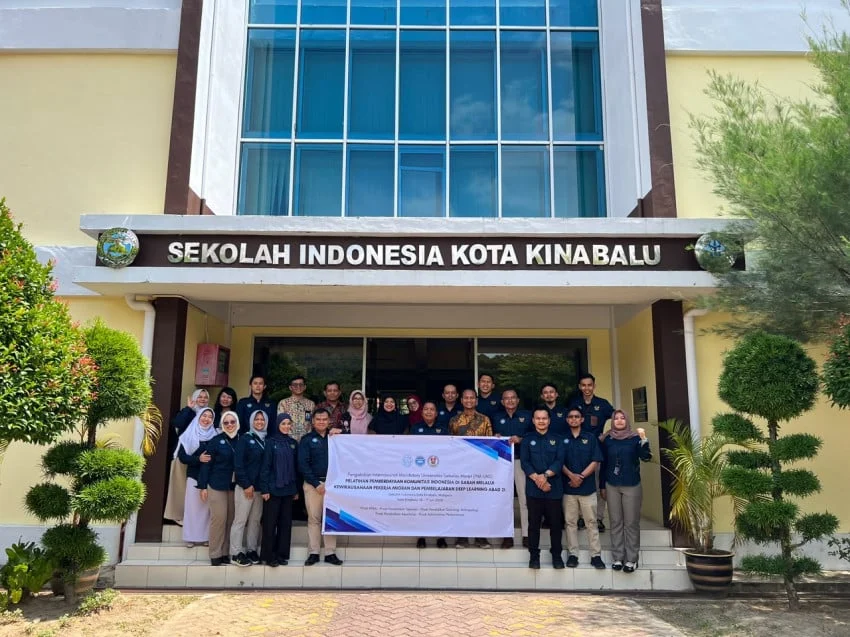
The Faculty of Teacher Training and Education (FKIP) at Universitas Sebelas Maret (UNS) has taken a decisive step toward international educational diplomacy and community empowerment by executing a comprehensive Mandated International Community Service (Pengabdian Internasional Mandatori or PIM) program at Sekolah Indonesia Kota Kinabalu (SIKK) located in Sabah, Malaysia. Conducted on July 15, 2026, the high-profile intervention centered around the theme of "Empowering the Indonesian Community in Sabah through Migrant Worker Entrepreneurship and 21st-Century Deep Learning Pedagogies." The strategic initiative brought together 41 participants, comprising educators, academic staff, and members of the SIKK school committee, all of whom play critical roles in shaping the futures of Indonesian children residing in East Malaysia.
Main Facts of the International Community Service
The academic deployment to Sabah was spearheaded by a multidisciplinary team of esteemed academics from FKIP UNS, led by Prof. Dr. Triyanto, S.H., M.Hum. The delegation featured a diverse array of subject-matter experts representing various academic departments within the faculty, including the Accounting Education Study Program, Office Administration Education Study Program, History Education Study Program, Sociology-Anthropology Education Study Program, and the Pancasila and Civic Education (PPKn) Study Program.
The primary objective of this mission was twofold: to elevate the pedagogical competencies of teachers at SIKK in alignment with modern global educational standards, and to strengthen the economic resilience and entrepreneurial knowledge of the school committee members, many of whom are Indonesian migrant workers (Pekerja Migran Indonesia or PMI) striving to build sustainable livelihoods in Sabah.
By targeting both educators and community leaders, the UNS delegation implemented a holistic approach designed to address educational disparities while simultaneously fostering economic self-reliance within the diaspora community. The event unfolded within the main hall of the SIKK Senior High School building, serving as a hub for collaborative dialogue, knowledge transfer, and cross-border academic solidarity.
Chronology and Event Execution
The day-long program commenced with a formal opening ceremony that underscored the significance of institutional collaboration between Indonesian higher education institutions and overseas diplomatic-educational outposts. The proceedings began with an official address delivered by the head of the FKIP UNS community service team, Prof. Dr. Triyanto, who outlined the strategic vision behind the PIM program and emphasized the moral and academic obligation of domestic universities to support Indonesian communities abroad.
Following the opening remarks, the Head of SIKK delivered a welcoming speech, formally inaugurating the sessions and expressing deep appreciation for the continuous support extended by Universitas Sebelas Maret. The leadership of SIKK noted that such academic interventions are vital for maintaining morale, upgrading professional standards, and bridging the gap between educational advancements in mainland Indonesia and the unique operational realities faced by diaspora schools.
Upon the conclusion of the plenary opening, the program transitioned into a dynamic, two-track parallel session structure. This methodological design allowed the facilitators to tailor their content precisely to the distinct needs of the two target groups: educators seeking advanced pedagogical frameworks and school committee members looking to acquire practical business acumen.
First Parallel Session: Advancing 21st-Century Pedagogies
The first parallel session was specifically curated for the teaching staff of SIKK, focusing intensely on the practical mastery of 21st-century educational frameworks and the implementation of Deep Learning approaches in the classroom. This track was led by two prominent educational experts and facilitators from UNS: Nur Fatah Abidin, M.Pd., and Yosafat Hermawan Trinugraha, Ph.D.
During this intensive workshop, the facilitators introduced modern pedagogical strategies designed to move away from rote memorization and toward critical thinking, creativity, collaboration, and communication—the foundational pillars of 21st-century learning. The integration of Deep Learning principles was explored in depth, providing teachers with actionable methodologies to help students develop a conceptual understanding of subjects rather than superficial proficiency.
Facilitators demonstrated how educators can adapt these global teaching trends to fit the specific demographic and cultural contexts of students in Sabah. Teachers were guided through interactive simulations, curriculum mapping exercises, and peer-review workshops aimed at embedding digital literacy and problem-solving tasks into daily lesson plans. The reception from the SIKK teaching corps was overwhelmingly positive, with instructors actively engaging in discussions regarding the contextualization of these modern teaching techniques within their respective classrooms.
Second Parallel Session: Fostering Migrant Entrepreneurship
While the educators engaged in pedagogical refinement, the second parallel track catered to the members of the SIKK school committee. Given that a significant proportion of committee members operate as Indonesian migrant workers in Sabah, this session was strategically designed to bolster entrepreneurial competencies, financial literacy, and small-business management skills.
Facilitated by specialists from the Accounting and Office Administration education programs, the entrepreneurship module addressed the unique economic challenges faced by the diaspora community. Participants were provided with comprehensive insights into market identification, product branding, basic financial bookkeeping, capital management, and digital marketing strategies. The objective was to equip migrant workers with the practical tools necessary to diversify their income streams, enhance household financial stability, and eventually transition toward independent business ownership, either while residing in Malaysia or upon their eventual return to Indonesia.
The interactive nature of the workshop allowed participants to share real-world business challenges they encounter in Sabah, receiving tailored advice and professional insights from the UNS academic team. Case studies of successful migrant-led enterprises were analyzed to demonstrate how small-scale capital can be scaled effectively through disciplined financial management and strategic networking.
Supporting Data and Context: The Plight and Potential of the Indonesian Diaspora in Sabah
To fully understand the gravity and relevance of the FKIP UNS initiative, one must examine the socio-economic landscape of the Indonesian diaspora in Sabah, Malaysia. Sabah hosts one of the largest concentrations of Indonesian migrant workers outside the homeland, primarily employed in the agricultural sector, particularly in expansive palm oil plantations, as well as in construction, domestic services, and small-scale commerce.
While these workers contribute significantly to the economic ecosystems of both Malaysia and Indonesia through remittances, their families often encounter unique systemic challenges. Access to formal, structured education for children of migrant workers has historically been a complex diplomatic and logistical hurdle. Institutions like Sekolah Indonesia Kota Kinabalu serve as vital lifelines, ensuring that these children retain their national identity, access standardized curricula, and secure foundational credentials that facilitate their future educational and career pathways.
However, schools operating in overseas frontier settings frequently face resource constraints, geographical isolation from mainland professional development networks, and the challenge of keeping pace with rapid educational reforms back in Indonesia. Furthermore, migrant workers themselves often operate in precarious economic environments, underscoring the necessity for targeted empowerment programs that build financial resilience and long-term economic security.
By deploying multidisciplinary academic teams to international outposts such as SIKK, universities like UNS operationalize the "Tri Dharma Perguruan Tinggi" (The Three Pillars of Higher Education)—specifically the pillar of community service—on a transnational scale. This approach not only addresses immediate capacity-building needs but also aligns with broader national policies aimed at protecting and empowering Indonesian citizens abroad.
Official Responses and Institutional Perspectives
The execution of the PIM program at SIKK highlights a growing institutional commitment among Indonesian state universities to extend their academic reach beyond national borders. Speaking on behalf of the delegation, Prof. Dr. Triyanto emphasized that education and economic empowerment are intrinsically linked, particularly within vulnerable or diaspora communities.
"Our presence here in Kota Kinabalu is a testament to the belief that the boundaries of academic responsibility do not end at the national border," stated Prof. Triyanto during the post-event evaluation. "Teachers at SIKK are frontline warriors of the Indonesian state, nurturing the minds of children who will carry the future of our nation. By equipping these educators with cutting-edge 21st-century pedagogical tools and empowering our migrant workers with foundational entrepreneurial knowledge, we are building a sustainable foundation for community resilience."
School officials at SIKK echoed these sentiments, noting that continuous professional development is essential for maintaining high instructional standards in a challenging overseas environment. The school administration pointed out that programs combining pedagogical training for teachers with practical economic empowerment for parents create a mutually reinforcing support system that directly benefits the students.
Broader Impact and Implications for Future Cross-Border Initiatives
The success of the FKIP UNS Mandated International Community Service program in Sabah carries significant implications for the future of international educational cooperation between Indonesia and Malaysia. First, it demonstrates the efficacy of a multidisciplinary intervention model. By combining expertise from education, accounting, administration, and the social sciences, the program addressed the holistic needs of the community rather than focusing on a single, isolated problem.
Second, the initiative serves as a blueprint for other Indonesian universities seeking to engage in international community outreach. As Indonesia continues to prioritize the welfare, protection, and education of its migrant workforce, higher education institutions are uniquely positioned to act as intellectual bridges. They can translate complex academic research into practical, grassroots solutions that directly improve the quality of life for citizens abroad.
Looking forward, stakeholders from both UNS and SIKK have expressed a strong desire to formalize and expand this partnership into a recurring annual agenda. Proposed future expansions include continuous online mentoring for SIKK teachers implementing Deep Learning methodologies, advanced incubation programs for migrant entrepreneurs, and expanded student-teaching placement programs where UNS education majors can complete their practical training in international school settings.
Ultimately, the collaborative endeavor in Kota Kinabalu stands as a powerful reminder of the transformative potential of education. By bridging geographic divides and fostering collaborative networks between domestic academics and overseas diaspora communities, initiatives like the FKIP UNS program ensure that no Indonesian citizen—regardless of where they live or work—is left behind in the pursuit of knowledge, dignity, and economic prosperity.