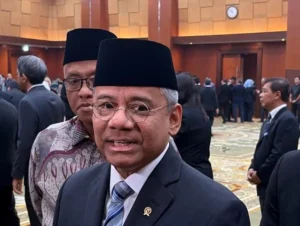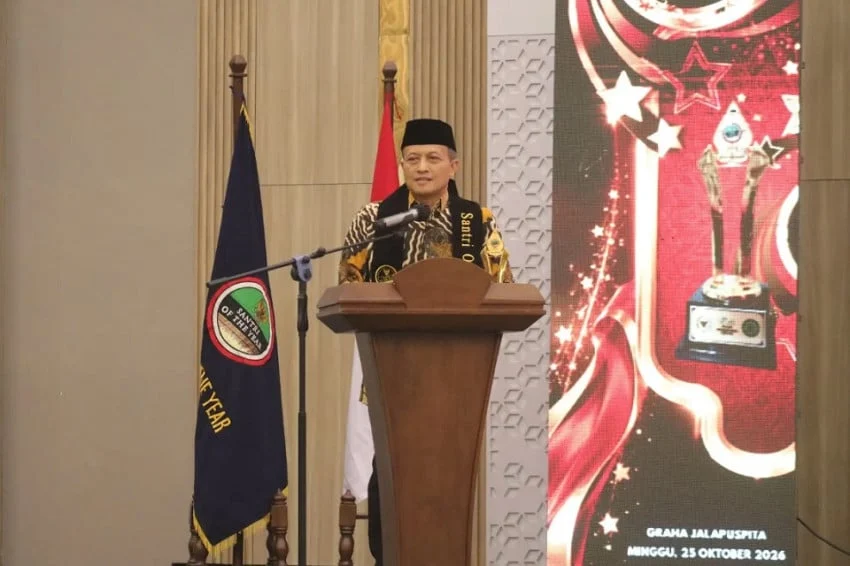
The office of the Attorney General of the Republic of Indonesia recently saw one of its senior officials, Deputy Attorney General for Oversight (Jamwas) Rudi Margono, honored with the prestigious Santri Dhyaksa Inspiratif award. The recognition took place during the annual Santri of The Year 2026 event held at the Graha Jalapuspita in Central Jakarta. The event, which serves as a platform to celebrate the contributions of individuals with Islamic boarding school (pesantren) backgrounds who have made significant impacts in public service, was organized by the Islam Nusantara Center (INC) in collaboration with Majelis Pesona and supported by the House of Representatives (DPR RI).
This award highlights the intersection between religious education and professional excellence within the Indonesian state apparatus. For Rudi Margono, a career prosecutor with decades of experience, the recognition is a testament to the integration of ethical values derived from his academic and religious background into the rigorous demands of the legal profession.
The Significance of the Santri Dhyaksa Inspiratif Award
The Santri of The Year ceremony has evolved over the years into a prominent national event. It aims to bridge the gap between traditional Islamic scholarship and modern governance. By introducing the category of "Santri Dhyaksa"—a term derived from Sanskrit roots often associated with the judiciary—the organizers sought to specifically honor legal professionals who maintain the integrity, discipline, and moral compass associated with the santri tradition.
During the ceremony, the selection committee emphasized that the recipients were chosen based on their track record of institutional reform, ethical leadership, and commitment to the rule of law. Rudi Margono, having served in various critical capacities within the Attorney General’s Office (Kejagung), was noted for his steadfast approach to internal oversight and legal reform, roles that require both high legal proficiency and uncompromising moral character.
A Career Built on Jurisprudence and Public Service
To understand the weight of this recognition, one must examine the professional trajectory of Rudi Margono. Born on December 6, 1969, in Magetan, East Java, Margono represents a generation of public servants who have balanced academic rigor with field experience. His educational foundation was laid at the Faculty of Law at Brawijaya University, Malang, where he developed an early interest in the complexities of the Indonesian criminal justice system.
His pursuit of knowledge did not end with his undergraduate degree. Margono went on to earn a Master of Humanities degree from Gadjah Mada University (UGM) in Yogyakarta, a center for academic excellence in legal studies. He later returned to Brawijaya University to complete his doctorate in legal studies. This academic background has allowed him to approach his roles as a prosecutor not merely as a law enforcer, but as a scholar of jurisprudence.
Throughout his career at the Attorney General’s Office, Margono has occupied various strategic positions. His recent appointment as the Acting Deputy Attorney General for Special Crimes (Plt. Jampidsus) in addition to his role as Jamwas underscores his versatility and the trust placed in him by the Attorney General. His tenure has been characterized by a focus on asset recovery—a complex and often controversial aspect of white-collar crime prosecution—and the strengthening of internal supervision mechanisms to ensure that the prosecutorial body remains free from corruption.
Promoting Human Capital and Institutional Integrity
During his acceptance speech, Margono reflected on the broader role of organizations like the Islam Nusantara Center in shaping the nation’s future. He argued that the development of human capital is the most critical pillar for Indonesia’s progress toward its 2045 vision.
"The role of the Islam Nusantara Center in developing human resources is indispensable," Margono stated during the event. "This gathering should not be viewed merely as a ceremonial affair. Instead, it must serve as a catalyst for strengthening our collective commitment to serve the public with sincerity and to foster a culture of integrity within our professional environments."
His remarks touched upon the "santri spirit"—a ethos of lifelong learning, humility, and service. He expressed hope that the networking facilitated by the event would lead to collaborative efforts that benefit the marginalized and improve the efficiency of legal institutions.
The Broader Implications for the Indonesian Judiciary
The recognition of a senior prosecutor like Rudi Margono carries broader implications for the Indonesian judiciary. In recent years, the Attorney General’s Office has been under public scrutiny, with citizens demanding higher levels of transparency and accountability. By elevating figures who emphasize the "santri" values of honesty and ethical conduct, the institution is signaling a shift toward a more value-based leadership model.
Analysts suggest that such awards serve as a form of "soft power" within the bureaucracy. When senior officials are publicly lauded for their integrity, it sets a standard for subordinates. Furthermore, the collaboration between the Islam Nusantara Center, the DPR RI, and the judiciary highlights the role of civil society in monitoring and encouraging professional growth within state institutions.
The focus on asset recovery, a subject for which Margono has become a prominent advocate, is particularly timely. As Indonesia grapples with the fallout of large-scale corruption cases, the ability of the state to reclaim stolen assets is seen as a litmus test for the success of the current legal administration. Margono’s academic work on this topic suggests that his approach is not just reactive but structural, aiming to change how the law views the financial components of criminal activity.
Chronology of Public Service and Recent Developments
The timeline of Rudi Margono’s career reflects a steady climb through the ranks of the Indonesian legal system:
- Early Academic Years: Undergraduate studies at Brawijaya University, establishing a foundation in criminal law.
- Professional Entry: Joining the ranks of the Attorney General’s Office as a junior prosecutor, handling various criminal and civil litigation cases across the archipelago.
- Academic Advancement: Completion of his Master’s at UGM and Doctorate at Brawijaya, contributing to his analytical approach to prosecutorial work.
- Senior Leadership Roles: Appointment to high-level positions within the Attorney General’s Office, including his current role as Jamwas (Deputy Attorney General for Oversight).
- 2026 Recognition: Receipt of the Santri Dhyaksa Inspiratif award, acknowledging his contributions to institutional integrity and his commitment to combining professional duty with ethical standards.
Official Responses and Community Impact
While the event was centered on the awardees, the presence of various stakeholders, including members of the House of Representatives, indicated strong political support for the initiative. Supporters of the event argue that by creating categories specifically for professionals with a santri background, the organizers are effectively debunking the myth that religious education is disconnected from the modern, secular requirements of high-level state governance.
From an institutional perspective, the Attorney General’s Office has frequently cited the need for its members to possess a "moral compass" to navigate the pressures of high-stakes investigations. The acknowledgement of Margono by an independent body like the INC provides a level of external validation that is often missing in purely internal promotions.
Looking Ahead: The Challenges of Oversight
Despite the accolades, the role of Deputy Attorney General for Oversight remains one of the most challenging in the Indonesian government. The position requires the incumbent to investigate internal complaints, ensure compliance with procedural law, and maintain the public trust.
Rudi Margono’s philosophy, as evidenced by his public statements and academic work, suggests he intends to modernize oversight. By integrating digital tracking of case files and promoting a culture of transparency, his office is attempting to reduce the opportunities for "judicial rent-seeking."
As Margono continues his service, the Santri Dhyaksa Inspiratif award will likely be viewed as a milestone in a career defined by the pursuit of institutional improvement. For the younger generation of prosecutors and legal scholars, his trajectory offers a roadmap: the combination of deep academic study, field-hardened experience, and a persistent adherence to ethical principles.
In conclusion, the recognition of Rudi Margono is more than just a personal honor; it is a reflection of the evolving nature of public service in Indonesia. As the country continues to refine its legal frameworks, the role of individuals who can bridge the gap between traditional values and modern legal complexities will remain paramount. The 2026 Santri of The Year ceremony has successfully highlighted this synthesis, providing the public with a glimpse into the leadership qualities required to sustain the integrity of the Indonesian state.