The Indonesian Communist Party (Partai Komunis Indonesia, or PKI) stands as one of the most polarizing and influential political entities in modern Indonesian history, evolving from an early 20th-century anti-colonial movement into a dominant parliamentary force before its violent dismantling and legal prohibition in 1966.
The trajectory of the PKI encapsulates the tumultuous shifts of Indonesia’s state-building era. It weaves through Dutch colonial resistance, the revolutionary fervor of the 1940s, the democratic experimentation of the 1950s, the centralized autocracy of Guided Democracy, and the devastating national trauma of the 30 September Movement (G30S) in 1965. Decades after its dissolution, the legacy of the PKI remains a subject of intense historical scrutiny, ongoing archival research, and deep socio-political sensitivity, prompting historians, human rights organizations, and state institutions to continually re-examine documented facts, official decrees, and differing historiographical interpretations.
The Genesis of the Left: From Colonial Resistance to the 1926 Rebellion
The roots of the communist movement in the Indonesian archipelago stretch back to the Dutch colonial era. In May 1914, a group of Dutch socialists—most notably Henk Sneevliet—established the Indische Sociaal-Democratische Vereeniging (ISDV). Initially operating within a small circle of European and indigenous intellectuals, the organization sought to introduce Marxist ideology to the local population, recognizing the deep agrarian and labor grievances under Dutch rule.
As the movement gained traction among indigenous activists, ideological shifts occurred. By 1920, the ISDV transformed into the Perserikatan Komunis di Hindia (PKH), and by 1924, it officially adopted the name Partai Komunis Indonesia (PKI), making it the first communist party in Asia outside of the Soviet Union to emerge within a colonial setting.
Operating under severe surveillance and pressure from the Dutch colonial administration, radical elements within the party pushed for direct insurrection. In 1926 and 1927, the PKI spearheaded uprisings against the Dutch colonial government in parts of West Java and West Sumatra. The rebellions were poorly coordinated, lacked broad strategic support, and were swiftly crushed by colonial security forces. The aftermath was devastating for the party: thousands of members and suspected sympathizers were arrested, imprisoned, or exiled to the remote Boven Digoel concentration camp in Western New Guinea, effectively driving the PKI underground and neutralizing its overt political presence for the remainder of the colonial period and the Japanese occupation.
The 1948 Madiun Affair and the Post-Independence Fracture
Following Indonesia’s declaration of independence in August 1945, the political landscape opened dramatically, allowing surviving and emerging left-wing figures to resurface. The PKI reconstituted itself, rapidly regaining influence within the labor movement, peasant organizations, and military factions during the Indonesian National Revolution against returning Dutch forces.
However, ideological friction within the nationalist movement soon reached a boiling point. The climax of this tension occurred on September 18, 1948, in Madiun, East Java, where elements of the PKI and allied leftist organizations—collectively known as the People’s Democratic Front (Front Demokrasi Rakyat, or FDR)—instigated an armed rebellion against the republican government led by President Sukarno and Vice President Mohammad Hatta.
Historical records, including entries from the Ministry of Culture’s Encyclopedia of Indonesian History, note that the Madiun Affair began with the unilateral proclamation of a "Soviet Republic of Indonesia" by left-wing factions. At the time, the young republic was already locked in a bitter diplomatic and military struggle with the Dutch, making the internal rebellion a critical threat to national survival.
The Republican government, spearheaded by loyal elements of the Indonesian National Armed Forces (TNI), launched a decisive counter-offensive. Within weeks, the rebellion was suppressed. Top leftist leaders, including Musso, were killed during military operations, while Amir Sjarifuddin and other key figures were subsequently captured and executed. The Madiun Affair left deep institutional scars, cementing a profound distrust between the military establishment and the Indonesian left that would persist for the next two decades.
Resurgence in the 1950s: Electoral Triumph and Mass Mobilization
Despite its near-total destruction in 1948, the PKI staged a remarkable political comeback during the 1950s. Under the pragmatic leadership of Dipa Nusantara (D.N.) Aidit, along with younger cadres such as Njoto, M.H. Lukman, and Sudisman, the party underwent a process of ideological modernization and tactical restructuring.
Rather than relying solely on underground agitation, the new leadership emphasized legal, democratic political participation and mass mobilization. The PKI successfully embedded itself within everyday Indonesian society by establishing powerful subsidiary organizations representing workers (SOBSI), peasants (BTI), youth (Pemuda Rakyat), women (waniwan), and cultural figures (Lekra). This grassroots strategy struck a chord with millions of Indonesians facing severe economic hardship, inflation, and agrarian inequality.
The efficacy of this strategy was definitively demonstrated during Indonesia’s first democratic general elections in 1955. According to official data from the General Elections Commission (KPU), the PKI secured 6,179,914 votes, translating to 16.36 percent of the national vote and capturing 39 seats in the House of Representatives (DPR). This placed the party fourth nationally, trailing only the Indonesian National Party (PNI), Masyumi, and Nahdlatul Ulama (NU). In the subsequent elections for the Constituent Assembly (Konstituante), the PKI improved its standing further, garnering roughly 6.23 million votes and securing 80 seats. By the mid-1950s, the PKI had undeniably reclaimed its status as a major political heavyweight within Indonesia’s parliamentary democracy.
Guided Democracy, Nasakom, and Growing Polarization
The collapse of parliamentary democracy and President Sukarno’s implementation of "Guided Democracy" following his Presidential Decree on July 5, 1959, fundamentally altered the nation’s political architecture. Power became increasingly centralized in the presidency, while a delicate three-way equilibrium emerged among President Sukarno, the burgeoning strength of the PKI, and a deeply suspicious military establishment, specifically the Indonesian Army (Angkatan Darat).
To navigate this tense environment, President Sukarno advanced the political concept of Nasakom—an acronym uniting Nationalism (Nasionalis), Religion (Agama), and Communism (Komunis). For the PKI, Nasakom served as a crucial protective shield and an avenue for state legitimacy. Through the early 1960s, the party enjoyed unprecedented official patronage, expanding its membership to an estimated three million people, with millions more enrolled in its affiliated mass organizations.
However, this rapid expansion exacerbated existing structural tensions. Ideological polarization deepened across the country as the PKI aggressively pushed for sweeping land reforms (Undang-Undang Pokok Agraria), which threatened the economic interests of traditional landowners, religious elites, and rural notables. Simultaneously, friction intensified between the party and the military over foreign policy, labor disputes, and the PKI’s controversial proposal to arm a "Fifth Force" consisting of peasants and workers alongside the official branches of the armed forces. By 1965, the Indonesian political arena had transformed into a powder keg of competing ambitions and irreconcilable ideological visions.
The 1965 Turning Point: The 30 September Movement and Historiographical Debates
The breaking point in modern Indonesian history occurred in the darkness between September 30 and October 1, 1965. A faction within the military, calling itself the September 30 Movement (G30S) and led by Lt. Col. Untung Syamsuri, commander of a battalion of the Tjakrabirawa presidential bodyguard, executed a series of coordinated operations in Jakarta.
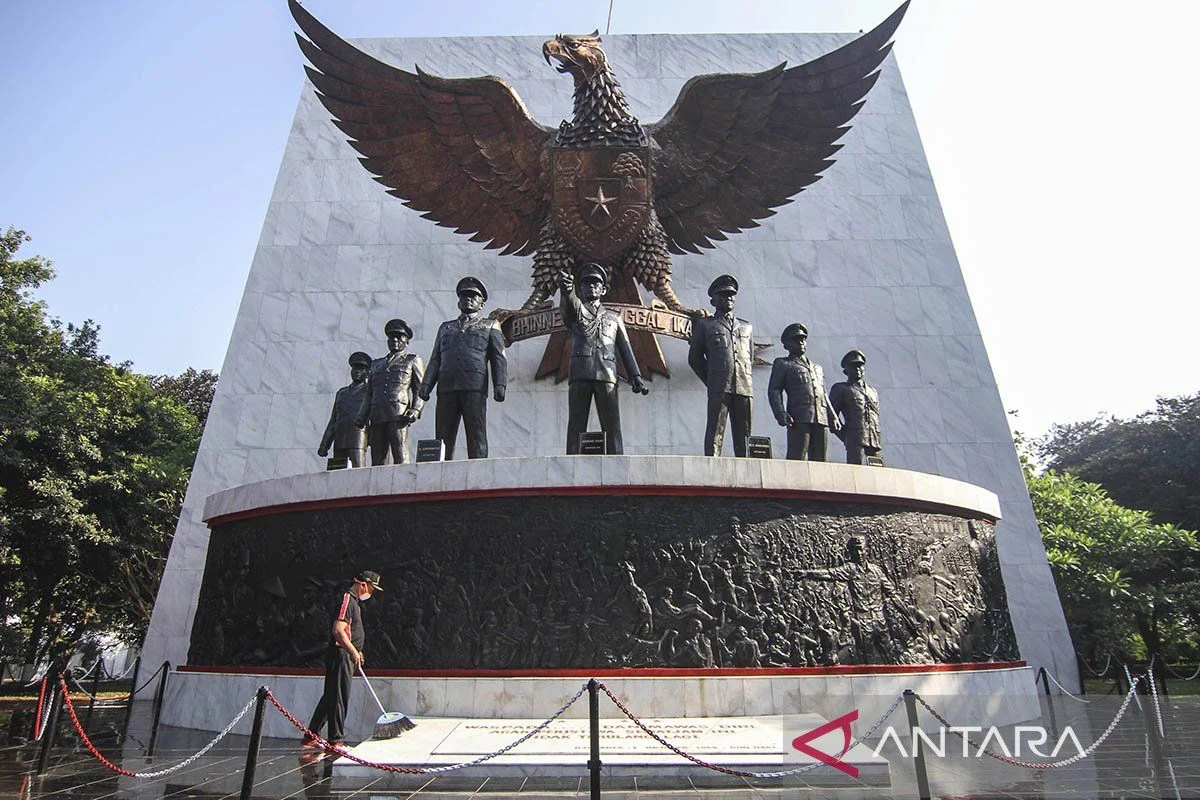
During the operation, groups of soldiers abducted and murdered six prominent Army generals and one lieutenant, transporting their bodies to an abandoned well in the Lubang Buaya area on the outskirts of Jakarta. The stated objective of the movement was to preempt an alleged coup d’état against President Sukarno by a secretive cabal of generals known as the "Council of Generals."
The events of that night triggered an immediate power vacuum and set off a ferocious political shockwave. The official narrative constructed during the subsequent New Order regime under General Suharto placed total institutional blame for G30S squarely on the shoulders of the PKI, framing the kidnappings as the opening salvo of a communist revolution aimed at overthrowing the state.
In the decades since, historians, human rights researchers, and international scholars have debated various aspects of the event. Contemporary historiography recognizes multiple layers of interpretation, examining whether G30S was driven primarily by internal factionalism within the military, orchestrated intelligence maneuvers, or a direct party-sanctioned conspiracy.
The National Archives of Republic Indonesia (ANRI) has repeatedly emphasized that a comprehensive understanding of 1965 requires examining diversified archival collections—not only domestic government records but also declassified diplomatic papers from the United States, Great Britain, and Japan. This multi-archival approach helps historians separate documented factual evidence from politically motivated state narratives and long-standing historical debates.
The Human Toll, Political Collapse, and the 1966 Prohibition
The failure of the 30 September Movement paved the way for a rapid and violent reconfiguration of power. Seizing control of security operations in the immediate aftermath of the assassinations, Major General Suharto sidelined President Sukarno’s authority and initiated a systematic campaign to eradicate the PKI and dismantle its extensive support network.
Between late 1965 and 1966, Indonesia descended into one of the worst mass bloodlettings of the 20th century. Supported by military authorities, various civilian and religious anti-communist militias launched sweeping purges across Java, Bali, and parts of Sumatra. Hundreds of thousands of individuals accused of being members, supporters, or sympathizers of the PKI—along with innocent civilians caught in the crossfire—were summarily executed, while hundreds of thousands more were arrested, detained without trial, or subjected to long-term forced labor and internal exile.
The Indonesian National Commission on Human Rights (Komnas HAM) has officially classified the atrocities of 1965–1966 as gross human rights violations. Investigations by the commission detailed widespread patterns of murder, extermination, arbitrary imprisonment, torture, rape, forced displacement, and enforced disappearances. The multi-layered violence devastated not only the active cadres of the party but also fractured family structures, generational continuity, and social trust within countless communities across the archipelago.
Politically, the institutional demise of the PKI was codified through formal legal instruments. On March 12, 1966, following the issuance of the Supersemar (Letter of Order of March 11), General Suharto signed Presidential Decree/Commander of the Armed Forces Order No. 1/3/1966, officially dissolving the PKI and banning all of its mass organizations, declaring them illegal entities.
This executive action was permanently reinforced legislatively on July 5, 1966, when the Provisional People’s Consultative Assembly (MPRS) ratified MPRS Decree No. XXV/MPRS/1966. This landmark legal product explicitly banned the PKI throughout the territory of the Republic of Indonesia and outlawed any efforts to propagate or develop the teachings of communism, Marxism, and Leninism. To this day, the decree remains a foundational element of Indonesian positive law, continuing to govern the state’s official posture toward communist ideology.
Conclusion: A Legacy Carved in Research and National Memory
The dissolution of the PKI in 1966 effectively terminated its existence as an active political force and marked the definitive death knell of the Guided Democracy era. It catalyzed the ascent of General Suharto to the presidency in 1968, inaugurating the 32-year authoritarian rule of the New Order regime, which built its foundational legitimacy on its anti-communist stance.
More than half a century after the turbulent events of 1965, the history of the Indonesian Communist Party remains a complex and sensitive subject of academic research, national memory, and legal debate. Initiatives by institutions like the National Archives (ANRI) to open domestic and international historical repositories underscore an ongoing societal need to ground historical discourse in verifiable documentation rather than dogmatic repetition.
Ultimately, the history of the PKI is far broader than the tragedy of 1965. It represents a sweeping, century-long arc that mirrors Indonesia’s painful birth as a modern nation-state—tracing the trajectory from early anti-colonial resistance and revolutionary internal fractures to a towering democratic presence, followed by catastrophic political collapse, human rights tragedies, and enduring legal prohibitions.