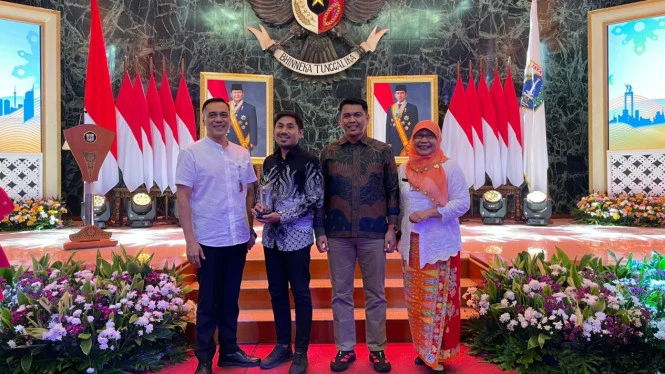
In a significant recognition of corporate commitment to social development, PT Jakarta International Container Terminal (JICT) was officially honored with the prestigious Derap Kerja Sama Award 2025 in the education category. The award was presented directly by the Governor of DKI Jakarta, Pramono Anung, during a high-profile ceremony held in Jakarta on Friday, July 11, 2025. This accolade serves as a testament to JICT’s successful implementation of its Business-Based Social and Environmental Responsibility (TJSLBU) programs, which have demonstrably improved the quality of life and educational access for communities surrounding Indonesia’s busiest maritime gateway.
The Derap Kerja Sama Award is an annual initiative by the Jakarta Provincial Government designed to appreciate private sector entities that go beyond their commercial mandates to foster sustainable urban development. For the 2025 edition, JICT emerged as a standout performer due to its flagship "Rumah Belajar" (Learning House) initiative. This program has been lauded for its multifaceted approach to community empowerment, addressing critical issues such as digital literacy, formal educational support, and the prevention of social friction among the youth in the high-density districts of Tanjung Priok, North Jakarta.
A Strategic Vision for Community Empowerment
During the awarding ceremony, Governor Pramono Anung emphasized the importance of synergy between the provincial government and major industrial players. He noted that the growth of Jakarta as a global economic hub depends heavily on the resilience and education of its local workforce and residents. JICT, as the largest container terminal operator in Indonesia, has set a benchmark for how industrial operations can coexist harmoniously with local neighborhoods by investing in the human capital of the next generation.
The "Rumah Belajar" program, which formed the core of JICT’s award-winning entry, was evaluated based on its measurable impact and long-term sustainability. The evaluation committee highlighted that the program does not merely offer temporary assistance but provides a structured curriculum that complements the formal schooling system. By focusing on children living in the densely populated areas surrounding the Port of Tanjung Priok, JICT has created a safe haven for learning that steers teenagers away from negative influences and juvenile delinquency—a persistent challenge in industrial port zones.
The Impact of the Rumah Belajar Initiative
Since its inception, JICT’s Rumah Belajar has evolved from a simple tutoring center into a comprehensive community hub. The program currently serves hundreds of children annually, offering courses that range from basic literacy and numeracy to advanced digital skills. In an era where the maritime and logistics sectors are undergoing rapid digitalization, JICT has recognized that providing local children with computer skills and internet literacy is essential for their future employability.
The program’s success is rooted in its localized approach. Tanjung Priok is a unique environment characterized by its strategic economic importance and its complex social fabric. Many families in the area are dependent on informal labor within the port ecosystem, and educational attainment has historically lagged behind other parts of the capital. JICT’s intervention has bridged this gap by providing free access to high-quality learning materials and mentorship.
Furthermore, the initiative includes character-building modules designed to reduce the "kenakalan remaja" or juvenile delinquency that often arises in urban environments where extracurricular opportunities are scarce. By engaging youth in productive activities, such as creative arts, technology workshops, and sports, JICT has contributed to a noticeable decline in local disturbances, fostering a more stable social environment for both residents and port operations.

Leadership Perspectives on Corporate Responsibility
Responding to the honor, the President Director of JICT, Ade Hartono, expressed profound gratitude and reaffirmed the company’s dedication to social equity. He stated that the award is not just a trophy for the boardroom but a validation of the hard work put in by the educators and community leaders who manage the Rumah Belajar on a daily basis.
"We believe that business growth must run in tandem with social contribution," Hartono remarked during his address at the ceremony. "The Rumah Belajar program is more than just a corporate social responsibility requirement; it is a tangible form of collaboration between JICT, the community, and the local government. Our goal is to build a better future generation that is ready to compete in an increasingly complex global economy."
Hartono further explained that JICT’s philosophy of "sustainable port growth" involves ensuring that the local community feels the benefits of the terminal’s success. He argued that a company cannot thrive in isolation and that the security and efficiency of port operations are intrinsically linked to the well-being of the surrounding populace.
Expanding Horizons: Vocational Training and Green Initiatives
Looking toward the future, JICT has announced plans to scale the Rumah Belajar program into a more robust vocational training platform. Recognizing the specific needs of the maritime industry, the company intends to introduce specialized training modules focused on port logistics, heavy equipment operation, and digital supply chain management. This vocational shift is designed to create a direct pipeline for local youth to enter the professional workforce, potentially within JICT or the broader maritime sector.
In addition to vocational expansion, JICT is pioneering the "Green Dock School" concept. This initiative aims to integrate environmental education into the local school curriculum, teaching students about marine conservation, waste management, and the importance of sustainable industrial practices. The Green Dock School aligns with JICT’s broader corporate campaign for sustainability and its commitment to reducing the carbon footprint of port operations.
By educating the youth on environmental stewardship, JICT hopes to foster a community that is not only economically empowered but also environmentally conscious. This holistic approach to CSR—combining education, economics, and ecology—is what set JICT apart during the 2025 Derap Kerja Sama Award selection process.
Socio-Economic Context of Tanjung Priok
To understand the significance of JICT’s achievement, one must consider the socio-economic landscape of North Jakarta. As the primary gateway for Indonesia’s international trade, Tanjung Priok handles over 50% of the country’s container traffic. However, the wealth generated by the port does not always filter down to the immediate neighborhoods. High population density, limited green space, and the pressures of urban poverty create a challenging environment for child development.
Data from the Jakarta Statistics Agency (BPS) has historically shown that North Jakarta faces specific hurdles in educational parity compared to South or Central Jakarta. Initiatives like Rumah Belajar are critical in closing this disparity. By providing resources that many families could not otherwise afford, JICT is effectively acting as a catalyst for social mobility.

The 2025 award also highlights the shift in CSR trends in Indonesia. There is a moving away from "philanthropic" CSR—where companies simply donate money—toward "strategic" CSR, where companies use their expertise and resources to solve systemic social problems. JICT’s focus on education and digital literacy is a prime example of this strategic alignment, as it addresses both a social need and a future business requirement for a skilled workforce.
Collaborative Governance and the Role of the Private Sector
The Derap Kerja Sama Award 2025 also serves as a platform to showcase the success of Public-Private Partnerships (PPP) in Jakarta. Governor Pramono Anung’s administration has been vocal about the need for "gotong royong" (mutual cooperation) to solve the city’s complex issues. The recognition of JICT suggests that the provincial government views the maritime sector as a key partner in its urban renewal and social welfare strategies.
Industry analysts suggest that JICT’s success in winning this award will likely encourage other state-owned and private enterprises in the logistics sector to enhance their social programs. The competitive nature of these awards fosters a "race to the top" in terms of social impact, ultimately benefiting the citizens of Jakarta.
The recognition also carries weight on the international stage. As global investors increasingly prioritize Environmental, Social, and Governance (ESG) criteria, JICT’s documented success in community engagement strengthens its reputation as a responsible global terminal operator. This, in turn, enhances the attractiveness of Jakarta’s port infrastructure to international shipping lines and trade partners who value ethical supply chains.
Conclusion and Future Outlook
The awarding of the Derap Kerja Sama Award 2025 to PT Jakarta International Container Terminal marks a milestone in the company’s history. It transitions the narrative of JICT from being merely a logistics powerhouse to being a cornerstone of social progress in North Jakarta.
As the ceremony concluded, Ade Hartono reiterated that the award serves as a motivator rather than a final destination. "This recognition is an acknowledgment that collaboration between the business world, the government, and the community can create concrete, positive change," he said. "We are committed to ensuring that the Port of Tanjung Priok remains not only a hub of trade but also a beacon of hope and opportunity for the people who live in its shadow."
With plans for vocational expansion and green education already in motion, JICT is poised to continue its role as a leader in corporate citizenship. The success of the Rumah Belajar program provides a blueprint for other industrial entities in Indonesia, proving that when a company invests in the minds of the youth, it is ultimately investing in the stability and prosperity of its own future. The 2025 award is a clear signal that in the heart of Jakarta’s industrial engine, the most valuable cargo being handled is the potential of the next generation.