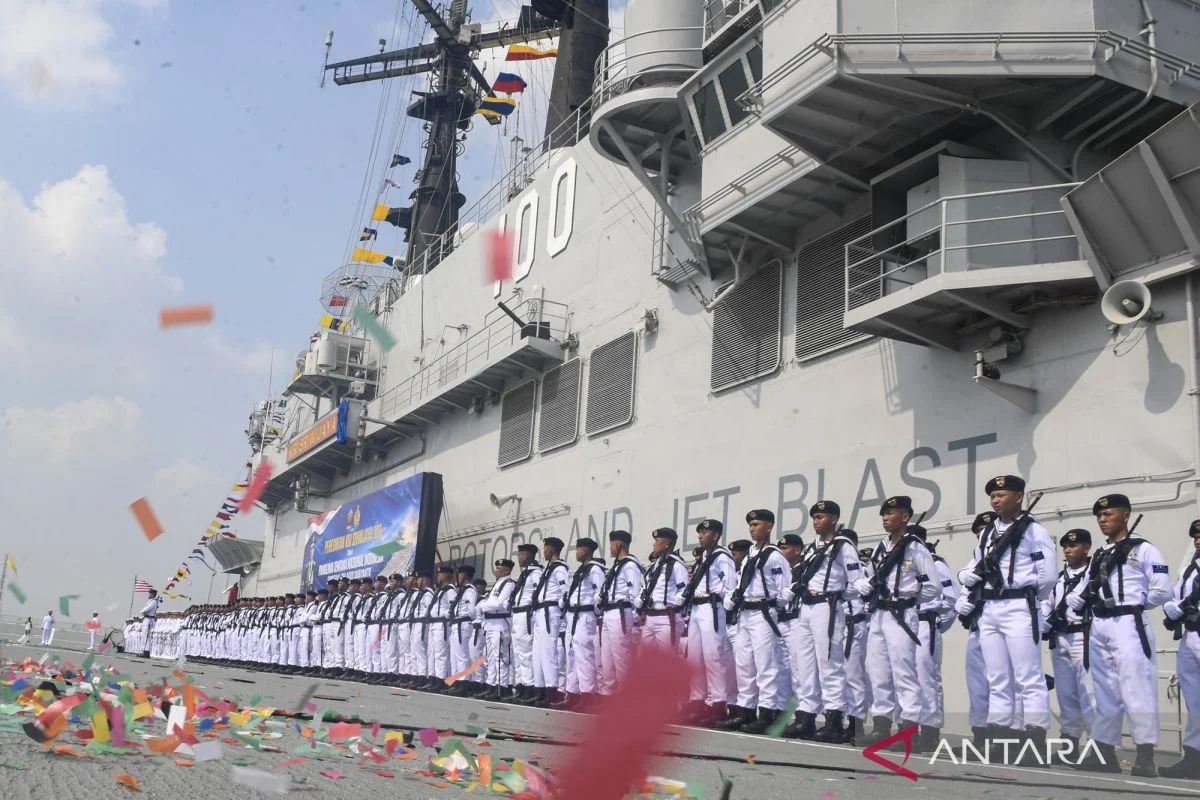
The Indonesian Navy has officially entered a new strategic era following the arrival of the former Italian Navy aircraft carrier ITS Giuseppe Garibaldi at Pier 107 of Tanjung Priok Port, North Jakarta. Docking on Friday, September 18, the heavy warship marks a monumental milestone as the very first aircraft carrier to join the fleet of the Indonesian National Armed Forces (TNI).
Rechristened as KRI Sriwijaya, the vessel represents a significant leap forward in the nation’s blue-water navy capabilities. While the ship arrived earlier in September, the official handover ceremony and flag-changing protocol—transitioning the vessel from the Italian Navy tricolor to the Indonesian Red and White flag—are formally scheduled for September 24 at the Tanjung Priok naval facility. The acquisition has ignited widespread public interest and intense discourse regarding the strategic definition, operational utility, and broader geopolitical implications of operating a sovereign floating air base.
Strategic Chronology and Key Milestones
The integration of KRI Sriwijaya into the TNI-AL inventory is the culmination of prolonged bilateral defense diplomacy and strategic naval planning.
- Initial Negotiations and Agreement: Preliminary discussions regarding the acquisition of the Italian flagship began years prior, driven by Indonesia’s growing need to project power and secure its vast maritime territory.
- Transit and Arrival: The vessel departed from European waters, navigating thousands of nautical miles before making its highly anticipated entrance into Jakarta’s Tanjung Priok Port on September 18.
- Official Commissioning and Flag Transition: Set for September 24, this landmark ceremony will officially mark the ship’s redesignation as KRI Sriwijaya, cementing its status as the crown jewel of Indonesia’s naval fleet.
- Upcoming Refurbishment Phase: Following the handover, the vessel will undergo comprehensive dockyard maintenance, propulsion overhauls, and structural adaptations to meet the specific operational doctrines of the Indonesian Navy.
Dissecting the Asset: Beyond a Standard Warship
In naval nomenclature, the presence of a flight deck fundamentally separates a carrier from standard surface combatants like destroyers, frigates, or corvettes. While conventional warships rely heavily on surface-to-air missiles, anti-ship missiles, and primary naval guns, an aircraft carrier functions primarily as a mobile, sovereign airfield.
KRI Sriwijaya is not merely characterized by its massive physical tonnage and imposing dimensions; its true strategic value lies in its specialized infrastructure. The ship is engineered with an extensive flight deck, internal aircraft hangars, sophisticated aviation maintenance workshops, dedicated flight control systems, and high-capacity aviation fuel storage tanks. These integrated facilities allow the vessel to launch, recover, repair, and rearm rotary-wing and fixed-wing aircraft far from mainland logistics hubs.
Historically, the vessel—under its Italian designation—was designed to operate vertical or short takeoff and landing (V/STOL) aircraft, such as the AV-8B Harrier II, alongside a diverse array of anti-submarine and utility helicopters. For Indonesia, however, naval architects and defense planners envision a tailored operational profile that maximizes the ship’s utility as a multi-role command and logistics platform.
Official Stances and Operational Doctrine: Prioritizing Military Operations Other Than War (OMSP)
The acquisition of KRI Sriwijaya has prompted detailed clarifications from military leadership regarding how the vessel will be utilized within Indonesia’s defensive framework. Chief of Staff of the Indonesian Navy (KSAL) Admiral Muhammad Ali has repeatedly emphasized that the platform will not immediately mirror the high-end offensive strike carrier groups deployed by global superpowers.
Instead, the primary focus for KRI Sriwijaya will center on Military Operations Other Than War (OMSP). Given Indonesia’s unique geography as an expansive archipelagic nation comprising over 17,000 islands, rapid maritime and aerial mobility is critical during national emergencies.
Defense analysts and naval officials have highlighted that the vessel’s expansive flight deck and massive internal capacity make it an ideal floating base for humanitarian assistance and disaster relief (HADR) missions. In the event of catastrophic natural disasters—such as earthquakes, tsunamis, or volcanic eruptions that routinely sever terrestrial bridges and compromise local airstrips—KRI Sriwijaya can anchor offshore to serve as a command center. From its flight deck, heavy transport helicopters and unmanned aerial vehicles (drones) can continuously ferry emergency medical supplies, potable water, heavy rescue equipment, and evacuation personnel directly to isolated disaster zones.
Geopolitical and Strategic Implications for the Indo-Pacific
The introduction of an aircraft carrier into Southeast Asia alters the regional naval balance, signaling Jakarta’s growing commitment to safeguarding its sovereign waters, exclusive economic zones (EEZs), and critical maritime choke points.
Strategically, the platform provides the TNI-AL with persistent aerial surveillance and maritime domain awareness capabilities that extend far beyond the operational radii of land-based tactical fighters and maritime patrol aircraft. By maintaining a mobile air-sea task group centered around KRI Sriwijaya, Indonesia enhances its capability to deter unauthorized incursions, combat illegal, unreported, and unregulated (IUU) fishing, and protect vital sea lanes of communication (SLOCs) traversing the archipelago.
Furthermore, defense experts note that operating a vessel of this magnitude serves as a vital institutional learning curve for the Indonesian Navy. Mastering carrier operations, deck management, aviation fuel safety, and integrated battle group coordination will elevate the technological and procedural competencies of the naval workforce, laying a strong foundation for future modernization phases.
Addressing Logistical Challenges and Future Fleet Integration
While the arrival of KRI Sriwijaya is a source of national pride, military analysts emphasize that sustaining an aircraft carrier demands rigorous logistical backing, substantial financial investment, and specialized training regimens.
The upcoming refit phase overseen by naval engineers will be critical to aligning the ship’s legacy Italian engineering systems with modern Indonesian defense electronics and command-and-control networks. Additionally, ongoing discussions within the TNI-AL regarding the integration of advanced V/STOL aircraft and heavy-lift naval helicopters underscore a long-term commitment to maximizing the platform’s combat readiness and multi-mission versatility.
As the Red and White flag officially rises over KRI Sriwijaya on September 24, Indonesia firmly establishes its presence as a forward-looking maritime power capable of projecting stability, humanitarian relief, and sovereign defense across the Indo-Pacific theater.