Months after surviving a devastating coordinated air campaign launched by Israel and backed by the United States—an operation that sent shockwaves through the Middle East and briefly plunged the Iranian leadership into deep uncertainty—Teheran’s top diplomats walked the bustling streets of Manhattan under the stringent security of the United States Secret Service. The stark contrast between the fiery explosions over Iranian skies earlier in the year and the calm, calculated demeanor of Iranian officials in New York underscored a profound geopolitical shift. Rather than appearing fractured or isolated by ongoing wartime sanctions and naval blockades, the Islamic Republic’s delegation managed to command the global stage at the United Nations General Assembly, casting themselves not merely as survivors of a protracted conflict, but as active participants shaping a new diplomatic paradigm.
The high-stakes journey to New York City was laden with immense political risk for President Masoud Pezeshkian and Foreign Minister Abbas Araghchi. Domestically, the administration faced sharp rebukes from hardline factions who viewed any engagement with Washington or its Western allies as an intolerable compromise. Yet, through a carefully orchestrated strategy of high-level meetings, defiance-laced rhetoric, and calculated outreach, the Iranian delegation achieved what many analysts initially deemed impossible: transforming a moment of post-war vulnerability into a platform for international positioning and domestic consolidation.
A Gathering Storm: The Prelude to New York
To understand the weight of Iran’s presence at the recent UN General Assembly, one must examine the tumultuous chronology of the preceding months. The escalation began in late winter, culminating in a series of precision airstrikes that targeted critical infrastructure and military command centers across Iran. The unprecedented scale of the joint US-Israeli operations left the nation’s leadership temporarily paralyzed, with communications severed and initial reports falsely suggesting the death of several high-ranking officials, including Supreme Leader Ayatollah Ali Khamenei.
For hours on February 28, the international community held its breath as conflicting reports emerged regarding the fate of the Iranian executive branch. President Pezeshkian’s disappearance from public view during the height of the bombardment fueled intense speculation about a potential collapse of the central government. However, the regime proved resilient, quickly reorganizing its security apparatus and initiating a counter-strategy that relied on asymmetric deterrence abroad and tightened internal control.
By the time spring transitioned into summer, the physical destruction had given way to an equally punishing economic war. Comprehensive sanctions and a strict US naval blockade crippled Iran’s shipping lanes, choked off oil revenues, and exacerbated domestic inflation. Yet, rather than capitulating under the weight of economic strangulation, Tehran pivoted toward a dual-track strategy: reinforcing its defensive capabilities while preparing for an aggressive diplomatic offensive on the world stage.
Delegation as a Diplomatic Magnet in Manhattan
When world leaders converged on the United Nations headquarters in New York, the Iranian delegation immediately transformed into an unexpected focal point of diplomatic activity. Eschewing the isolation that Western nations hoped to impose, Foreign Minister Abbas Araghchi and President Masoud Pezeshkian engaged in a relentless schedule of bilateral meetings, press briefings, and closed-door discussions.
Throughout the week, Araghchi held consultations with over two dozen foreign diplomats. Significantly, this outreach extended far beyond traditional allies, encompassing representatives from more than ten European nations and the Foreign Minister of Jordan—a regional neighbor that had previously found itself in the crosshairs of Iranian defensive maneuvers. These interactions were designed to project an image of a cooperative state willing to engage with the international community, provided that mutual respect and international law were upheld.
The most critical moment of the delegation’s trip, however, occurred behind closed doors. In a development that surprised Western intelligence analysts, Araghchi partook in rare, direct talks with US envoy Steve Witkoff. While details of the conversation remained tightly guarded, subsequent statements to Western media outlets confirmed that Tehran had introduced fresh diplomatic proposals aimed at de-escalating regional tensions and addressing the deadlock over its nuclear program. By positioning themselves as willing negotiators while simultaneously calling out what they termed the "lawless behavior" of Western powers, the Iranian delegation effectively shifted the narrative from one of military defeat to diplomatic resilience.
Balancing Domestic Hardliners and Global Rhetoric
Back home, the decision to dispatch top leaders to the United States—the very nation orchestrating the wartime blockade—sparked fierce resistance from domestic hardliners. Conservative lawmakers and security hawks argued that engaging Western adversaries while the country was still reeling from military aggression constituted a dangerous display of weakness.
The criticism intensified following reports of Araghchi’s meeting with US envoy Steve Witkoff. Prominent hardline figures took to social media and parliamentary platforms to voice their outrage. Ebrahim Rezaei, a vocal conservative member of the Iranian parliament, publicly challenged the Foreign Ministry’s mandate on social media platform X, stating that foreign policy and national security are not arenas for reckless diplomacy, and demanding formal explanations regarding the authority under which the meeting with the enemy’s representative was conducted.
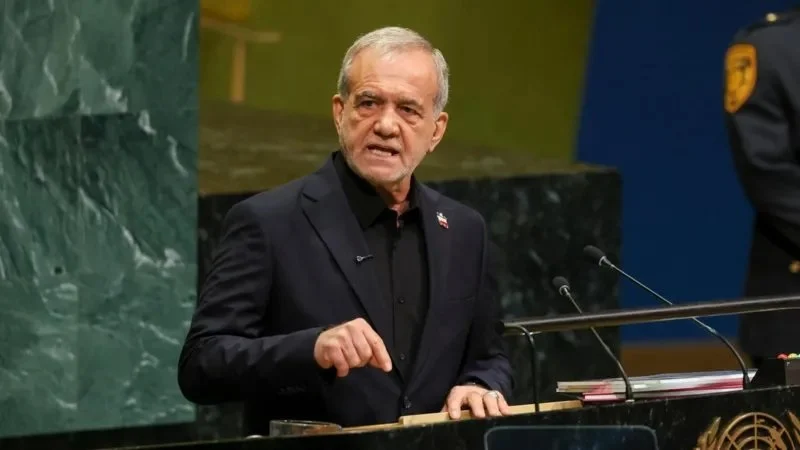
Recognizing the domestic peril, President Pezeshkian utilized his platform at the UN General Assembly and subsequent press engagements to placate the conservative base without alienating international interlocutors. In his formal address to the General Assembly, Pezeshkian delivered a resounding declaration that the Islamic Republic would never "bow" to foreign coercion. This fiery rhetoric played directly to the domestic audience, offering reassurance that national sovereignty remained non-negotiable.
Furthermore, in a masterclass of political balancing, Pezeshkian sat down with Western journalists and think-tank analysts at a Midtown Manhattan hotel. During these sessions, he systematically laid out his administration’s vision for regional stability, emphasizing that Iran’s pursuit of diplomacy does not stem from desperation, but from a position of strategic endurance. This dual approach allowed the administration to weather domestic storms while projecting confidence to global observers.
Implications and Broader Geopolitical Fallout
The successful execution of Iran’s diplomatic mission in New York carries significant implications for the future of Middle Eastern geopolitics. By re-establishing direct communication channels with Western counterparts, Tehran has injected a degree of pragmatism into an otherwise frozen diplomatic landscape. The willingness of both sides to engage, even tentatively, suggests a mutual recognition that prolonged military confrontation serves no sustainable strategic interest.
For the United States and its allies, the Iranian delegation’s reception in Manhattan highlights the limitations of a purely punitive approach. While economic sanctions and naval blockades have undeniably strained the Iranian economy, they have failed to induce regime change or force unconditional surrender. Instead, these measures have driven Tehran to diversify its diplomatic partnerships, leveraging multilateral platforms like the UN to counter Western narratives and build coalitions of sympathetic or neutral states.
Moreover, the internal friction within Iran—exemplified by the clash between the reform-oriented executive branch and the entrenched hardline parliament—demonstrates the complex internal dynamics governing Tehran’s foreign policy. Pezeshkian’s ability to navigate these competing factions and return home politically intact suggests that the administration holds sufficient backing from the supreme leadership to pursue limited tactical engagements when deemed advantageous to national security.
As the dust settles on the United Nations General Assembly, the prevailing assessment among international relations experts is that Iran has successfully reclaimed a degree of diplomatic initiative. By blending uncompromising nationalist rhetoric with pragmatic backchannel negotiations, Tehran has navigated the immediate aftermath of war to redefine its standing on the global stage. Whether these diplomatic overtures translate into lasting structural agreements or remain merely a temporary tactical maneuver depends heavily on the willingness of Washington and its regional allies to reciprocate the gesture in the months to come.