The search and rescue operation in the Sunda Strait reached a critical juncture on Thursday, September 10, 2026, as joint search teams discovered a life jacket and auxiliary flotation devices believed to be linked to the speed boat that went missing with eight individuals on board, including five journalists. The discovery has provided the first tangible leads in a massive search effort that has spanned three days, yet authorities remain cautious about drawing definitive conclusions until further forensic identification is completed.
The Incident and Initial Search Efforts
The disappearance of the vessel, which was carrying a total of eight passengers, triggered an immediate and widespread search-and-rescue (SAR) mission. The speed boat lost contact under circumstances that remain under investigation, sparking concerns regarding the safety of the passengers and the treacherous maritime conditions often associated with the Sunda Strait. The strait, a vital shipping lane connecting the Java Sea to the Indian Ocean, is known for its complex currents and unpredictable weather patterns, which have frequently complicated search operations in the past.
The mission, coordinated by the Banten Naval Base (Lanal Banten) and involving elements from the National Search and Rescue Agency (Basarnas), has been active since the initial report of the vessel’s disappearance. Rescue teams have deployed multiple naval assets, including the patrol vessel KAL Anyer, to scan the coordinates where the boat was last believed to be operating.
Chronology of the Discovery
On the third day of the operation, the search intensity was increased as teams expanded their grid patterns. According to the Commander of the Banten Naval Base, Lieutenant Colonel (P) Wawan Subagyo Mardani, the breakthrough occurred at approximately 15:10 WIB (Western Indonesian Time).
The crew of the KAL Anyer identified a suspicious object floating in the water while patrolling the designated sector. Upon closer inspection at the coordinates 06°04’40" South Latitude and 105°45’17" East Longitude, the team confirmed that the object was a life jacket. The identification of this specific piece of safety equipment is significant, as it represents the first physical evidence recovered from the sea since the start of the search.
Following the initial discovery, the crew conducted a thorough sweep of the immediate vicinity. Their vigilance was rewarded when they recovered a second object: a makeshift flotation device fashioned from a white plastic bottle. The presence of both a professional-grade life jacket and a secondary, improvised flotation aid suggests that the passengers may have attempted to deploy whatever resources were available during a potential emergency.
Technical Challenges in the Sunda Strait
The geography of the Sunda Strait presents significant challenges for maritime search operations. The area is characterized by deep troughs and shallow reef systems, with tidal currents that can reach speeds of several knots. These environmental factors complicate the drift modeling used by SAR experts to predict the movement of missing objects or individuals.
Meteorological data from the period suggests that wind speeds and sea states were moderate, but the inherent volatility of the region means that objects floating on the surface can be dispersed over a wide area within hours. The recovery of the life jacket at the specified coordinates is being used by search planners to refine their drift models, effectively creating a "starting point" for the next phase of the operation. By analyzing the condition of the life jacket—whether it was buckled, torn, or showed signs of wear—investigators hope to gain a clearer picture of what transpired in the final moments of the vessel.
Official Response and Coordination
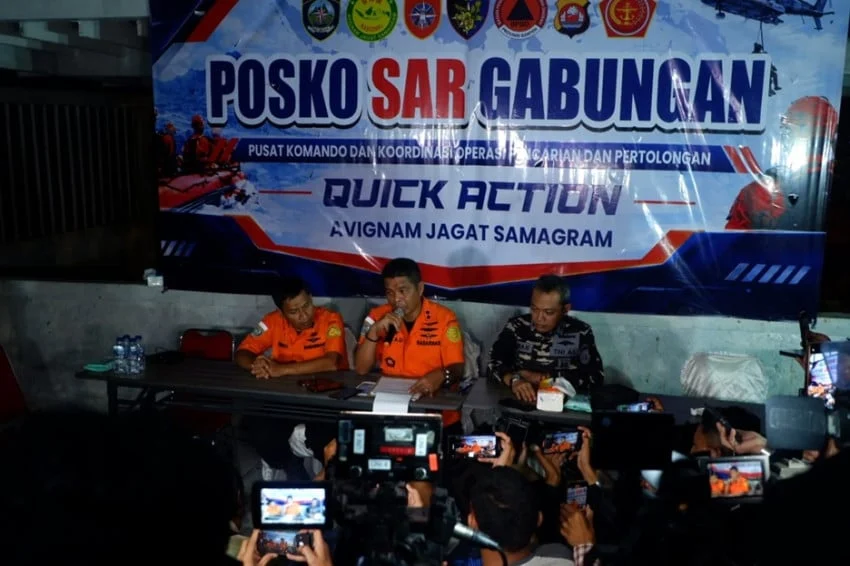
Lieutenant Colonel Wawan Subagyo Mardani emphasized that the discovery, while encouraging for the search teams, does not yet confirm the status or location of the victims. "We have secured the objects as evidence," Wawan stated. "Our current priority is to cross-reference these findings with the manifest of the missing speed boat and to continue the expansion of the search grid based on the currents and wind vectors observed at the time of the discovery."

The coordination between the Indonesian Navy and civilian SAR agencies has been characterized as seamless, with multiple vessels and aerial assets involved in the hunt. Family members of the missing journalists and other passengers have been kept informed of the developments, with authorities providing daily briefings to manage expectations and provide updates on the technical progress of the search.
Implications for Maritime Safety
The disappearance of the journalists and their companions has sparked a wider conversation regarding maritime safety protocols for media personnel operating in coastal regions. Journalists frequently utilize small vessels to cover maritime events, environmental stories, or offshore infrastructure projects. The risks inherent in these assignments are often overlooked until a tragedy occurs.
Industry experts suggest that this incident may lead to stricter enforcement of maritime safety regulations for non-commercial vessels. These include mandatory satellite communication devices, automated identification systems (AIS) for smaller speed boats, and more rigorous weather-monitoring requirements before departure. For the media industry, the event serves as a somber reminder of the dangers faced by field reporters and technical crews who work in high-risk environments.
The Ongoing Search Strategy
As of the evening of September 10, the search remains active. The discovery of the life jacket has led to the deployment of additional divers to the site, tasked with conducting underwater scans to determine if the vessel itself is submerged in the vicinity. The use of side-scan sonar technology has been prioritized to map the seabed, as the depth in the specific coordinates of the discovery is significant.
SAR teams are also monitoring the movement of surface debris. If the boat suffered a catastrophic mechanical failure or capsized, the debris field is expected to follow the prevailing current. The integration of local fishermen and coastal communities into the search effort has also been a crucial component, as these individuals possess deep local knowledge of the currents and are often the first to spot anomalies in the water.
Looking Ahead
The investigation into the cause of the accident is being conducted in parallel with the search. Authorities are examining the vessel’s maintenance records, the qualifications of the operator, and the flight-plan-equivalent maritime filing. Preliminary reports suggest that there were no distress calls transmitted via marine radio or satellite phone, which adds a layer of mystery to the incident.
The discovery of the life jacket is a crucial piece of the puzzle, but it is far from the final answer. As the search enters its fourth day, the pressure on the teams to locate the vessel or survivors is immense. The maritime community and the public at large are waiting for further updates, with the hope that the evidence recovered will eventually lead to the resolution of this tragic event.
The Banten Naval Base has pledged to continue the operation with full force, promising that no effort will be spared until the fate of all eight individuals is determined. In the coming hours, further forensic analysis of the recovered items will be conducted, potentially providing insight into whether the boat was damaged by a collision, a weather-related incident, or a sudden mechanical failure.
For now, the focus remains on the coordinates where the life jacket was found. As the sun rises over the Sunda Strait, the search fleet is repositioning to continue the systematic grid search, fueled by the hope that these small items of evidence are the precursors to finding the missing crew and passengers. The tragedy has already left a profound impact on the media community, and the ongoing search is a testament to the dedication of those working in the most challenging of conditions to bring closure to the affected families.