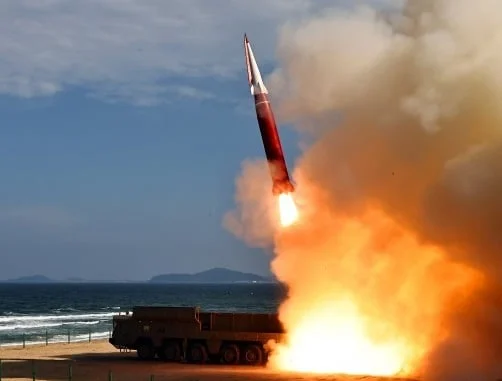
Pyongyang has once again escalated geopolitical tensions on the Korean Peninsula and across the wider Indo-Pacific region by conducting a high-profile weapons test. According to state-run media outlets in North Korea, the country’s dedicated missile administration successfully tested a previously unseen weapon system described as being of paramount strategic importance. The launch drew immediate and coordinated international concern, prompting diplomatic scrambles among key regional allies, particularly South Korea, Japan, and the United States, as defense analysts pore over photographic evidence indicating a significant leap forward in Pyongyang’s military engineering capabilities.
The sequence of events began on a Sunday when military monitors in Seoul detected the launch of two short-range ballistic missiles. The projectiles were fired from inland locations in North Korea and traveled eastward before splashing down into the waters of the Sea of Japan, also known as the East Sea. While South Korea’s Joint Chiefs of Staff quickly identified the initial flight characteristics as short-range ballistic trajectories, the definitive nature of the hardware deployed only became clear when the official Korean Central News Agency released detailed reports and imagery the following morning.
Visual analysis of the state-published photographs quickly drew the attention of international defense experts. The images depicted a mobile missile launcher system outfitted with what specialized military analysts strongly suspect to be a hypersonic glide vehicle. Unlike traditional ballistic missiles, which follow a predictable, arched trajectory governed by the laws of orbital mechanics, weapons equipped with hypersonic glide vehicles are designed to maneuver unpredictably at speeds exceeding Mach 5 within the upper atmosphere. This capability dramatically complicates the calculus for existing missile defense architectures, potentially rendering radar tracking and interception systems deployed by regional adversaries obsolete or severely compromised.
Supreme Leader Kim Jong-un personally observed the test-firing procedure, signaling the high political and strategic value placed on the event by the ruling Workers’ Party of Korea. Speaking to state media following the successful launch, Kim asserted that the acquisition and mastery of ultra-modern defense technologies are indispensable for the continuous strengthening of the nation’s nuclear and conventional deterrent capabilities. Furthermore, the North Korean leader declared that these advancements would provide what state media translated as an "incurable headache for the enemy," framing the sophisticated weaponry as a direct and necessary countermeasure against what Pyongyang perceives as hostile encirclement and military provocations by the United States and its regional allies.
Chronology of Escalation and Immediate Diplomatic Fallout
The timing of this latest provocation has not gone unnoticed by intelligence analysts. The missile launch closely follows a series of joint military exercises conducted by rival nations in the region. Specifically, local media and defense analysts have linked the timing of Pyongyang’s test to the Pacific Vanguard maritime exercises, a multinational naval training event held across August and September involving forces from the United States, Japan, Australia, and South Korea. North Korea has historically viewed such exercises as rehearsals for an eventual preemptive invasion, utilizing these drills as a convenient political justification to accelerate its own indigenous weapons development cycles.
In the wake of the Sunday launch, diplomatic channels swung into immediate motion. High-ranking diplomatic and security officials from South Korea, Japan, and the United States held an urgent three-way telephone consultation on Monday. According to an official statement released by the Ministry of Foreign Affairs in Seoul, the participants engaged in a comprehensive evaluation of the security implications posed by the launch. The allied representatives strongly condemned the action, noting that such continuous ballistic missile tests constitute clear and flagrant violations of multiple United Nations Security Council resolutions, which explicitly prohibit North Korea from developing or testing ballistic technology regardless of range or payload.
The multilateral call underscored the ongoing commitment of Washington, Tokyo, and Seoul to maintaining a unified front against persistent security challenges emanating from the North. However, despite the issuance of joint statements expressing grave concern and urging Pyongyang to return to the negotiating table, international diplomatic leverage over the Kim regime remains severely constrained. Years of sweeping economic sanctions, diplomatic isolation, and occasional high-level summits have thus far failed to halt North Korea’s steady march toward comprehensive military modernization.
Technological Evolution and Hypersonic Ambitions
North Korea’s persistent pursuit of hypersonic weapons technology marks a distinct evolutionary phase in its defense strategy. Over the past several years, Pyongyang has systematically unveiled a dizzying array of sophisticated weapon systems, including tactical guided weapons, train-launched ballistic missiles, submarine-launched ballistic missiles, and intercontinental ballistic missiles capable of threatening the continental United States.
The integration of hypersonic glide vehicles represents a particularly worrisome hurdle for missile defense planners. Traditional ballistic missile defense shields, such as the American Patriot systems, the Terminal High Altitude Area Defense system, and the Aegis Ballistic Missile Defense system deployed on warships, are optimized to intercept incoming warheads along predictable ballistic arcs. Hypersonic weapons, by contrast, combine high speed with low-altitude maneuverability, allowing them to glide, skip, and alter course unpredictably during atmospheric reentry.
While North Korea’s state media reports did not elaborate on the specific technical parameters, operational ranges, or flight durations achieved during the recent test, the mere documentation of a mobile-launched hypersonic system indicates that Pyongyang’s defense scientists are making measurable progress in overcoming complex engineering challenges. These include managing extreme thermal stress during high-speed atmospheric flight, developing reliable onboard guidance and control systems, and ensuring the structural integrity of the vehicle under intense aerodynamic forces.
Broader Strategic Implications for the Indo-Pacific Region
The successful testing of advanced strategic weaponry by North Korea carries profound implications for the broader security architecture of the Indo-Pacific. As Pyongyang refines its military capabilities, the security dilemma on the Korean Peninsula intensifies. Each successful test emboldens North Korea’s military posture while simultaneously deepening the security anxieties of South Korea and Japan, potentially sparking a localized arms race.
In response to these evolving threats, Seoul has continued to advance its own indigenous defense initiatives, including the development of the Kill Chain preemptive strike system, the Korea Air and Missile Defense system, and the Korea Massive Punishment and Retaliation strategy. Meanwhile, Tokyo has steadily increased its defense spending and debated the acquisition of counterstrike capabilities, signaling a notable and historic shift in Japan’s post-war pacifist defense posture.
Furthermore, the geopolitical backdrop complicates global diplomatic efforts. With ongoing strategic competition between the United States and major powers like China and Russia, traditional consensus within the United Nations Security Council has fractured. Past efforts to pass tightening sanctions against North Korea in response to missile tests have met with stiff resistance or veto threats from Beijing and Moscow, effectively shielding Pyongyang from severe new economic penalties and emboldening its leadership to continue testing programs without immediate multilateral retribution.
As regional monitors and intelligence agencies continue to analyze telemetry data and photographic evidence from the recent launch, the international community remains locked in a familiar cycle of provocation, condemnation, and uneasy watchfulness. Until a sustainable diplomatic framework can be established that addresses the core security concerns of all parties involved, the skies over the Korean Peninsula will likely remain an arena for technological posturing and heightened military readiness.