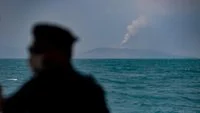
The picturesque yet perilous landscape of the Sunda Strait has once again captured the attention of geologists, disaster mitigation authorities, and the general public. Following a period of intense volcanic activity that blanketed vast portions of Sumatra and Java in volcanic ash earlier in the month, Mount Anak Krakatau—one of the world’s most closely monitored and active juvenile volcanoes—has displayed a striking and unusual geological anomaly within its crater. A distinct, bright yellow circular pool resembling a "fried egg" has formed in the crater basin, sparking widespread curiosity across social media platforms and prompting rigorous scientific explanation from volcanologists.
The phenomenon, first brought to light through dramatic aerial footage shared on the Instagram account @wxchasing, showcases a vivid yellowish-orange liquid pooled centrally within the grey and rugged caldera of the volcano. The imagery quickly circulated online, contrasting sharply with the desolate, ash-covered slopes that had dominated the regional landscape since the volcano’s major eruption on September 3, 2026. While social media users marveled at the surreal, culinary-inspired appearance of the crater, scientific authorities have moved swiftly to contextualize the event, emphasizing that beneath the visual novelty lies a powerful reminder of the raw, volatile forces still simmering beneath the Earth’s crust.
Chronology of Events and the September 2026 Eruption Cycle
The emergence of the fried-egg pool follows a significant escalation in volcanic activity at Mount Anak Krakatau. On September 3, 2026, the volcano experienced a major eruption that sent colossal columns of ash, smoke, and tephra high into the atmosphere. Due to prevailing wind patterns and the sheer scale of the explosive event, the volcanic ash cloud was carried far beyond the immediate vicinity of the Sunda Strait, severely impacting air quality and visibility across multiple provinces.
Reports of ashfall quickly poured in from neighboring regions, stretching from Bengkulu and South Sumatra across the Lampung province, and extending even as far as the densely populated capital city of Jakarta and various districts in West Java. The widespread dispersion of volcanic debris disrupted regional aviation advisories and raised immediate concerns among environmental and disaster management agencies.
However, by mid-September, the aggressive explosive phase had noticeably subsided, transitioning into a relative surface calm. It was during this post-eruption window of quiescence that researchers and monitoring teams observed the striking geochemical transformation inside the crater. The sudden appearance of the yellowish pool highlighted the complex chemical interactions taking place as cooling magma, trapped gases, and meteoric or marine waters mixed within the collapsing caldera walls.
Scientific Explanation: Decoding the "Fried-Egg" Crater Pool
Addressing public curiosity, Suwarno, the Head of the Mount Anak Krakatau Monitoring Post in South Lampung, provided a definitive scientific breakdown of the phenomenon. According to Suwarno, the pool is the result of water accumulating in the crater basin and becoming heavily contaminated with sulfur gas and other acidic minerals released by the underlying magmatic system.
"Yes, that is the crater of Mount Anak Krakatau. What you are seeing is water that has been heavily contaminated with sulfur gas," Suwarno explained, referencing reports from regional observation networks.
While sulfur-rich geothermal pools are a common hallmark of active volcanic systems worldwide, the precise visual geometry—a bright yellow center mimicking a yolk surrounded by a lighter or darker rim—is less uniform across all volcanoes. Suwarno noted that while sulfur is a universal byproduct of volcanic degassing, the distinct coloration and pooling at Anak Krakatau are shaped by a unique combination of factors. The trapped water reacts dynamically not only with rising sulfur dioxide and hydrogen sulfide gases but also with the mineral-rich sediment, ash, and unstable rock layers comprising the inner walls of the crater.
The leaching of iron, sulfur compounds, and hydrothermal minerals into the standing water creates vibrant coloration gradients. Depending on the temperature, pH levels, and concentration of suspended colloidal sulfur particles, these volcanic crater lakes can shift dramatically in appearance, transitioning from milky turquoise to intense mustard yellow.
Ongoing Volcanic Unrest and Micro-Seismicity
Despite the calm surface conditions that allowed the sulfur pool to form and become visible, geological authorities stress that Mount Anak Krakatau remains far from dormant. The cessation of major surface explosions does not equate to an end to internal magmatic movement.
Data collected by the Mount Anak Krakatau Monitoring Post underscores continuous subterranean activity. On Friday, September 18, 2026, monitoring instruments recorded persistent seismic signatures beneath the volcanic edifice. During the early morning hours, seismic stations captured a low-frequency earthquake with an amplitude of 12 millimeters and a duration of 5 seconds, alongside a distant tectonic earthquake registering an amplitude of 8 millimeters with a prolonged duration of 72 seconds.
Furthermore, continuous micro-tremors—often indicative of fluid movement, hydrothermal circulation, or minor magma migration beneath the surface—were recorded consistently. The amplitude of these continuous tremors ranged between 0.5 and 6 millimeters, with a dominant reading of 2 millimeters. These instrumental readings serve as a critical reminder to both scientists and the public that the plumbing system beneath the volcano remains active and pressurized.
Official Status and Strict Safety Protocols
In response to the ongoing seismic instability and the potential for sudden, unheralded phreatic or magmatic eruptions, the Center for Volcanology and Geological Hazard Mitigation (PVMBG) maintains a heightened alert level for the volcano. Mount Anak Krakatau is officially classified under Level III (Siaga), the second-highest warning tier in Indonesia’s national volcanic alert system.
Given the inherent unpredictability of juvenile volcanic systems—which can transition from apparent calm to violent eruption in a matter of minutes—authorities have enforced strict territorial boundaries. A mandatory exclusion zone is strictly enforced, prohibiting residents, fishermen, and tourists from entering or approaching within a 3-kilometer radius of the Mount Anak Krakatau crater and its surrounding active zones.
Local governments and disaster response units in Lampung and Banten provinces remain on standby, continuously coordinating with the geological monitoring post to ensure timely dissemination of information to coastal communities bordering the Sunda Strait. Emergency preparedness drills and public awareness campaigns continue to emphasize adherence to safety perimeters, drawing sobering historical lessons from the catastrophic 2018 flank collapse and tsunami triggered by the same volatile volcanic complex.
Broader Implications and Environmental Monitoring
The appearance of the sulfur pool and the ongoing seismic volatility at Mount Anak Krakatau offer valuable insights for volcanologists studying the lifecycle of island arcs in subduction zones. The Sunda Strait, situated at the complex tectonic junction where the Indo-Australian Plate subducts beneath the Eurasian Plate, is one of the most geodynamically active regions on the planet.
Changes in crater morphology, hydrothermal fluid chemistry, and seismic patterns serve as critical diagnostic tools for researchers attempting to forecast future eruptive behavior. The ability of sulfur pools to form rapidly following an eruption indicates high degassing rates and active hydrothermal systems close to the surface. Continued geochemical sampling and remote sensing analysis—utilizing satellite imagery and drone reconnaissance—will be essential for monitoring the evolution of the crater and assessing whether the current phase of activity points toward stabilization or the prelude to a new eruptive cycle.
As public fascination with natural phenomena continues to grow via digital media channels, agencies like the PVMBG reiterate the vital balance between scientific curiosity and strict adherence to public safety. While the "fried-egg" crater of Mount Anak Krakatau provides a fascinating glimpse into the complex alchemy of our dynamic planet, it remains a potent symbol of nature’s unpredictable fury, demanding absolute respect from those living and working in its shadow.