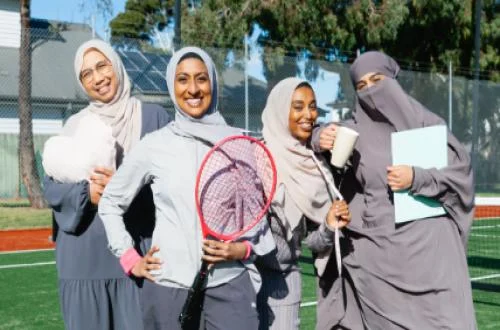
The burgeoning landscape of digital storytelling has welcomed "Salma’s Season," a compelling new comedy series that delves into the multifaceted lives of Muslims residing in Australia. This ambitious project, helmed by director and writer Kauthar Abdulalim, aims to illuminate the rich tapestry of Muslim experiences, moving beyond stereotypical portrayals to explore the everyday realities, challenges, and triumphs faced by this diverse community. The series, which premiered with a screening and discussion event at Teater Komunitas Utan Kayu in Jakarta on Monday, February 13, 2023, offers a poignant yet humorous lens on cultural integration, identity, and the universal human experiences that bind us all, regardless of background or location.
Abdulalim articulated his core vision for "Salma’s Season" during the Jakarta event, emphasizing a desire to capture the authentic nuances of daily Muslim life. "For instance, a scene where the husband is in the kitchen and can’t find the salt. We laugh because we’ve experienced it, and that’s precisely what I want to show," he explained. This commitment to relatable, everyday scenarios serves as a cornerstone of the series, grounding its narrative in the shared human condition and fostering an immediate connection with viewers. The comedy, therefore, arises not from caricature or exaggeration, but from the recognition of familiar struggles and joys.
Beyond the domestic sphere, "Salma’s Season" also confronts the significant hurdles faced by Muslims navigating life as a minority group in Western societies. Abdulalim highlighted this aspect through the character of Zoya, portrayed by Lyeba Khan. Zoya’s journey is marked by the profound difficulty of securing employment due to her adherence to the niqab and her distinctly Islamic name. This narrative thread directly addresses the subtle yet pervasive forms of discrimination that can impact individuals from minority backgrounds, even when they possess the requisite qualifications.
"It’s difficult for Muslims to get jobs in Australia because they are a minority group and they are Muslim," Abdulalim stated, echoing the experiences of many. "Sometimes, just seeing your name can be enough for them not to consider hiring you." This candid observation underscores a critical issue within contemporary Australian society: the challenge of overcoming unconscious bias and ensuring equitable opportunities for all citizens, irrespective of their religious or ethnic affiliations. The series thus serves as an important platform for raising awareness about these systemic challenges.
The multifaceted nature of the Muslim community in Australia was further elaborated upon by Yanuardi Syukur, Chairman of the Australian Indonesia Muslim Exchange Program Alumni Forum. Syukur underscored that the term "Muslim" in Australia encompasses a broad spectrum of individuals hailing from diverse origins, including significant populations from Lebanon, Africa, Pakistan, and numerous other nations. This inherent diversity within the Muslim community itself is a key theme explored in "Salma’s Season."
"In Australia, there are many Muslim communities. Immigrants come from Lebanon, Africa, Pakistan, and many more," Syukur observed. He emphasized that these individuals are striving for survival and integration, and the series provides a window into their adaptive strategies. "The characters try to survive. Through this series, viewers learn how they survive, like the character Zoya who tries to get a job. Then she changes her name. That is a form of adaptive strategy," he noted, pointing to the practical measures individuals may take to overcome societal barriers.
Syukur also critically contrasted the portrayal of Islam in "Salma’s Season" with the often-negative narratives propagated by Western media. He lamented the tendency of many Western outlets to associate Islam with terrorism, a portrayal that he believes is both inaccurate and damaging. "In its various versions, Muslims are many. Some wear hijabs, some wear niqabs, some do not wear hijabs. They are all Muslim in terms of religion," he asserted, reinforcing the notion that religious identity is not monolithic and should not be reduced to a single, often vilified, image.
The series’ titular character, Salma, is a 45-year-old Australian-Pakistani woman with aspirations of competing in the Australian Open tennis tournament. This central storyline offers a compelling narrative arc, blending personal ambition with cultural identity. The cast features Faryaal Jabbar in the lead role of Salma, supported by Seble Girma, Pudak Nayati, and Lyeba Khan as her friends Nur, Maryam, and Zoya, respectively. Bryan Hynes rounds out the principal cast as Salma’s tennis coach, Brod.
"Salma’s Season" comprises six episodes, each running between six and nine minutes, making it an accessible and engaging watch for online audiences. The series is available for free viewing on the Vidly YouTube channel, a deliberate choice by the creators to ensure broad accessibility and reach. This distribution strategy aligns with the goal of fostering wider understanding and appreciation of the Muslim experience.
Historical Context and Societal Integration
The narrative of "Salma’s Season" is situated within a broader historical context of Muslim migration and settlement in Australia. Beginning in the mid-19th century with the arrival of small numbers of traders and laborers, the Muslim population in Australia has grown significantly over the decades, particularly with post-World War II immigration and more recent arrivals from various Muslim-majority countries. This demographic shift has inevitably led to ongoing dialogues about multiculturalism, religious freedom, and social cohesion.
The series’ exploration of challenges such as employment discrimination reflects real-world data. Studies on workplace diversity in Australia have consistently shown that individuals from minority ethnic and religious backgrounds can face barriers to career progression. For instance, research from organizations like the Scanlon Foundation and the Australian Human Rights Commission has highlighted instances of bias in hiring practices, often linked to names, perceived cultural differences, or religious attire. The portrayal of Zoya’s struggle, therefore, is not an isolated fictional event but a reflection of documented societal issues.
The "Muslim Exchange Program" mentioned in relation to Yanuardi Syukur’s involvement also speaks to a history of bilateral engagement between Australia and Muslim-majority nations, aimed at fostering mutual understanding and cultural exchange. Such programs, alongside educational initiatives and community outreach, play a vital role in bridging cultural divides and promoting a more inclusive society. "Salma’s Season" can be seen as a contemporary artistic contribution to this ongoing effort.
The Power of Comedy in Addressing Complex Issues
The choice of comedy as the primary genre for "Salma’s Season" is a strategic decision with significant implications. Humor has a unique ability to disarm audiences, making them more receptive to nuanced discussions about sensitive topics. By framing the challenges faced by Muslims within a comedic context, Abdulalim and his team can engage viewers on an emotional level, fostering empathy and breaking down preconceived notions.
The humor derived from everyday situations, as exemplified by the kitchen salt anecdote, serves to humanize the characters and their experiences. It demonstrates that despite their cultural and religious distinctiveness, Muslims share fundamental human needs, desires, and even minor domestic frustrations with people of all backgrounds. This relatable quality is crucial for building bridges of understanding and challenging the "othering" that often fuels prejudice.
Furthermore, comedy can effectively highlight the absurdity of discriminatory practices. When viewers laugh at the illogical reasons behind Zoya’s employment struggles, they are simultaneously invited to question the validity of such biases. This subtle form of social commentary, embedded within an entertaining narrative, can be far more impactful than direct pronouncements or lectures.
Diverse Perspectives Within the Muslim Community
A significant strength of "Salma’s Season" lies in its commitment to showcasing the internal diversity of the Muslim community. As Yanuardi Syukur pointed out, the Muslim population in Australia is not a homogenous bloc but a vibrant mosaic of ethnicities, cultural traditions, and interpretations of religious practice.
The series’ portrayal of characters with varying levels of religious observance – some wearing hijabs, others niqabs, and some not wearing head coverings at all – directly challenges the simplistic and often prejudiced Western media narrative that conflates all Muslims with a single, often extreme, image. By presenting this spectrum of observance, "Salma’s Season" affirms that religious identity is personal and multifaceted, and that diversity of practice does not diminish one’s Muslim faith.
This inclusive approach is vital for fostering a more accurate and nuanced public perception of Muslims. It encourages viewers to recognize the individuality within the community and to move beyond generalized stereotypes. The series thus contributes to a more sophisticated understanding of Islam and its adherents in a multicultural context.
Broader Implications and Future Outlook
The impact of "Salma’s Season" extends beyond its immediate entertainment value. By offering an authentic and humanizing portrayal of Muslim life in Australia, the series has the potential to:
- Counter negative stereotypes: It directly challenges prejudiced narratives often perpetuated by mainstream media, offering a refreshing and positive counterpoint.
- Promote cultural understanding: It provides a valuable educational tool for non-Muslim audiences, fostering empathy and a deeper appreciation for diverse cultural experiences.
- Empower minority voices: It gives a platform to stories that are often marginalized, validating the experiences of Muslims and encouraging greater self-representation.
- Spark dialogue: The series’ themes can serve as a catalyst for important conversations about multiculturalism, integration, discrimination, and religious freedom within Australia and beyond.
The success of "Salma’s Season" could pave the way for more content that explores the lives of diverse communities in Australia and other Western nations. As digital platforms continue to democratize content creation, stories that challenge the status quo and offer fresh perspectives are increasingly finding their audience. The series’ availability on YouTube further amplifies its potential reach, allowing it to transcend geographical and cultural boundaries.
The creators’ dedication to authenticity, coupled with the universal appeal of human stories, positions "Salma’s Season" as a significant contribution to contemporary media. It is a testament to the power of storytelling to foster empathy, challenge prejudice, and celebrate the richness of human diversity. As viewers engage with Salma’s journey and the experiences of her friends, they are invited to look beyond labels and discover the shared humanity that connects us all. The series offers a hopeful glimpse into a future where diverse narratives are not only accepted but celebrated, enriching the cultural landscape for everyone.