
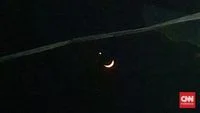
The night sky across parts of the Indonesian archipelago played host to a rare and mesmerizing celestial alignment on Monday evening, September 14, 2026, as the Moon passed directly in front of Venus, creating a striking astronomical phenomenon known as a lunar occultation. While fortunate observers in specific regions witnessed the brilliant planet temporarily vanish behind the lunar disc, millions of others across the country enjoyed a breathtaking conjunction, wherein the celestial bodies formed a vivid crescent-and-star configuration reminiscent of iconic cultural symbols.
Astronomical institutions, most notably the renowned Bosscha Observatory, had alerted the public days in advance to the impending spectacle. As twilight faded and the western horizon cleared, professional astronomers and amateur stargazers alike trained their eyes upward to witness a dynamic interplay of orbital mechanics, planetary brilliance, and atmospheric clarity that occurs only a few times within a decade for any given geographical location.
Understanding the Mechanics of Lunar Occultation
To the naked eye or through modest optical instruments, a lunar occultation appears as a graceful cosmic dance. However, the event is governed by precise gravitational and orbital parameters. The Bosscha Observatory formally defined the phenomenon ahead of the event through public advisories, explaining that a lunar occultation of Venus takes place when the Moon moves precisely between the Earth and Venus. Because the Moon is significantly closer to Earth than Venus, its apparent size in the sky is large enough to obscure the distant planet entirely for a brief period.
Prior to the moment of complete occultation, Venus appeared to hover infinitesimally close to the illuminated edge of the lunar limb. This phase closely mirrors the preliminary stages of a solar eclipse, where the foreground body gradually creeps toward the background object. Because the night side of the Moon was not facing Earth, the lunar disc was visible primarily as a thin, glowing silver crescent, beautifully illuminated by direct sunlight, with the rest of the sphere faintly visible due to earthshine—sunlight reflected from the Earth’s surface onto the Moon.
Geographical Disparities: Occultation Versus Conjunction
Because the Moon is relatively close to Earth, its exact position in the sky appears slightly different depending on the observer’s precise vantage point—a geometric effect known as lunar parallax. Consequently, the spectacular complete disappearance of Venus was not visible uniformly across the entire nation.
According to data compiled by observational astronomers, the actual occultation—where Venus was swallowed by the dark edge of the Moon and later reappeared from behind the bright limb—was restricted to a narrow observational corridor. This privileged path included parts of Sumatra, western areas of Java, and a small pocket of West Kalimantan. Residents situated within these specific coordinates enjoyed the full sequence of immersion and emersion.
Conversely, for millions of citizens residing outside this narrow band, the event manifested as a close planetary conjunction. In these regions, the Moon and Venus did not intersect path-wise from the observer’s perspective; rather, they passed remarkably close to one another in the celestial sphere. This alignment placed a brilliant, gleaming Venus just a fraction of a degree away from the delicate crescent Moon.
The striking visual configuration immediately drew comparisons to the classic lunar-and-star iconography historically significant in various cultural and religious contexts across Southeast Asia and the wider Islamic world. However, astronomers were quick to clarify for curious onlookers that the bright point of light accompanying the lunar crescent was not a star within our galaxy, but rather the cloud-covered, sulfuric-acid-laden atmosphere of Earth’s planetary neighbor, Venus—the second planet from the Sun and often referred to as the "Evening Star" when visible after sunset.
Chronology and Visibility Window
The celestial event unfolded within a tightly constrained timeframe during the early evening hours, rendering it exceptionally accessible to the general public without the need for specialized laboratory equipment.
The visible phase of the conjunction and occultation generally spanned from approximately 19:30 Western Indonesia Time (WIB) to 20:43 WIB, though exact timing varied by a matter of minutes depending on the observer’s precise longitude and latitude. Stargazers were advised to direct their gaze toward the western horizon shortly after sunset, a period during which the sky transitions from a deep twilight blue to the dark canvas of night, providing optimal contrast for viewing planetary brightness against the lunar glow.
Unlike deep-sky objects such as distant nebulae or faint galaxies, Venus possesses an apparent magnitude that makes it easily visible even in moderately light-polluted urban environments. Consequently, millions of Indonesians living in dense metropolitan areas such as Greater Jakarta were able to observe the phenomenon simply by stepping outside and looking west, requiring nothing more than clear weather conditions.
Expert Insights and Public Engagement
The Bosscha Observatory, operated by the Bandung Institute of Technology (ITB) and serving as Indonesia’s premier astronomical research facility, played a pivotal role in maximizing public engagement and scientific literacy surrounding the event. Through digital outreach campaigns, social media advisories, and public information releases issued in the days leading up to September 14, the institution provided accurate telemetry, timing guides, and safety reminders.
Astrophysicists emphasize that events like the lunar occultation of Venus serve a vital function beyond mere aesthetic appreciation. They act as natural catalysts for public interest in STEM (Science, Technology, Engineering, and Mathematics) fields. When astronomical occurrences coincide with peak evening hours—when families are typically gathered at home—they spark curiosity among younger generations, prompting questions about orbital mechanics, the scale of the solar system, and the physical properties of neighboring worlds.
Furthermore, amateur astronomy clubs and university physics departments across Java and Sumatra utilized the occasion to host public viewing nights. Equipped with portable telescopes, binoculars, and tracking mounts, these groups allowed citizens to observe the phases of Venus—which exhibits crescent and gibbous phases much like the Moon—just hours before it slipped behind the lunar limb.
Broader Astrophysical Context and Future Implications
While planetary conjunctions occur with relative frequency due to the geometry of the solar system (as the planets orbit the Sun at varying speeds along the ecliptic plane), occultations of bright planets by the Moon are considerably less common for any specific geographic location. Because the orbital plane of the Moon is tilted by about five degrees relative to the Earth’s orbital plane around the Sun, the Moon frequently passes above or below planets rather than directly crossing paths with them.
When an occultation does occur, it provides professional astronomers with unique opportunities for precision measurements. Timing the exact second a planet disappears behind the lunar limb and reappears on the other side allows scientists to refine lunar topography data, particularly the contours of polar craters and mountain ranges along the Moon’s edge, as these jagged features momentarily block the light of the background star or planet.
Additionally, studying how the light of Venus dims as it passes behind the upper layers of the lunar exosphere—though extremely tenuous—contributes to broader planetary atmospheric studies. While Venus itself has a dense, opaque atmosphere composed primarily of carbon dioxide with thick clouds of sulfuric acid, analyzing the ingress and egress phases offers educational validation of stellar occultation techniques used by space agencies to study exoplanets orbiting distant stars outside our solar system.
Conclusion: A Memorable Night for Indonesian Skies
As the convergence of the Moon and Venus drew to a close past 20:40 WIB on Monday night, social media platforms across Indonesia were flooded with photographs, videos, and commentary from mesmerized observers. Despite varying degrees of cloud cover in different regions, the vast majority of the archipelago enjoyed favorable atmospheric conditions.
The successful observation of the 2026 lunar occultation underscores the growing enthusiasm for astronomy within Indonesia. By bridging the gap between rigorous scientific forecasting provided by institutions like the Bosscha Observatory and the widespread public wonder of casual stargazing, events of this magnitude continue to enrich cultural appreciation for the cosmos, reminding observers of the dynamic, clockwork precision governing our local solar neighborhood.
