
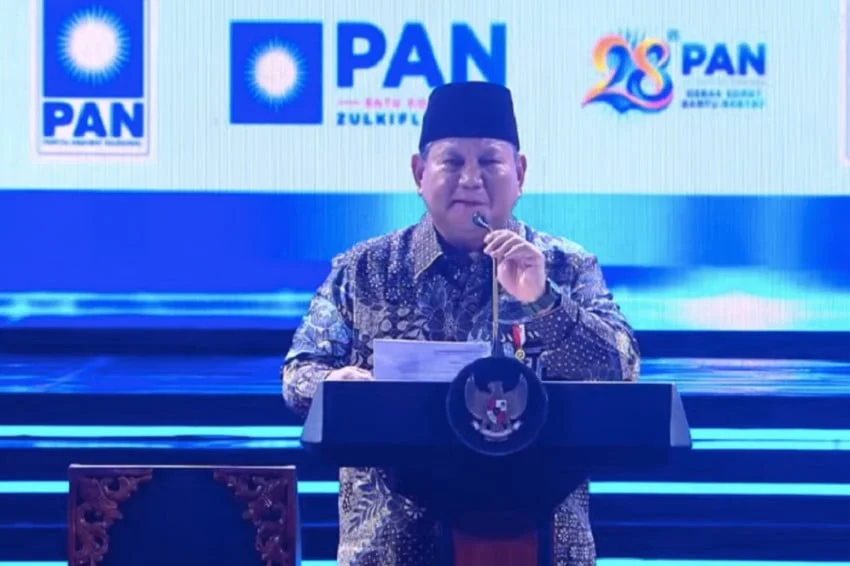
President Prabowo Subianto has delivered a stark warning regarding the evolving nature of global conflict and the vulnerabilities inherent in modern democratic systems. Speaking at the 28th-anniversary celebration of the National Mandate Party (PAN) held at the Jakarta International Convention Center (JICC) in Senayan, Jakarta, on Friday, September 18, 2026, the President underscored that warfare in the 21st century has shifted from traditional kinetic deployments to sophisticated digital manipulation.
In his address, President Prabowo highlighted that the battlefield is no longer confined to physical borders or trenches. Instead, modern adversaries are increasingly utilizing social media platforms as conduits for psychological warfare, misinformation, and societal destabilization. By flooding digital spaces with fabricated information and divisive content, state and non-state actors can weaken a nation’s social fabric without firing a single shot or deploying a single soldier.
The Evolution of Modern Warfare: From Kinetic to Cognitive
The assertion made by President Prabowo aligns with contemporary military doctrines observed by global powers, often referred to as "Hybrid Warfare" or "Fifth-Generation Warfare." This concept emphasizes the use of non-military tools—such as cyberattacks, economic pressure, and, most notably, information operations—to achieve strategic objectives.
Information warfare, in particular, leverages the viral nature of social media to sow discord, erode trust in democratic institutions, and manipulate public opinion. By targeting the "cognitive domain," these actors can paralyze a nation’s decision-making process or influence electoral outcomes. The President’s emphasis on "damaging social media" suggests a recognition that the digital sphere has become a primary arena for sovereignty challenges.
Democratic Vulnerabilities and Economic Influence
Beyond the threat of external digital subversion, President Prabowo turned his focus to the internal threats facing Indonesia’s democratic governance. He cautioned that the democratic process itself is susceptible to "hijacking" and "purchase" by entities possessing substantial economic power.
"We must be cautious because democracy can be hijacked. Democracy can be bought. It is vulnerable to those who possess significant economic power, those who have vast wealth, and especially those whose wealth has been acquired through illicit means," the President stated.
This warning serves as a significant commentary on the intersection of capital and politics. In many developing democracies, the influence of money politics remains a critical concern, where wealthy donors or corporations can disproportionately sway policy agendas, effectively silencing the voices of the broader populace. The President’s rhetoric suggests an administration increasingly concerned with the integrity of the political system against the encroachment of unchecked capital.
Contextualizing the 28th Anniversary of PAN
The event at the JICC served not only as a celebratory milestone for the National Mandate Party but also as a platform for the head of state to reinforce his administration’s national security agenda. PAN, a long-standing political entity in Indonesia, has been a key partner in the current governing coalition. The presence of the President at this milestone underscored the importance of the party’s alignment with his vision for national resilience.
The anniversary event was marked by a gathering of party loyalists and political elites, reflecting the consolidation of support for the current government. President Prabowo’s presence served to solidify the bond between the executive and his "comrades-in-arms," emphasizing a shared responsibility in safeguarding the nation’s future amidst a rapidly changing geopolitical landscape.
Chronology and Emerging Trends in Indonesian Politics
The discourse on the integrity of democracy and national security has been a recurring theme in the President’s public appearances throughout 2026. This latest statement follows a series of policy initiatives aimed at bolstering cybersecurity and protecting the digital sovereignty of Indonesia.

- Early 2026: The administration intensified efforts to strengthen national data centers and cybersecurity protocols, responding to a surge in regional cyber threats.
- Mid-2026: Increased legislative focus on the regulation of digital platforms, aiming to curb the spread of deepfakes and automated misinformation campaigns.
- September 18, 2026: During the PAN anniversary, the President formally articulated the connection between digital misinformation and national defense.
This progression indicates a shift from reactive measures to a proactive, doctrine-based approach to national security, where the protection of the "information space" is now considered as critical as the protection of physical territory.
Data-Driven Analysis of the Threat Landscape
The concerns raised by the President are supported by global data on digital manipulation. According to various cybersecurity think tanks, the proliferation of "bot farms" and AI-generated content has made the cost of launching a large-scale disinformation campaign significantly lower than it was a decade ago.
In Indonesia, where social media penetration is among the highest in the world, the potential for rapid mobilization based on false information is a significant strategic risk. Analysts note that during election cycles and periods of social tension, the velocity at which unverified information travels often outpaces the capacity of regulatory bodies or fact-checkers to respond.
Furthermore, the "economic hijacking" mentioned by the President correlates with international indices on political corruption and campaign finance transparency. When political parties are overly dependent on opaque funding sources, the risk of "state capture"—where private interests dictate public policy—becomes a palpable reality that threatens the stability of the state.
Official Responses and Strategic Implications
Political analysts and observers have responded to the President’s remarks with a mix of cautious support and calls for concrete action. While many agree that the threats to democracy from both digital manipulation and illicit money are existential, the challenge lies in implementing regulations that protect the truth without infringing upon the principles of free speech.
The government is expected to accelerate the drafting of regulations concerning the accountability of social media corporations operating within Indonesia. By placing the onus on these platforms to police their content more effectively, the administration aims to mitigate the risk of foreign or domestic actors exploiting these tools for destabilization.
Broader Impact: Securing the Future
The implications of the President’s warning are profound. If the Indonesian government successfully pivots its defense strategy to include the digital and cognitive domains, it could serve as a model for other nations in the Global South facing similar challenges.
However, the strategy also carries risks. Centralizing the control of information and monitoring digital discourse requires a delicate balance. If over-implemented, such measures could be perceived as a tool for political suppression, potentially contradicting the very democratic values the President seeks to protect.
The path forward, as hinted by the President, requires a collaborative approach between the state, civil society, and technology companies. It necessitates a "whole-of-society" resilience, where the public is educated on media literacy, and institutions are empowered to resist the corrupting influence of illicit money.
Conclusion
As the Indonesian government looks toward the remainder of the decade, the dual threats of digital subversion and economic interference in democracy remain at the forefront of the national agenda. President Prabowo’s address at the PAN anniversary serves as a clarion call for vigilance. It is a recognition that the security of a nation is no longer just about the strength of its armed forces, but about the integrity of its information environment and the purity of its democratic processes.
The coming months will likely see intensified debates in the legislature and among the public regarding the implementation of policies intended to safeguard the nation. Whether through enhanced digital regulation or more rigorous oversight of political finance, the administration’s response to these challenges will define the health and stability of Indonesian democracy for years to come. The era of silent, digital warfare has arrived, and the nation’s response will determine its ability to navigate the complex geopolitical currents of the future.
