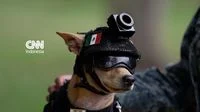
The Mexico National Guard formally welcomed its most diminutive yet fiercely determined recruit to date on Tuesday, September 29, officially enlisting a 13-month-old Chihuahua named Comando into its ranks. In a ceremony that quickly captured public attention both domestically and internationally, the pint-sized service animal was outfitted in a custom-tailored tactical vest and specialized protective eyewear, setting a new precedent for unconventional working dogs within federal law enforcement agencies. Weighing a mere seven kilograms and standing at a height of just 21 centimeters, Comando defies the traditional physical stereotypes associated with military and police working dogs, which are typically dominated by larger, high-endurance breeds such as German Shepherds, Belgian Malinois, and Labrador Retrievers. Despite his diminutive stature, the young Chihuahua demonstrated exceptional agility, focus, and tenacity during a live demonstration of his capabilities, successfully navigating obstacle courses, scaling stairs, and leaping across wooden barriers with the precision and enthusiasm of a canine twice his size. This strategic recruitment highlights a growing recognition among tactical units worldwide regarding the specialized utility of smaller breeds in specific operational environments, ranging from tight-space searches to psychological deterrence and community engagement initiatives within federal security apparatuses.
Chronology of Recruitment and Training
The journey of Comando from a private companion animal to an enlisted member of the Mexico National Guard began months prior to the official induction ceremony on September 29. Initial assessments of the young Chihuahua’s temperament began when handlers within the National Guard’s specialized K9 division noticed unusual alertness, high energy reserves, and an exceptional capacity for focus during preliminary behavioral screenings. Unlike many dogs of his breed, which are frequently relegated to sedentary domestic roles, Comando exhibited a pronounced drive for task-oriented activities, prompting trainers to design a customized conditioning program tailored to his unique physiological profile.
By the age of ten months, Comando had commenced rigorous foundational obedience training alongside standard-sized tactical dogs at the Guard’s premier training facility. Handlers focused on maximizing his natural agility, teaching him to negotiate scaled-down obstacle courses designed to simulate the physical barriers he would encounter in urban operational scenarios. The training regimen emphasized speed, directional control, and desensitization to loud noises and tactical gear.
The culmination of these preparatory months arrived in late September, when Comando successfully passed a comprehensive series of evaluations testing his responsiveness to commands under simulated operational stress. On Tuesday, September 29, the National Guard formally integrated the Chihuahua into active service. The induction ceremony featured Comando outfitted in his specialized tactical vest—complete with National Guard insignia—and protective eyewear, marking a significant milestone in the evolution of federal K9 deployment protocols and signaling the official commencement of his duties.
Physiological and Behavioral Traits of the Chihuahua Breed
To understand the operational rationale behind Comando’s recruitment, it is necessary to examine the foundational characteristics of the Chihuahua breed. Originating in the state of Chihuahua, Mexico, these dogs are historically recognized as the smallest canine breed in the world. Standard adult weight typically ranges from one to three kilograms, though larger specimens, such as Comando at seven kilograms, occasionally occur. Despite their miniature proportions, Chihuahuas possess a distinct genetic predisposition toward high energy, pronounced alertness, and a fierce, confident demeanor that often belies their physical size.
In professional canine handling literature, Chihuahuas are frequently characterized as intensely loyal, highly observant, and possessing a sharp predatory drive directed toward smaller stimuli. These traits, when properly channeled through structured positive reinforcement and operational training, translate into remarkable situational awareness. Their acute sense of hearing and natural wariness make them exceptional sentinels, capable of detecting subtle environmental changes or auditory cues that larger dogs might overlook.
Furthermore, the breed’s high metabolic rate contributes to boundless energy reserves during short-burst activities, a physical attribute that handlers leveraged during Comando’s agility trials. While the breed is predominantly kept as a companion animal due to its vulnerability to extreme temperatures and physical trauma from larger predators, selective individuals with high psychological resilience—such as Comando—demonstrate that breed stereotypes do not universally preclude utility in specialized law enforcement capacities.
Official Responses and Public Reactions
The public unveiling of Comando generated significant discourse across traditional media platforms and digital channels, eliciting a spectrum of reactions from animal behaviorists, law enforcement veterans, and the general public. Representatives from the Mexico National Guard issued formal statements emphasizing that the inclusion of non-traditional breeds reflects an adaptive philosophy in modern security operations. Officials noted that while large working dogs remain indispensable for high-intensity apprehension and extensive tracking assignments, smaller operatives offer distinct tactical advantages in scenarios requiring covert movement or access to confined spaces.
Animal welfare organizations and professional K9 trainers offered generally favorable commentary, tempered with cautionary reminders regarding the ethical treatment of working animals. Several prominent canine behavior specialists pointed out that while Comando’s enthusiasm during the public demonstration was palpable, handlers must maintain rigorous oversight to ensure the dog is not subjected to physical environments that exceed his physiological limits. The National Guard responded by assuring the public that Comando’s welfare, health, and psychological well-being remain paramount, with veterinary specialists monitoring his workload and development on a continuous basis.
On social media, the reaction was overwhelmingly positive, with Comando quickly achieving viral status. Hashtags dedicated to the tactical Chihuahua trended nationally within hours of the induction ceremony, transforming the canine into an unorthodox mascot for the security forces. Public affairs strategists within the government noted that the deployment of an approachable, unique mascot serves a dual purpose: it humanizes the federal security apparatus and fosters stronger, more positive engagement between law enforcement agencies and civilian communities.
Strategic Implications for Modern Law Enforcement K9 Units
The integration of Comando into the Mexico National Guard introduces broader implications for the deployment of K9 units in federal law enforcement and military operations globally. Historically, institutional reliance has centered on heavy-set, robust breeds capable of physical deterrence and high-impact suspect neutralization. However, modern security challenges—ranging from urban counter-terrorism operations to complex contraband interdiction in restricted architectural spaces—demand a more diversified tactical toolkit.
Smaller dogs possess inherent operational benefits that are increasingly difficult for tactical commanders to ignore. Their reduced physical footprint allows for rapid deployment in cramped environments, such as narrow ventilation shafts, collapsed building voids during disaster response, and densely packed cargo containers where narcotics or structural anomalies are concealed. Additionally, the psychological impact of a tactical Chihuahua, while unconventional, can alter the dynamics of suspect engagement by defusing tension or introducing an element of surprise that disrupts hostile situational assessments.
Economically and logistically, smaller working dogs also present distinct advantages. Their daily nutritional requirements, medical resource consumption, and transportation footprint are fractionally smaller than those of traditional German Shepherds or Malinois, translating into reduced long-term operational expenditures for public safety agencies operating under constrained budgets.
As law enforcement agencies worldwide continually seek innovative force multipliers, Comando’s deployment serves as a fascinating case study in adaptive recruitment. Whether this event marks the beginning of a broader trend toward the institutional utilization of toy breeds in federal security remains to be seen; however, the successful integration of a seven-kilogram Chihuahua into the Mexico National Guard firmly establishes that operational effectiveness is defined less by physical scale and more by discipline, training, and unyielding determination.