
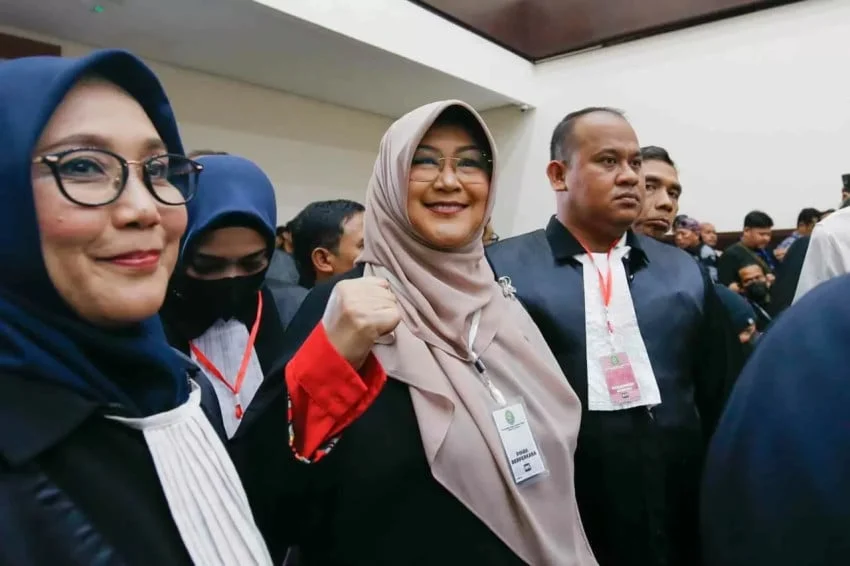
The legal team representing Tifauzia Tyassuma, a medical doctor and social media figure widely known as Dokter Tifa, has expressed strong confidence that the Jakarta Public Prosecutor’s Office (JPU) will refrain from re-filing an indictment following a significant legal victory at the East Jakarta District Court. Abdullah Alkatiri, lead counsel for the defendant, suggested that the prosecution is unlikely to pursue the case further after the panel of judges granted the defense’s preliminary objection, known as an eksepsi, effectively halting the current proceedings regarding the alleged defamation of the 7th President of Indonesia, Joko Widodo, concerning his academic credentials.
The case, which has captured significant public attention, centers on allegations that Dokter Tifa spread false information and committed defamation by questioning the authenticity of President Joko Widodo’s undergraduate diploma from Gadjah Mada University (UGM). However, the trial reached a sudden impasse when the court ruled that the prosecution’s indictment contained procedural flaws and lacked the necessary documentation to proceed to the evidentiary stage. Alkatiri’s assessment, shared during a televised appearance on the program Interupsi on iNews, posits that the prosecution has recognized the "maximum resistance" put forth by the defense and may fear the negative repercussions of continuing a flawed legal battle.
The Legal Significance of the Granted Exception
In the Indonesian criminal justice system, an eksepsi is a formal objection raised by the defense at the start of a trial, arguing that the court lacks jurisdiction, the prosecution’s right to charge has expired, or—as in this case—the indictment is "obscure" (obscuur libel) or procedurally defective. By granting the exception, the East Jakarta District Court indicated that the JPU’s formal charges did not meet the stringent requirements set forth in the Criminal Procedure Code (KUHAP).
Abdullah Alkatiri emphasized that the defense’s "persistent resistance" was a primary factor in this outcome. He noted that during the preliminary stages, the prosecution failed to provide several critical documents to the defense team. "If you ask me, they will not repeat the indictment," Alkatiri stated. "The facts show that there were several documents withheld from us. Because our resistance is fierce and consistent, they likely fear that continuing this path will result in a negative outcome for the opposing side or the complainant."
The core of the defense’s argument rested on the principle of equality of arms, a legal doctrine ensuring that both the prosecution and the defense have equal access to the evidence and information relevant to the case. Alkatiri revealed that the prosecution had submitted statements from 26 expert witnesses to the judges but had initially failed to share the corresponding Berita Acara Pemeriksaan (BAP) or investigation reports with the defense. "What is given by the prosecutor to the judge must also be given to us, so it is fair," Alkatiri asserted. "If we are kept in the dark while they hold all the information, we would be disadvantaged in the courtroom. That is the procedural unfairness we fought against."
Forensic Evidence and the Missing Laboratory Results
Beyond the procedural issues involving expert statements, Dokter Tifa herself has pointed to a critical gap in the prosecution’s evidence: the absence of a forensic laboratory report. The case against her is built on the premise that her public statements regarding the President’s diploma were factual lies intended to defame. However, Tifa argues that the prosecution has yet to present a definitive forensic analysis of the physical diploma to prove its authenticity beyond a doubt.
"The list of evidence presented by the prosecutor did not include the results of a forensic laboratory examination regarding the diploma in question," Tifa noted. For the defense, this omission is not merely a technicality but the crux of the entire dispute. In a case where the "truth" of a document is the central point of contention, the defense maintains that a forensic validation of the paper, ink, and stamps used in the 1985-era diploma is the only evidence that could legally substantiate a defamation charge. Without such a report, the defense argues that the prosecution cannot prove that Tifa’s questioning of the document constituted a "fitnah" or malicious slander.
Chronology of the Controversy
The legal battle involving Dokter Tifa is the culmination of a long-standing and highly polarized debate within Indonesian social media circles. The timeline of the case reflects a broader trend of legal actions taken against individuals who challenge the official narratives surrounding high-ranking state officials.
- Initial Social Media Assertions (2022-2023): Dokter Tifa, who has a significant following on platforms like X (formerly Twitter), began posting side-by-side comparisons of photos of President Joko Widodo from his university years and his current appearance. She suggested discrepancies in facial features and questioned the validity of his graduation from UGM in 1985.
- Police Reports and Investigation: Following these viral posts, several parties filed police reports against Tifa, alleging violations of the Electronic Information and Transactions Law (UU ITE) and articles of the Criminal Code related to the spread of false news and defamation.
- Formal Indictment (2025-2026): After a lengthy investigation, the case was handed over to the East Jakarta District Attorney’s Office. Tifa was officially named a defendant, and the first hearing was scheduled at the East Jakarta District Court.
- The Preliminary Objection (Eksepsi): During the initial hearings, Alkatiri and his team filed an eksepsi, arguing that the indictment was drafted haphazardly and that the defense was being denied access to witness statements.
- The Court’s Decision (July 2026): The panel of judges ruled in favor of the defense, stating that the indictment was "void by law" or "inadmissible" due to the procedural failures cited by Alkatiri.
The Strategy of the "2,000 Questions"
One of the more striking aspects of the defense’s strategy was the announcement that they had prepared a staggering 2,000 questions to be posed to President Joko Widodo should the trial proceed and should he be called as a witness. While the President is rarely called to testify in defamation cases where he is the aggrieved party, the defense insisted that as the subject of the alleged slander, his direct testimony was essential for the discovery of material truth.
This move was viewed by many legal analysts as a form of "legal pressure" intended to highlight the complications of pursuing the case. By signaling their intent to cross-examine the head of state on minute details of his academic history, the defense raised the stakes of the trial, potentially making it a high-profile political spectacle that the government or the prosecution might prefer to avoid.
Broader Implications for Freedom of Speech and Legal Procedures
The dismissal of the case against Dokter Tifa, even if temporary, carries significant implications for the Indonesian legal landscape. It highlights the growing scrutiny of how the JPU handles high-profile defamation cases, particularly those involving the UU ITE.
1. Procedural Rigor over Political Sensitivity:
The court’s decision to grant the eksepsi suggests a commitment to procedural integrity. In many high-stakes cases, there is public pressure for the judiciary to fast-track proceedings. By insisting that the prosecution provide all BAPs and forensic evidence to the defense, the court has reaffirmed the right to a fair trial.
2. The Burden of Proof in Defamation:
The case underscores the difficulty of prosecuting defamation when the "truth" of the statement is tied to physical evidence. If the prosecution chooses to re-indict, they will likely be forced to produce the very forensic evidence they have so far omitted. This creates a "double-edged sword" for the state; proving the diploma is authentic via a forensic lab might end the controversy, but any perceived irregularities in that forensic process would only fuel further public skepticism.
3. The Role of "Citizen Skepticism":
Dokter Tifa’s case is representative of a segment of the Indonesian electorate that remains deeply skeptical of official state records. While the government and UGM have repeatedly affirmed the authenticity of the President’s diploma, the legal system is now being used as the final arbiter of this factual dispute.
Potential Future Scenarios
While Abdullah Alkatiri believes the prosecution will not return, the JPU does have legal options. They could attempt to rectify the flaws in the indictment and file a new case. This is known as ne bis in idem protection not yet applying, as the case was dismissed on procedural grounds rather than a verdict on the merits of the evidence.
However, legal experts suggest that the "negative impact" mentioned by Alkatiri refers to the potential for the trial to become a platform for further conspiracy theories. If a new trial begins and the prosecution still fails to produce a forensic lab result, it could be perceived as a sign of weakness. Furthermore, the political climate in 2026—as the nation moves further into the post-Jokowi era—may diminish the appetite for pursuing a case that many see as a relic of past political tensions.
For now, the release of Dokter Tifa from the immediate threat of this trial marks a tactical victory for her legal team. It serves as a reminder that in the court of law, the strength of an indictment is measured not by the status of the complainant, but by the completeness of the evidence and the adherence to the rights of the accused. The 2,000 questions prepared by the defense remain on the shelf, a symbolic deterrent against a renewed legal offensive.
