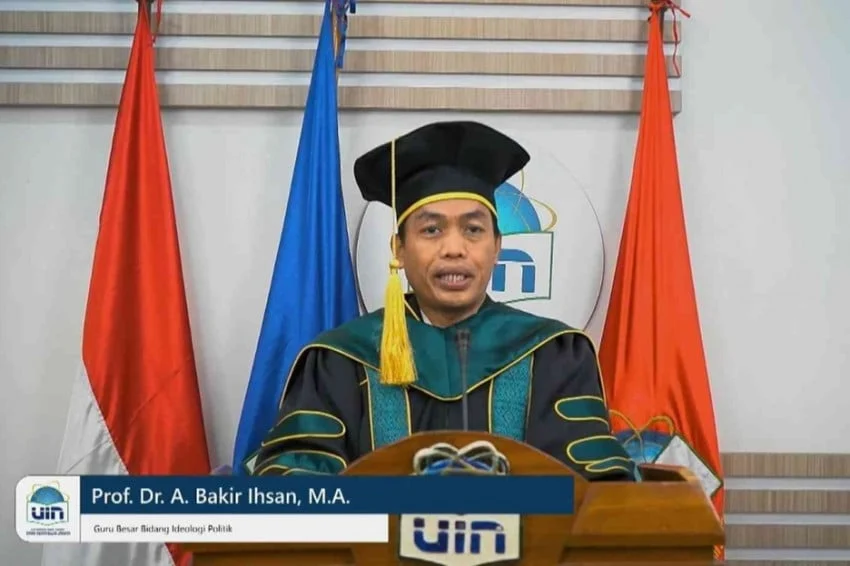
The trajectory of Indonesia’s democratic consolidation cannot be fully evaluated through the standard analytical lenses of elite behavior, systemic corruption, or the tightening grip of oligarchic networks. Deeper structural vulnerabilities are at play, primarily characterized by a profound disconnect between the foundational tenets of Pancasila and an increasingly pragmatic, transactional political culture. This critical assessment was articulated by Professor Dr. A. Bakir Ihsan during his inaugural academic address following his official appointment as Professor of Political Science within the Department of Political Science at the Faculty of Social and Political Sciences (FISIP) of UIN Syarif Hidayatullah Jakarta on Wednesday, September 30, 2026.
Addressing an audience of academics, policymakers, students, and civic leaders at the university’s main auditorium, Professor Bakir delivered a comprehensive scientificoration titled Ideologi Politik yang Terbelah: Institusionalisasi Pancasila untuk Konsolidasi Demokrasi di Indonesia (Split Political Ideology: The Institutionalization of Pancasila for Democratic Consolidation in Indonesia). His thesis confronts a central paradox defining contemporary Indonesian politics: while Pancasila remains universally acknowledged and rhetorically revered by virtually all political factions, its core values fail to serve as functional operational guidelines for the actual exercise of state power and governance.
Chronology and Academic Context of the Inauguration
The academic inauguration ceremony commenced at 09:00 Western Indonesia Time (WIB) on September 30, 2026, marking a significant milestone for the Department of Political Science at FISIP UIN Syarif Hidayatullah Jakarta. The event brought together notable figures from Indonesia’s higher education sector, religious scholars, and political analysts to bear witness to the conferment of the highest academic title upon Professor Bakir, a respected scholar known for his extensive research on political Islam, democratization, and ideological shifts in post-reformasi Indonesia.
The proceedings opened with a formal senate session led by the university rector, followed by the reading of the professor’s academic dossier and career achievements. Professor Bakir then took the podium to deliver his inaugural lecture, which lasted approximately 45 minutes. His presentation served not only as a personal academic milestone but also as a timely intervention in national political discourse, coinciding with ongoing debates regarding the quality of democratic institutions, electoral reform, and the future of governance in the world’s third-largest democracy.
Following the delivery of the scientific oration, a panel of academic respondents—comprising senior professors from national and state Islamic universities—offered brief critical commentaries. The event concluded with the formal presentation of the professorial decree, congregational prayers, and a networking luncheon that allowed civil society actors and academic peers to discuss the broader implications of the address.
The Democratic Paradox and the Root Causes of Systemic Failure
In his address, Professor Bakir challenged the prevailing conventional wisdom held by many political scientists who attribute Indonesia’s democratic stagnation primarily to surface-level symptoms.
"For a long time, we have frequently assumed that Indonesia’s democratic problems lie solely with bad elites, corruption, or oligarchies," Professor Bakir stated during his oration. "In reality, the much more fundamental problem is the emergence of a split in political ideology."
He elaborated that while the constitutional framework and state ceremonies continuously pay homage to Pancasila—the five principles governing the republic—daily political maneuvering is driven almost exclusively by transactional calculations, short-term pragmatism, and power-sharing arrangements. This dual reality has plunged the nation into a structural paradox where procedural democracy thrives while substantive democracy languishes.
Electoral cycles continue to function with regular institutional predictability. National, provincial, and local elections occur on schedule, power transitions peacefully between administrations, and voter participation rates remain relatively high. However, Professor Bakir emphasized that procedural regularity does not automatically translate into substantive democratic strengthening. When political parties operate less as ideological vehicles for public policy and more as electoral machinery or transactional cartels, the fundamental social contract embedded within Pancasila becomes hollowed out.
Crucially, the professor clarified that Indonesia is not currently suffering from an ideological crisis in the sense of a widespread rejection of the state ideology. Unlike the tumultuous ideological polarization of the early post-independence era or the sectarian divides of the late 20th century, contemporary political actors almost universally pledge allegiance to Pancasila. The crisis, therefore, is not one of ideological absence, but of institutional failure—the systemic inability to translate abstract philosophical principles into binding, enforceable norms of political behavior.
Empirical Data and Broader Political Implications
To contextualize Professor Bakir’s arguments, political analysts point to a growing body of empirical data highlighting the friction between democratic ideals and institutional reality in Indonesia. Recent reports from domestic and international democracy watchdogs—such as the Institute for Development of Economics and Finance (INDEF), Amnesty International Indonesia, and various university-based research centers—consistently indicate rising public dissatisfaction with the transactional nature of lawmaking, high campaign costs, and the unchecked influence of political-business coalitions.
Data from the General Elections Commission (KPU) and the Election Supervisory Agency (Bawaslu) over successive electoral cycles reveal that electoral campaigns have become increasingly capital-intensive. The reliance on private financing, high nomination fees within political parties (popularly known as mahar politik), and the monetization of voter support have systematically marginalized candidates committed to grassroots policy debates. Consequently, elected officials often find themselves beholden to financial backers and party elites rather than the constituencies they were elected to represent.
Furthermore, indices measuring the quality of democracy in Indonesia—including those published by Freedom House, the Economist Intelligence Unit (EIU), and the Varieties of Democracy (V-Dem) project—have documented a subtle yet persistent plateauing or democratic regression over the past decade. These indices frequently cite a weakening of checks and balances, the erosion of civil liberties, and the narrowing of opposition space within legislative bodies as key factors inhibiting democratic consolidation.
Professor Bakir’s analysis provides a theoretical framework to understand these empirical trends. By diagnosing the issue as a failure of ideological institutionalization, his work suggests that standard technical fixes—such as altering electoral thresholds, revising campaign finance laws, or introducing stricter anti-corruption measures—will remain insufficient unless political parties and state institutions actively internalize the ethical and social justice dimensions of Pancasila.
Academic and Political Reactions
The academic community and political observers have responded favorably to Professor Bakir’s conceptual framework, recognizing it as a necessary pivot away from superficial critiques toward structural self-reflection.
Senior political science scholars from various institutions noted that the concept of "split political ideology" accurately captures the cognitive dissonance experienced by many Indonesian citizens. While voters are routinely exhorted to uphold national unity and social justice through state-sponsored campaigns, they simultaneously witness high-profile corruption scandals, unpunished environmental abuses, and policy formulations that favor elite economic conglomerates over vulnerable populations.
Representatives from civil society organizations focused on good governance and anti-corruption have also weighed in on the implications of the address. Several watchdogs highlighted that Professor Bakir’s call for the institutionalization of Pancasila offers a constructive pathway for political education. Rather than treating Pancasila merely as a state-mandated dogma or a tool for political exclusion—as has occasionally occurred in Indonesian history—the institutionalization approach reinterprets the ideology as a living ethical standard for accountability, equity, and public service.
Meanwhile, responses from political party insiders, while cautious, reflect a growing awareness of the public’s exhaustion with transactional politics. Several mid-level cadres and legislative members acknowledged off-the-record that the high cost of contesting elections forces parties into pragmatic compromises that dilute their ideological coherence. However, they also pointed out the systemic hurdles involved in reforming party financing and internal democratization without robust state intervention and support.
Pathways to Democratic Consolidation: The Imperative of Institutionalization
In the concluding segments of his inaugural address, Professor Bakir outlined several conceptual directions aimed at bridging the gap between state ideology and political practice. True democratic consolidation, he argued, requires a deliberate effort to embed the values of Pancasila into the internal rules, recruitment procedures, and policy platforms of political parties, as well as the operational protocols of state bureaucracies.
The first step in this institutionalization process involves reforming political recruitment and party governance. Political parties must transition from being elite-dominated oligarchic structures into open, meritocratic institutions where policy competence and ethical integrity outweigh financial contributions. By anchoring party platforms firmly within the substantive values of social justice, human rights, and deliberative democracy—core elements of Pancasila—parties can re-establish trust with an increasingly cynical electorate.
The second step entails strengthening institutional checks and balances. While formal state organs such as the judiciary, the legislature, and executive agencies exist, their operational independence and commitment to public welfare must be continually safeguarded against capture by narrow interest groups. When state institutions function predictably and fairly, the temptation for citizens and elites alike to rely on informal, transactional networks diminishes.
Finally, Professor Bakir emphasized the role of civic education and public discourse in sustaining democratic health. Citizens must be equipped not only with procedural knowledge of voting but also with the critical analytical tools to demand accountability from their representatives. Educational institutions, from primary schools to universities like UIN Syarif Hidayatullah Jakarta, bear a heavy responsibility in fostering a political culture that values substantive justice over procedural empty rhetoric.
As Indonesia looks toward future electoral cycles and the ongoing maturation of its political system, Professor Bakir’s intervention serves as a timely reminder that democracy is not self-sustaining. Without a concerted, structural effort to align political practices with foundational national values, the democratic paradox identified in his address will continue to constrain the nation’s potential, leaving its political institutions structurally vulnerable despite their procedural façade.