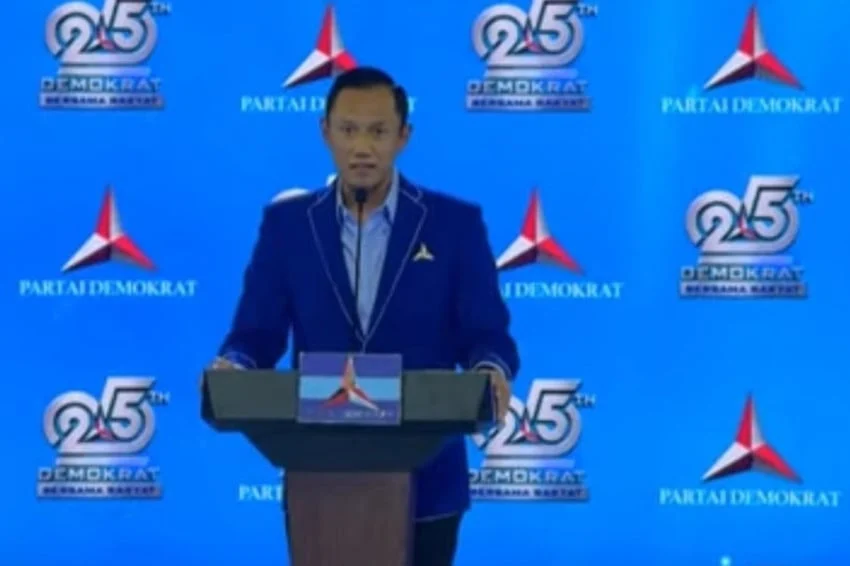
JAKARTA — In a poignant address that underscored the importance of national cohesion over political division, Democratic Party Chairman Agus Harimurti Yudhoyono delivered a landmark speech during the grand celebration of the party’s silver jubilee. The high-profile event, held on Wednesday, September 9, 2026, at the Indonesia Arena in Central Jakarta, brought together key political figures from across the national spectrum, culminating in a powerful message about the resilience of Indonesian democracy.
Amid a vibrant sea of supporters and distinguished guests, including President Prabowo Subianto, Yudhoyono focused his remarks on the myriad colors representing Indonesia’s diverse political parties. However, he forcefully reminded the audience and the nation’s political elite that only one color palette truly matters when the interests of the sovereign state are at stake: the red and white of the Indonesian national flag. The event served not only as a commemoration of the Democratic Party’s founding quarter-century ago but also as a critical platform for discussing the future trajectory of Indonesian politics, democratic maturity, and post-election reconciliation.
Main Facts and Highlights of the Silver Jubilee
The celebration of the Democratic Party’s 25th anniversary was marked by significant displays of political camaraderie and strategic messaging. The gathering at the Indonesia Arena drew thousands of party loyalists, cabinet ministers, lawmakers, and leaders from various political factions represented in the national parliament.
Central to the proceedings was the address by Agus Harimurti Yudhoyono—commonly known as AHY—who currently serves in a prominent national leadership role. His speech pivoted heavily on the theme of inclusivity and the mechanics of a healthy, functioning democracy. AHY noted that while political pluralism is a natural and healthy manifestation of a democratic republic, party affiliations must never supersede the foundational imperative of national development and unity.
President Prabowo Subianto’s attendance added substantial weight to the event. The presence of the head of state signaled a continuation of cross-party dialogue and mutual respect among political heavyweights who have navigated fierce electoral competition in past cycles. The anniversary event thus transcended a standard partisan celebration, transforming into a symbolic forum for national solidarity.
Chronology of the Democratic Party: A 25-Year Political Journey
To understand the weight of the Democratic Party’s silver jubilee, it is essential to examine the historical trajectory of the organization, which has played a pivotal role in shaping modern Indonesian governance.
Founded in September 2001, the Democratic Party emerged during the reformasi era as a vehicle centered on nationalism, pluralism, and democratic reform. The party achieved its most significant historical milestone when its founder, Susilo Bambang Yudhoyono (SBY)—AHY’s father—won the historic 2004 presidential election, becoming Indonesia’s first directly elected president. SBY subsequently secured a second term in 2009, cementing the party’s status as a dominant force in national politics throughout the 2000s.
Following the conclusion of SBY’s second presidential term in 2014, the Democratic Party entered an era of opposition, navigating the shifting dynamics of Indonesian politics under successive administrations. During this period, the party focused on grassroots consolidation, policy critique, and generational leadership renewal. The transition of leadership to Agus Harimurti Yudhoyono marked a generational shift, positioning younger leaders at the helm of a party with deep historical roots.
By 2026, marking its 25th anniversary, the party found itself integrated into the broader coalition supporting President Prabowo Subianto’s administration. This positioning allowed AHY to reflect on the party’s long journey—from an upstart political movement to a ruling party, to a constructive opposition, and finally to a core partner in governance.
Political Pluralism and the Metaphor of Colors
A central element of AHY’s address in Jakarta was his poetic yet pragmatic reflection on the diverse political landscape of contemporary Indonesia. Acknowledging the kaleidoscope of partisan identities, he noted the distinct visual markers of the nation’s democratic ecosystem.
"Of course, we each have our own colors," AHY stated to the assembled crowd and dignitaries. "There is the color red, there is the color green, there is the color yellow, there is also blue, orange, white, and even different shades of blue, both light and dark."
This colorful mosaic represents the ideological, regional, and demographic diversity of the world’s third-largest democracy. Indonesia’s multi-party system has historically fostered intense competition, leading to polarization during high-stakes electoral cycles such as the presidential and legislative elections. However, AHY pivoted from this diversity to emphasize a unifying ethos, asserting that despite the distinct banners under which politicians campaign, the ultimate loyalty of every public servant and political actor must remain tethered to the red and white of the Indonesian flag.
Furthermore, AHY highlighted President Prabowo Subianto’s unique aptitude for bridging ideological and partisan divides, praising his leadership style in bringing disparate political factions into a collaborative framework for governance.
Broader Context: Praise for Constructive Opposition and Democratic Maturity
The anniversary event also brought to light broader narratives regarding democratic norms in Indonesia. Prior to AHY’s address, interactions and complementary statements between state leadership and opposition figures underscored a growing political maturity within the country. Notably, historical commentary surrounding SBY’s tenure—particularly regarding how the Democratic Party conducted itself when outside the formal ruling coalition—received public acclaim. Observers and leaders noted that during periods when the party was not in power, it refrained from destructive rhetoric or malicious attacks, setting a constructive precedent for parliamentary opposition.
This historical context directly informed AHY’s remarks on the true meaning of democracy. He argued forcefully that maintaining a democratic society extends far beyond the mechanics of casting ballots every five years.
"Democracy is also about how we respect differences, maintain brotherhood, and continue to move forward. I repeat, remaining capable of working together after the competition has ended," AHY emphasized.
This sentiment resonates deeply within the current political climate, where post-election reconciliation has become a cornerstone of national stability. By emphasizing that electoral competition is a temporary phase followed by a permanent obligation to national development, the Democratic Party sought to position itself as an advocate for institutional stability and national harmony.
Supporting Data and Political Implications
The 25th-anniversary celebration of the Democratic Party carries several critical implications for the future of Indonesian politics:
- Coalition Dynamics: As political parties begin positioning themselves well in advance of future electoral cycles, messaging that prioritizes national unity over hyper-partisanship helps stabilize governing coalitions. AHY’s public alignment with the overarching goals of the Prabowo administration signals continued inter-party cooperation.
- Generational Transition: Under AHY’s leadership, the Democratic Party has actively courted younger demographic cohorts—millennials and Generation Z—who constitute a vast majority of Indonesia’s electorate. The emphasis on forward-looking, collaborative politics is strategically designed to appeal to voters weary of toxic polarization.
- Institutional Resilience: By framing democracy as a continuous practice of mutual respect and post-competition cooperation, the party reinforces the legitimacy of democratic institutions against the backdrop of global democratic backsliding.
Official Responses and Reactions
While AHY’s speech was the focal point of the evening, reactions from across the political spectrum highlighted broad agreement on the necessity of national unity. Analysts and representatives from various political parties noted that the presence of high-ranking officials from competing political backgrounds at the Indonesia Arena signaled a maturing political culture.
Political analysts observed that the silver jubilee served as a platform for the Democratic Party to reaffirm its ideological center—balancing nationalist credentials with democratic reformism. By publicly validating President Prabowo’s leadership in managing a complex multi-party cabinet, AHY reinforced the narrative that executive stability relies heavily on inclusive governance.
Conclusion
The 25th anniversary of the Democratic Party of Indonesia will be remembered as more than a milestone for a single political organization. Through Agus Harimurti Yudhoyono’s address, the event provided a reflective and forward-looking assessment of Indonesia’s democratic journey. By acknowledging the rich, multicolored tapestry of the nation’s political parties while anchoring loyalty firmly to the red and white of the republic, the leadership of the Democratic Party underscored a timeless political truth: that the ultimate measure of democratic success is the ability of diverse factions to lay down their partisan banners in service of the greater national good.