The maritime industry and the Indonesian public were struck by tragedy on Sunday, September 13, 2026, when the Kapal Motor (KM) Virgo Transport 8 lost contact and subsequently sank in the waters of the Java Sea. In the immediate aftermath of the incident, the Jasa Raharja Group—a state-owned entity responsible for social insurance—mobilized its emergency response teams to the Trisakti Port in Banjarmasin. The disaster, which has left a significant number of passengers missing and confirmed several fatalities, has prompted an integrated, multi-agency humanitarian and administrative response aimed at providing swift assistance to the victims and their families.
Chronology of the Disaster
The tragedy began in the early hours of Sunday, September 13, 2026. While the exact cause of the vessel’s distress remains under investigation by the National Transportation Safety Committee (KNKT), initial reports indicate that the ship encountered severe weather conditions and mechanical complications before losing contact with maritime authorities.
As of the latest reports from the field, the scale of the disaster is significant. Official data confirms that 113 individuals have been successfully evacuated by search and rescue (SAR) teams. Tragically, six passengers have been confirmed deceased, while 130 individuals remain missing. The search and rescue operation is currently in a critical phase, with teams from the National Search and Rescue Agency (BASARNAS), the Indonesian Navy, and the Water Police working in tandem to locate survivors amidst challenging sea conditions.
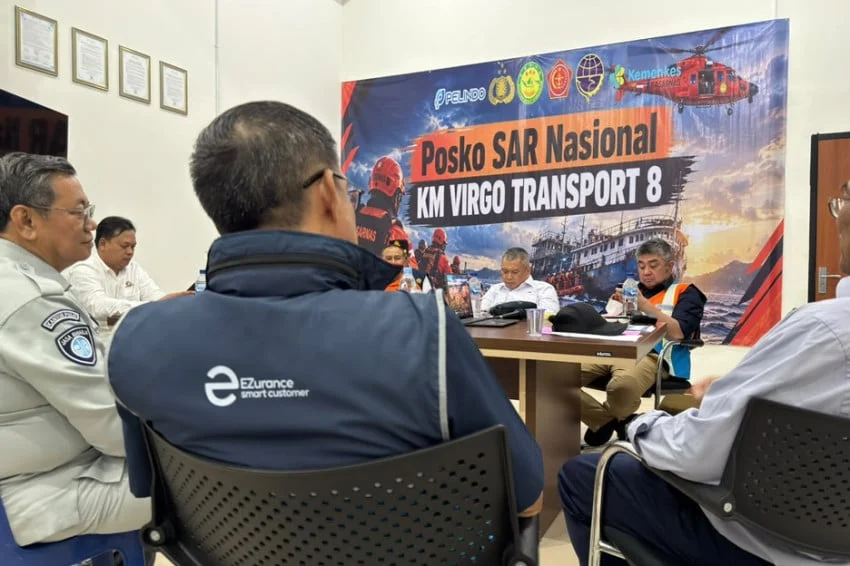
Leadership Presence at the Crisis Command Post
In a demonstration of the government’s commitment to victim support, top-level management from Jasa Raharja and its subsidiaries arrived at the Trisakti Port to personally oversee the coordination of the response. The delegation included the President Director of PT Jasa Raharja (Persero), Muhammad Awaluddin; the Director of Operations, Ariyandi; and the Technical Director of PT Asuransi Jasaraharja Putera, Suhardiman.
The primary objective of this high-level visit was to ensure that the process of identification, verification, and the distribution of financial aid is executed with maximum efficiency. By establishing a direct presence at the Command Post, the leadership aimed to remove administrative bottlenecks, ensuring that the families of the victims receive the necessary support without delay.
Minister of Transportation, Dudy Purwagandhi, also conducted an on-site inspection of the evacuation efforts at the Port of Trisakti. His presence underscores the national significance of the incident and the government’s determination to hold a thorough investigation into the vessel’s safety protocols and operational status at the time of the departure.
Integrated Insurance and Compensation Framework
The response to the KM Virgo Transport 8 incident is characterized by an integrated approach, utilizing both the statutory protection mandated by Indonesian law and the supplementary coverage provided by the private subsidiary arm of the Jasa Raharja Group.
Under the framework established by Law No. 33 of 1964 regarding Passenger Accident Insurance, PT Jasa Raharja is mandated to provide compensation to the victims of public transportation accidents. For those who lost their lives in the disaster, the company has committed to providing a death benefit of IDR 50 million to the legitimate heirs of each victim.
Beyond the statutory requirement, the involvement of PT Asuransi Jasaraharja Putera adds an extra layer of financial security. This subsidiary provides supplementary protection for passengers, crew members, and, in some cases, the cargo or vehicles carried by the vessel. This multi-tiered system is designed to provide immediate liquidity to families who are often faced with sudden financial hardship following the loss of a breadwinner or family member.
The Role of Data and Coordination
The effectiveness of the Jasa Raharja response relies heavily on the accuracy of the manifest and the speed of data verification. During the crisis, the command post at Trisakti Port has served as a central hub for data integration between the shipping line, the hospital authorities, and the police forensic units.
"In a situation as grave as this, our primary focus is to ensure that the victims and their families are treated with dignity and that the administrative process serves them rather than adding to their burden," stated Muhammad Awaluddin during the site visit. He noted that the company is maintaining real-time communication with SAR teams and local law enforcement to update the status of the victims. This coordination is vital to prevent misinformation and to ensure that the insurance claim process is initiated as soon as identities are confirmed.
Broader Implications for Maritime Safety
The sinking of the KM Virgo Transport 8 has reignited a broader national discourse on maritime safety in Indonesia. As an archipelago nation, Indonesia is heavily reliant on maritime logistics and ferry transport, making the safety of these vessels a matter of national security and economic stability.
Experts suggest that the incident highlights three major areas of concern that require urgent attention:
- Vessel Maintenance and Age: The age of the national fleet and the rigorousness of periodic maintenance checks are often debated following such tragedies. Investigators will likely examine the maintenance logs of KM Virgo Transport 8 to determine if structural fatigue played a role in the vessel’s failure.
- Weather Forecasting and Early Warning Systems: The incident occurred during the early hours, suggesting that visibility and sea state monitoring could be factors. The integration of real-time meteorological data into the vessel’s navigation system is critical for preventing future accidents.
- Standardization of Manifesting: Discrepancies in passenger manifests have historically hindered rescue and compensation efforts. The push for digital manifest systems is expected to accelerate in the wake of this disaster to ensure that authorities know exactly how many people are on board at any given time.
The Human Cost and Community Impact
Beyond the statistics of 113 saved, six dead, and 130 missing, the incident represents a profound psychological and social impact on the community of Banjarmasin and the families of the victims scattered across the region. The tragedy has triggered a massive outpouring of solidarity, with local volunteers, medical personnel, and non-governmental organizations assisting the authorities at the port.
The psychological support for the survivors and the families of the missing is an area that Jasa Raharja aims to address in collaboration with local health services. By providing clear channels for communication and ensuring that financial compensation is processed with empathy, the authorities hope to alleviate some of the trauma associated with the loss.
Looking Ahead: The Investigation Phase
As the rescue operations gradually transition into a recovery and investigation phase, the role of the Jasa Raharja Group will evolve from emergency support to long-term claim management. The company has pledged to remain on-site until all affected parties are identified and the necessary support has been delivered.
The findings of the KNKT investigation into the sinking of KM Virgo Transport 8 will be crucial. If the investigation reveals negligence, it could lead to stricter regulatory oversight for all operators in the Java Sea. For the Jasa Raharja Group, the event serves as a stress test for its operational capacity to respond to large-scale disasters in real-time.
In conclusion, the mobilization of Jasa Raharja Group management to the Trisakti Port reflects the critical importance of a coordinated state response in the wake of maritime disasters. While the financial assistance provided by the insurance funds cannot replace the lives lost, it represents a fundamental pillar of social protection that ensures affected families are not left entirely to their own devices in the wake of such an overwhelming tragedy. The eyes of the public remain fixed on the search and rescue efforts, hoping for a miracle for the 130 missing individuals, while the government faces the arduous task of preventing a recurrence of such a devastating event.