
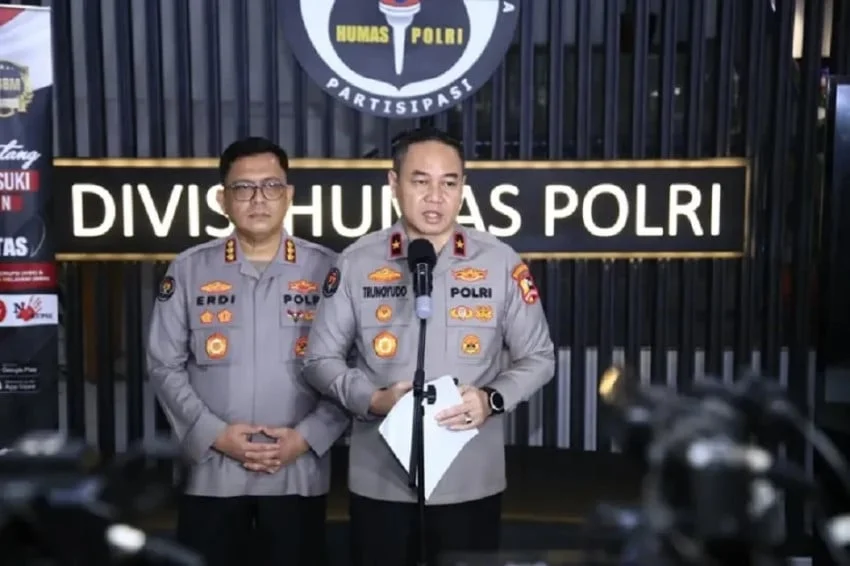
The Indonesian National Police (Polri) has officially confirmed that former high-ranking officials, including former National Police Chief General Listyo Sigit Prabowo and several associated high-ranking officers who have been designated as suspects in a massive illegal wiretapping scandal targeting President Prabowo Subianto, will soon face comprehensive internal code of ethics tribunals. This monumental development comes amidst a sweeping internal restructuring and accountability campaign within the nation’s primary law enforcement agency, as investigators continue to untangle a web of clandestine surveillance operations that allegedly targeted not only the sitting head of state but also a wide cross-section of influential national figures, including high-ranking government officials, prominent political leaders, mainstream media executives, mass organizations, non-governmental organizations, and key figures within the business community.
The confirmation regarding the impending disciplinary proceedings was formally delivered by the Head of the Public Information Bureau (Karo Penmas) of the Public Relations Division of Polri, Brigadier General Trunoyudo Wisnu Andiko, during a press briefing held in Jakarta. When questioned by members of the media regarding the administrative and professional accountability of the accused officers, Brigadier General Trunoyudo affirmed that the internal judicial process is actively being prepared. The code of ethics trials represent a critical parallel track to the ongoing criminal investigations being spearheaded by the Criminal Investigation Agency (Bareskrim Polri).
Despite confirming the inevitable trajectory toward internal tribunals, police leadership has maintained a cautious stance regarding precise timelines. Brigadier General Trunoyudo noted that investigators are still finalizing the dossier and focusing heavily on the ongoing expansion of the criminal investigation to uncover the full scope of the conspiracy, potential accomplices, and the ultimate destinations of the illegally harvested intelligence. Consequently, a definitive date for the commencement of the ethics hearings has not yet been announced to the public.
Background Context and the Expansion of the Criminal Probe
The genesis of this unprecedented scandal traces back to a series of coordinated cyber-investigations and internal whistleblowing reports that revealed systemic abuses of advanced telecommunications interception technology within elite operational units of the police force. Initially, public disclosures focused on localized breaches, but the investigation quickly escalated into a national security crisis when forensic examinations indicated that the communications infrastructure utilized by critical state actors had been compromised.
The Bareskrim Polri previously announced the formal designation of multiple high-profile suspects, prominently featuring General Listyo Sigit Prabowo, alongside Inspector General Eko Hadi Santoso and Inspector General Ahrie Sonta. These senior commanders have been implicated in a series of severe criminal violations, including unauthorized wiretapping directed against President Prabowo Subianto, the systematic destruction and deletion of crucial electronic data to obstruct justice, and unauthorized network intrusion or illegal access.
As the investigative net has widened, Bareskrim has continued to incorporate newly uncovered evidence into the judicial process. In his latest public statement, Brigadier General Trunoyudo referenced the recent inclusion of an additional suspect identified by the initials SU. This incremental expansion underscores the complex, multi-layered nature of the alleged wiretapping ring, which investigators believe operated with a significant degree of autonomy and technical sophistication.
Broader Implications and Public Reactions
The involvement of a former National Police Chief in a criminal conspiracy of this magnitude has sent shockwaves through Indonesia’s political and institutional landscape. Legal experts, civil society organizations, and political analysts have characterized the unfolding scandal as a defining moment for the administration of justice and institutional reform in the country.
Prominent figures have weighed in heavily on the systemic ramifications of the case. Notably, former Coordinating Minister for Political, Legal, and Security Affairs Mahfud MD publicly described the scandal as a golden momentum for the current leadership of the National Police—specifically referencing Chief of Police General Suyudi—to decisively cleanse the institution of lingering factions, unauthorized intelligence networks, and elements associated with previous power structures. Mahfud emphasized that restoring public trust in the police force requires absolute transparency, unyielding accountability, and the complete dismantling of rogue intelligence apparatuses operating outside the bounds of constitutional oversight.
The alleged scope of the wiretapping operation has also raised profound concerns regarding democratic resilience, privacy rights, and the protection of civil liberties in Indonesia. By targeting not only the executive branch but also independent pillars of democracy such as the press, civil society groups, and the business sector, the perpetrators appear to have sought comprehensive intelligence dominance over key decision-makers across civil and political society. Observers note that the thorough prosecution and administrative disciplining of all involved parties are vital to reassuring the public that state institutions cannot be weaponized for private or partisan intelligence-gathering endeavors.
Chronology of Key Developments
The unfolding chronology of the investigation highlights the rapid acceleration of law enforcement actions following the initial discovery of the security breaches:
- Initial Discovery and Forensic Audit: Cybersecurity units and internal oversight divisions detect anomalies in communication security protocols, uncovering unauthorized data interception streams directed at high-level state targets.
- Formal Criminal Investigation Initiated: Bareskrim Polri opens a formal dossier into allegations of illegal wiretapping, data destruction, and unauthorized system access.
- High-Profile Suspect Designations: Investigators officially name General Listyo Sigit Prabowo, Inspector General Eko Hadi Santoso, and Inspector General Ahrie Sonta as primary suspects in the criminal conspiracy.
- Broadening Scope and New Arrests: Further forensic analysis reveals the wider reach of the surveillance network, prompting the addition of new suspects, including an individual identified as SU, as announced by police spokespersons.
- Confirmation of Ethics Proceedings: Polri leadership confirms that the accused officers will face internal code of ethics tribunals to determine their professional futures within the police organization, running concurrently with the ongoing criminal prosecution.
Next Steps in the Judicial and Administrative Process
As the case moves forward, legal analysts anticipate that the criminal dossiers for the primary suspects will soon be transferred to the Attorney General’s Office (AGO) for formal indictment and subsequent trial in a public court of law. Concurrently, the Police Internal Affairs Division (Propam) is expected to finalize the preparation for the ethics commission hearings, which hold the authority to recommend dishonorable discharges (PTDH) for the accused generals and officers.
The outcome of these dual proceedings will serve as a critical benchmark for the rule of law in Indonesia, demonstrating whether institutional mechanisms are robust enough to hold even the highest-ranking law enforcement officials fully accountable under the constitution. Polri has reiterated its commitment to transparency throughout the remainder of the investigation, promising further updates as the legal and administrative processes reach subsequent milestones.
