
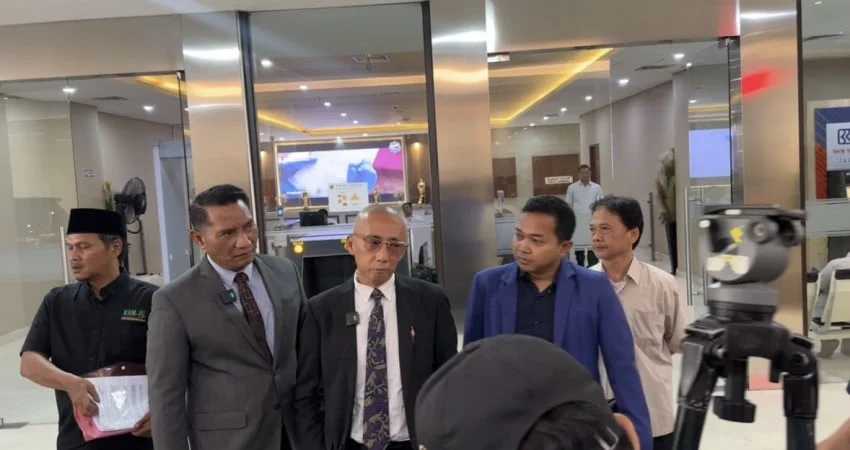
The legal and political controversy surrounding former Indonesian Vice President Gibran Rakabuming Raka escalated significantly as representatives of the North Jakarta Community Committee (KOMJU) officially arrived at the Indonesian National Police’s Criminal Investigation Agency (Bareskrim) Headquarters in Jakarta. Accompanied by their legal counsel, the delegation submitted a fresh tranche of evidentiary material intended to bolster an ongoing investigation into an alleged scandal involving educational equivalency certificates, commonly known as a surat keterangan (suket).
The visit marks a critical juncture in a legal battle that began earlier in the month, shedding light on deeper allegations of institutional malpractice, abuse of authority, and coordinated conspiracy. As public scrutiny intensifies, legal experts and political observers alike are closely monitoring the developments, which threaten to cast a long shadow over the administrative processes governing educational credentials for high-ranking public officials in Indonesia.
Expanding the Investigation: Fresh Evidence Presented to Bareskrim
Carrying heavy files containing what they described as "conclusive documentation," the KOMJU legal team, led by attorney Panca Nainggolan, entered the Bareskrim building to meet directly with senior police leadership. The primary objective of the delegation was twofold: to participate in a formal audience with the Head of Bareskrim Polri and to formally append new evidence to the initial police report filed weeks prior.
According to the legal representatives, the newly submitted materials aim to bridge critical gaps in the timeline of the alleged administrative wrongdoing. These documents purportedly illustrate not merely an isolated bureaucratic error, but a systematic effort involving multiple actors spanning both the issuing institutions and the ultimate beneficiaries of the credential.
Speaking to members of the press prior to entering the high-security complex, Panca Nainggolan articulated the core grievance of the complainant group. He emphasized that the unfolding sequence of events points toward coordinated criminal activity rather than a simple clerical oversight.
"The series of legal events leads our colleagues at KOMJU to believe that these allegations point directly toward specific criminal offenses," Panca told journalists. "In this scenario, there are users, issuers, and—at the time the equivalency certificate was issued—strong indications of abuse of authority and an underlying conspiracy."
The legal framework being invoked by the plaintiffs is notably comprehensive. The legal team has structured their reporting around multi-layered statutory provisions, specifically citing Article 391 paragraph (2) of the Indonesian Criminal Code (KUHP) concerning the unlawful use of documents. This charge has been conjunctively applied with Article 20, which addresses complicity and joint participation in criminal acts, alongside Article 13, which speaks directly to the element of conspiracy. By deploying these multifaceted legal instruments, the complainants are attempting to hold accountable every node in the administrative chain, from the individuals who drafted and authorized the paperwork to those who ultimately weaponized or presented the credential for official purposes.
Chronology of the Controversy: A Timeline of Events
To understand the weight of the current proceedings at Bareskrim, it is essential to examine the chronological progression of the case. The trajectory of the controversy spans multiple months, transitioning from whispered administrative irregularities in political circles to formal criminal allegations handled by national law enforcement agencies.
The timeline of key developments includes:
- Early to Mid-2024: Initial public discussions and social media queries begin to circulate regarding the specifics of Gibran Rakabuming Raka’s educational background and the formal equivalency processes required for international or non-standard degrees under Indonesian regulatory frameworks.
- Late October 2026: Civil society organizations, spearheaded by regional watchdogs including KOMJU, begin compiling public records, institutional correspondence, and academic accreditation data to investigate potential procedural deviations in the issuance of the educational equivalency letter.
- November 6, 2026: KOMJU formally registers its initial complaint with the National Police, alleging forgery, administrative fraud, and conspiracy regarding the suket associated with Gibran Rakabuming Raka.
- Mid-November 2026: Investigative teams within the civil society coalition gather secondary witness testimonies and cross-reference bureaucratic archives to substantiate claims of unauthorized expedited processing and irregular ministerial sign-offs.
- November 23, 2026: The KOMJU legal team returns to the Bareskrim Polri headquarters in Jakarta for a scheduled 10:00 AM WIB audience, presenting substantial supplementary evidence and invoking multi-layered criminal statutes under the KUHP.
This structured timeline highlights the deliberate, methodical approach taken by the complainants. Rather than relying solely on rhetorical political opposition, the coalition has sought to ground its grievances in formal legal mechanisms, forcing law enforcement agencies to evaluate the documentary trail surrounding the controversial credentials.
Contextual Background: The Regulatory Framework of Educational Equivalency
At the heart of the Bareskrim investigation lies a complex bureaucratic procedure: the issuance of educational equivalency certificates for qualifications obtained outside the conventional domestic school system or through foreign institutions. In Indonesia, the Ministry of Education, Culture, Research, and Technology (and its predecessor bodies) maintains strict regulatory guidelines for determining whether a foreign or non-standard diploma meets national standards.
The process typically requires rigorous verification of coursework, institutional accreditation, credit hours, and thesis or examination requirements. When an individual seeks high-level public office, these credentials undergo intense public scrutiny. Allegations that an equivalency certificate was granted outside normal operational parameters—or through the intervention of powerful political patrons—touch upon the foundational integrity of the civil service and educational administration.
Critics and civic watchdogs argue that any compromise in the integrity of educational verification undermines meritocratic principles within the Indonesian governance structure. If public officials are permitted to bypass standard verification protocols through bureaucratic shortcuts or direct political influence, the credibility of the entire administrative apparatus is diminished. Conversely, defenders of targeted officials frequently dismiss such accusations as politically motivated "lawfare"—the weaponization of the legal system to discredit political adversaries through protracted investigations and negative media cycles.
Legal and Political Implications
The decision by Bareskrim Polri to receive and review the supplemental evidence submitted by KOMJU carries significant implications for both the legal and political landscapes of Indonesia. While the filing of a police report and the submission of evidence do not equate to a formal indictment or a judicial finding of guilt, they place immense institutional pressure on law enforcement agencies to conduct a transparent, thorough, and impartial inquiry.
From a legal perspective, the invocation of conspiracy and abuse of authority charges under the Criminal Code broadens the scope of the investigation far beyond a simple paperwork dispute. If investigators find credible evidence supporting the plaintiffs’ claims, the inquiry could expand to include mid-level and high-level bureaucrats within the relevant ministries responsible for issuing educational certifications. This creates a delicate dilemma for law enforcement: balancing the imperative to investigate high-profile allegations without appearing to succumb to partisan political pressure.
Politically, the timing of the investigation coincides with a period of broader national transitions and institutional realignments. As the nation adjusts to shifting political alliances and administrative priorities following recent electoral cycles, any legal challenge involving prominent figures from previous executive configurations attracts intense media coverage. The controversy serves as a reminder of the persistent tensions between civil society oversight bodies and state institutions regarding accountability, transparency, and the rule of law.
Furthermore, the case sets a potential precedent for how educational credentials of high-ranking state officials are scrutinized in the future. Should the investigation yield formal charges or lead to institutional reforms in how equivalency certificates are audited, it could permanently alter the bureaucratic safeguards protecting public offices from credential fraud.
Next Steps in the Bareskrim Inquiry
Following the submission of the new evidentiary files on November 23, 2026, the ball is now firmly in the court of the national police investigators. Standard operational procedures dictate that Bareskrim will analyze the newly introduced documents, cross-reference them with prior submissions, and determine whether sufficient preliminary evidence exists to elevate the status of the case from a preliminary investigation (penyelidikan) to a full-scale criminal investigation (penyidikan).
Legal analysts note that investigators will likely summon additional witnesses, including administrative officials who were serving in relevant government departments during the period when the suket was processed. Expert testimony from educational accreditation specialists and forensic document examiners may also be required to ascertain whether the procedural anomalies cited by KOMJU violate statutory regulations.
As the legal battle unfolds, public interest remains high. Both supporters and detractors of the figures involved are watching closely to see whether the judiciary and law enforcement can maintain absolute neutrality in handling a case with such profound political and administrative undertones. For now, KOMJU and its legal team have signaled their intent to see the process through to its conclusion, demanding full transparency and strict adherence to the rule of law as Bareskrim evaluates the merits of their explosive allegations.
