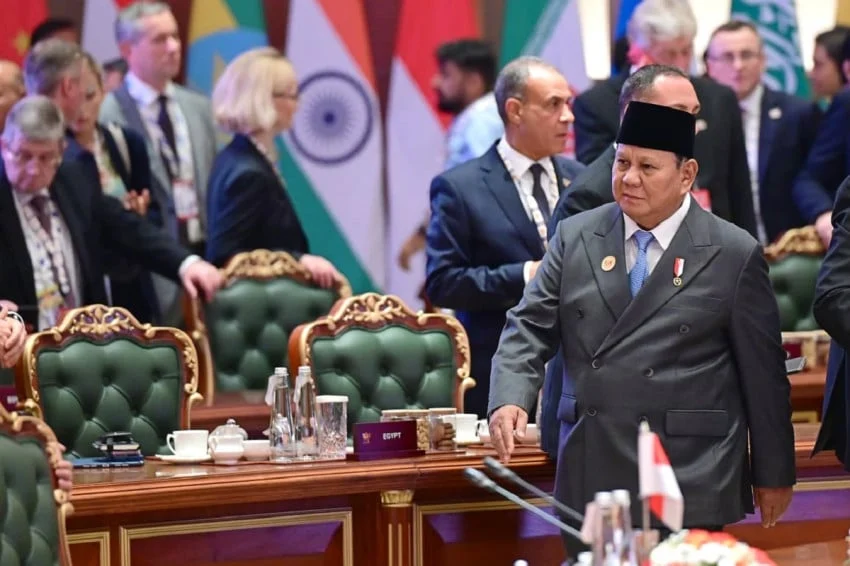
NEW DELHI — Indonesian President Prabowo Subianto delivered a compelling call for national self-reliance and inclusive international cooperation during a restricted session of the 18th BRICS Summit held in New Delhi, India. Addressing world leaders and international delegates under the thematic umbrella of Inclusive Global Governance and Strengthening Multilateralism, the Indonesian leader articulated a foreign policy vision rooted in domestic strength, food security, and strategic autonomy.
The high-level diplomatic gathering, hosted in the Indian capital, serves as a pivotal forum for emerging economies to deliberate on reshaping global governance architectures. President Prabowo’s participation underscores Indonesia’s active diplomatic posture on the international stage, balancing robust engagement with multilateral blocs while fiercely guarding its traditional principle of non-alignment.
Core Pillars of National Resilience
Speaking directly to his counterparts within the BRICS alliance—which comprises Brazil, Russia, India, China, and South Africa, alongside newly inducted members—Prabowo stressed that true international sovereignty originates from internal stability and the capacity to meet fundamental societal needs. He argued that collective strength among developing nations is ultimately derivative of the welfare and security of their respective citizenries.
"With us standing together, we also become stronger. Strength always begins from within, with our people, through our ability to provide for their food needs, guarantee the energy supplies they require, educate our children, and afford them the opportunity to live prosperous lives. That is how we build a resilient nation that is truly independent," President Prabowo stated during the session.
The Indonesian head of state elaborated that foundational domestic capabilities—encompassing stable food supply chains, reliable energy grids, accessible and high-quality education, and equitable economic mobility—form the bedrock upon which sustainable national security is built. Without these baseline achievements, nations remain vulnerable to external shocks, market volatilities, and geopolitical coercion.
Strategic Autonomy and Multilateral Engagement
Expanding on the theme of multilateralism, President Prabowo underscored that national resilience is the primary prerequisite for independent policymaking. In an increasingly polarized global environment marked by trade fragmentation and supply chain weaponization, Indonesia continues to champion an independent and active foreign policy (politik luar negeri bebas aktif).
Prabowo reiterated that Indonesia desires collaborative partnerships with all global powers but firmly rejects any form of dependency, hegemony, or undue external pressure. By fortifying national foundations from within, Jakarta aims to project confidence and stability, contributing constructively to regional and global peace without compromising its sovereign decision-making processes.
This messaging aligns closely with Indonesia’s broader developmental trajectory, particularly the ongoing national initiatives centered on downstreaming natural resources, achieving food self-sufficiency through expansive agricultural modernization, and transitioning toward renewable energy independence. By sharing these domestic imperatives at a major emerging-market summit, Indonesia positioned its national development agenda as a blueprint for collective resilience among developing nations.
Chronology and Diplomatic Engagement in New Delhi
President Prabowo’s appearance at the 18th BRICS Summit was the centerpiece of a tightly orchestrated diplomatic itinerary in India.
Upon his arrival at the summit venue in New Delhi, President Prabowo was formally welcomed by Indian Prime Minister Narendra Modi. The high-profile reception highlighted the robust bilateral ties between Jakarta and New Delhi, both of which play critical leadership roles in the Global South. The leaders exchanged pleasantries before proceeding to the restricted plenary sessions, where pressing global challenges—including reform of the international financial architecture, sustainable development, and geopolitical stability—took center stage.
The summit itself marks a crucial milestone in the evolution of BRICS. Following its historic expansion that brought in several major Middle Eastern and African economies, the bloc has increasingly positioned itself as a counterweight to Western-dominated multilateral institutions, advocating for a more multipolar world order. While Indonesia has historically maintained a cautious stance regarding formal membership in various economic blocs to preserve its strategic flexibility, Jakarta’s sustained participation in BRICS dialogues reflects its pragmatic commitment to engaging with all major economic coalitions that influence global trade and governance.
Background and Context of BRICS Expansion
The 18th BRICS Summit arrives at a tumultuous time for international relations. Established originally as an informal grouping of emerging market economies—Brazil, Russia, India, and China, with South Africa joining later—the bloc has evolved into a substantive geopolitical and economic platform. Collectively, the expanded BRICS nations represent a massive share of the global population, territory, and gross domestic product, giving them substantial leverage in discussions surrounding international trade reform, climate finance, and global security.
For Indonesia, engaging with BRICS offers multiple strategic advantages. As Southeast Asia’s largest economy and one of the world’s fastest-growing emerging markets, Indonesia shares many developmental priorities with BRICS members, particularly concerning the reform of Bretton Woods institutions such as the International Monetary Fund (IMF) and the World Bank. Developing nations have long criticized these legacy institutions for failing to provide adequate voice and representation to the Global South.
At the same time, Indonesia has carefully navigated its participation to ensure it does not become entangled in great power rivalries, particularly the ongoing strategic competition between the United States and China. By emphasizing "inclusive global governance," President Prabowo’s administration signals that Indonesia favors cooperative multilateralism that bridges divides rather than deepens them.
Expert Analysis: Implications for Indonesia’s Foreign Economic Policy
Foreign policy analysts and economic observers have noted that President Prabowo’s address in New Delhi signals continuity with Indonesia’s traditional diplomatic doctrines while adapting them to 21st-century economic realities.
By tying international standing directly to domestic self-sufficiency, Prabowo is operationalizing a neo-mercantilist approach to national development—one where domestic industrialization, food estates, and energy transition programs are viewed not merely as domestic policy goals, but as matters of supreme national security and foreign policy leverage.
Furthermore, analysts suggest that Indonesia’s active engagement with BRICS platforms provides Jakarta with valuable leverage in global trade negotiations. As protectionist sentiments rise in Western economies and traditional supply chains undergo rapid restructuring ("friend-shoring" and "near-shoring"), emerging economies are increasingly looking to diversify their economic partnerships. Participation in forums like BRICS allows Indonesia to advocate for fair trade terms, equitable technology transfers, and resilient financial networks that protect developing economies from sudden currency fluctuations and external debt distress.
However, challenges remain. Balancing relations between traditional Western partners and major emerging powers requires delicate diplomatic navigation. Indonesia’s insistence on strategic autonomy means that while Jakarta will cooperate extensively with BRICS members on trade, investment, and governance reform, it will continue to resist formal alignment that could restrict its diplomatic maneuvering room.
Conclusion and Future Outlook
As the 18th BRICS Summit concludes in New Delhi, President Prabowo Subianto’s intervention leaves a clear imprint on the discourse surrounding the future of global governance. By centering the conversation on domestic resilience, food and energy security, and genuine independence, Indonesia has forcefully reminded the international community that sustainable multilateralism must be built upon the solid foundation of sovereign, self-reliant nation-states.
Moving forward, Jakarta is expected to continue utilizing high-level multilateral platforms to advocate for the interests of the Global South, pushing for systemic reforms in international finance and trade while steadily implementing its domestic roadmap for economic independence and sustainable prosperity.