
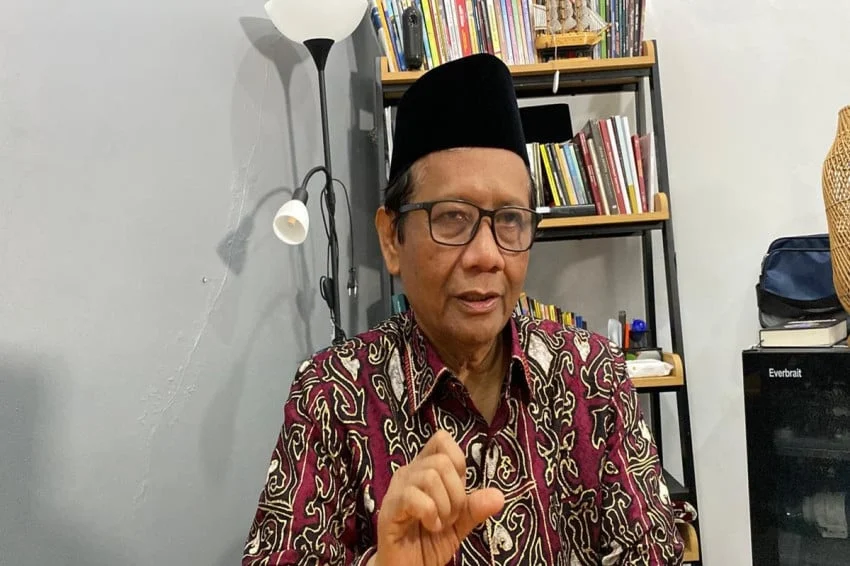
The legal and political landscape surrounding the 2024 Indonesian Presidential Election has encountered a significant development following a definitive ruling by the Supreme Court of Indonesia regarding the educational credentials of Vice President Gibran Rakabuming Raka. Former Coordinating Minister for Political, Legal, and Security Affairs, Mahfud MD, has publicly addressed the decision made by the Supreme Court (Mahkamah Agung – MA), which granted a cassation appeal declaring the high school diploma equivalence certificate (surat keterangan penyetaraan ijazah) of the Vice President to be legally invalid.
The judicial decision, recorded under case number 742 K/TUN/2026, concerns the documentation utilized by Gibran Rakabuming Raka to fulfill the mandatory administrative candidacy requirements stipulated by the General Elections Commission (Komisi Pemilihan Umum – KPU) ahead of the 2024 national polls. According to the Supreme Court ruling, the administrative document used to substantiate his secondary education equivalence is deemed invalid. This verdict has immediately triggered widespread discussions across legal, academic, and political spheres, raising critical questions regarding administrative compliance, executive legitimacy, and the boundaries of accountability between the judiciary and the legislature.
Judicial Context and the Core of the Supreme Court Ruling
The legal challenge originated from a series of administrative disputes initiated by citizen plaintiffs and concerned groups questioning the authenticity and procedural validity of the educational equivalence certificates issued to public officials. In this specific case, the plaintiff, HM Subhan, received notification of the Supreme Court’s decision through the court’s electronic litigation system. While the complete, unabridged written copy of the verdict has not yet been formally published on the official directory of the Supreme Court, the core legal finding has been confirmed: the cassation appeal was granted, effectively overturning previous administrative decisions that had favored or sustained the validity of the equivalence document.
Under Indonesian electoral law, candidates running for the offices of President and Vice President must satisfy strict educational prerequisites, typically requiring completion of senior high school (SMA) or an equivalent institution officially recognized by the Ministry of Education, Culture, Research, and Technology. For candidates who completed secondary education overseas—a factor central to the background discussions surrounding Gibran’s early educational trajectory—obtaining an official equalization certificate from the authorized directorate is a mandatory statutory step to validate foreign academic credentials against national standards.
The crux of the Supreme Court’s finding centers on whether the issuance of the equivalence certificate complied with established administrative procedures and statutory regulations. With the high court ruling in favor of the cassation, the legal presumption of validity previously attached to the document has been legally pierced, setting off a cascading series of interpretations regarding its administrative and constitutional consequences.
Mahfud MD’s Perspective: Between Political Discretion and Criminal Investigation
Reacting to the developments through his verified social media account on the platform X on Friday, October 30, 2026, Mahfud MD provided a nuanced breakdown of how the situation should be handled, separating the political domain from potential criminal accountability.
"The follow-up regarding his position as Vice President is entirely up to politics; whichever path they choose to take," Mahfud stated, highlighting that the ultimate remediation or response to the executive’s status rests with political institutions, specifically political parties represented within the House of Representatives (Dewan Perwakilan Rakyat – DPR). In Indonesia’s presidential system, impeachment or political accountability mechanisms involving the executive branch inherently intersect with legislative oversight and party politics, requiring a deliberative consensus among political elites.
However, Mahfud emphasized that the resolution of the matter should not be confined exclusively to political negotiations. He explicitly called for formal criminal investigations into the administrative processes that led to the creation of the equivalence certificate and what he termed the alleged smuggling or irregular insertion of specific regulatory provisions. Specifically, Mahfud pointed toward Article 18, paragraph (3) of KPU Regulation (PKPU) Number 19 of 2023, which governs the nomination procedures for presidential and vice-presidential candidates.
"The KPU and the Directorate of Primary and Secondary Education should be investigated immediately," Mahfud asserted, pointing to the administrative agencies responsible for drafting electoral regulations and verifying educational credentials. By suggesting that criminal law enforcement agencies scrutinize the institutional actions behind the documentation, the former minister signaled that the controversy extends far beyond a simple civil administrative dispute, potentially involving bureaucratic malpractice or regulatory manipulation.
Chronology of the Dispute and Background of the Educational Controversy
To fully comprehend the weight of the Supreme Court’s recent decision, it is necessary to examine the timeline of events leading up to the 2024 electoral cycle and the subsequent legal maneuvers:
- Pre-Electoral Registration (Late 2023): During the registration period for the 2024 presidential election, candidate pairs submitted their mandatory administrative files to the KPU. Questions arose regarding the foreign schooling background of Gibran Rakabuming Raka, prompting the submission of a high school diploma equivalence certificate issued by the relevant educational authorities.
- Electoral Validation (Late 2023 – Early 2024): The KPU reviewed and verified the submitted documents, declaring all candidate pairs eligible to contest the election under the prevailing PKPU guidelines, including PKPU No. 19/2023. Gibran subsequently participated in the election and was sworn into office alongside President Prabowo Subianto.
- Initiation of Administrative Litigation (2024–2025): Legal challenges were filed at the State Administrative Court (PTUN) by civil plaintiffs and legal watchdogs seeking to invalidate the administrative decisions regarding the equivalence certificate. These initial filings underwent various procedural phases, including temporary withdrawals, adjustments by legal teams, and subsequent refilings as plaintiffs sought to present comprehensive facts regarding educational programs pursued abroad, notably in Singapore.
- Appellate and Cassation Proceedings (2025–2026): After working its way through the judicial hierarchy, the case reached the Supreme Court via a cassation appeal. The legal teams for the plaintiffs maintained that procedural flaws marred the issuance of the certificate, while defenders of the documentation insisted that all educational verifications complied with standard administrative practices at the time of submission.
- The Supreme Court Ruling (October 2026): The Supreme Court issued its verdict under case number 742 K/TUN/2026, granting the cassation and declaring the equivalence certificate invalid, thereby creating a profound intersection between administrative law and executive governance.
Defense and Legal Counterarguments from the Executive’s Legal Team
Throughout the prolonged legal battle in the state administrative courts, legal representatives and defense teams associated with the respondents have consistently maintained the legitimacy of the Vice President’s educational background. In previous hearings and public disclosures, the legal team elaborated on the factual basis of Gibran’s education in Singapore, presenting transcripts, institutional records, and correspondence intended to prove that the academic milestones achieved abroad met the substantive criteria required for secondary school completion.
Proponents of the validity argument have consistently argued that administrative equivalence certificates are formal recognitions of substantive educational attainment. From this viewpoint, minor bureaucratic discrepancies or subsequent shifts in administrative interpretation should not retroactively invalidate credentials that were reviewed and accepted by competent electoral authorities prior to an election. They maintain that the legal challenges are politically motivated attempts to undermine the democratic mandate conferred by millions of voters during the 2024 presidential election.
Broader Implications and Future Outlook
The Supreme Court’s ruling on the invalidity of the equivalence certificate, coupled with Mahfud MD’s prominent intervention, introduces profound implications for Indonesian constitutional law, administrative jurisprudence, and electoral governance:
- Executive Stability and Political Calculus: While the judicial ruling invalidates an administrative prerequisite document, the removal or sanctioning of a sitting Vice President is an intricate constitutional process. As Mahfud noted, any direct action regarding executive office falls primarily into the political domain of the DPR and political coalition parties. This sets up a potential standoff between judicial findings of administrative illegality and political stability within the ruling coalition.
- Institutional Accountability of Election Organizers: The call for investigations into the KPU and the educational directorate places heavy pressure on oversight bodies. If regulatory provisions like PKPU No. 19/2023 are found to have been improperly drafted or manipulated to accommodate specific candidacies, public trust in the neutrality and professionalism of independent electoral administration could face severe erosion.
- Precedent for Administrative Law: This case establishes a powerful precedent regarding the judiciary’s willingness to review and invalidate administrative certificates utilized in high-stakes political contests long after the election has concluded. It signals that executive office does not inherently shield administrative preparatory documents from rigorous post-election judicial scrutiny.
As legal scholars await the publication of the complete written decision of the Supreme Court, national attention remains riveted on how political parties in Parliament, law enforcement agencies, and the executive branch will navigate the unprecedented legal reality created by the ruling.
