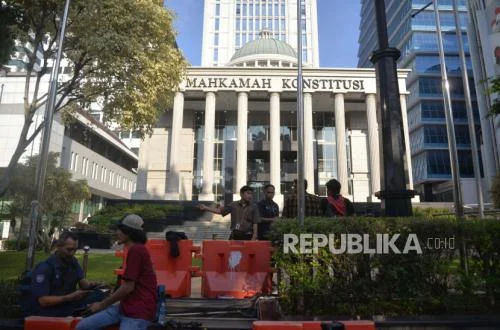
The hallowed halls of Indonesia’s Constitutional Court (MK), typically a bastion of judicial solemnity, were pierced by an unexpected outburst of emotion and accusation on Wednesday, May 29, 2024. This dramatic scene unfolded amidst the ongoing proceedings for the dispute over the results of the 2024 legislative elections (PHPU Pileg), underscoring the high stakes and deeply personal dimensions of electoral justice in the world’s third-largest democracy. The incident, involving family members of a key witness for the Democratic Party, cast a temporary shadow over the Court’s commitment to transparency and judicial independence, drawing attention to the delicate balance between legal process, political pressures, and individual rights.
The Unfolding Drama at the MK Building
The tranquility of the Constitutional Court’s Gedung I in Jakarta was abruptly shattered when family members of Sulaiman, a witness scheduled to testify for the Democratic Party in a legislative election dispute case, caused a commotion. The incident began shortly after Sulaiman was escorted into the building alongside a legal representative from the Democratic Party. Dressed entirely in black and with his face obscured by a mask, Sulaiman’s discreet entry soon became the focal point of a public spectacle.
Outside the secure perimeter, a man and a woman, later identified as Sulaiman’s siblings, began to shout, demanding immediate access to their relative. The woman, visibly distressed and clad in a yellow shirt with a black headscarf, cried out, "I am his sister! Do you understand? Everything is unfair! There is coercion!" Her impassioned accusations painted a stark picture of familial distress, alleging that Sulaiman was being held against his will or subjected to undue influence. Security personnel swiftly moved to prevent the woman and two other individuals from forcing their way into the building. Following the initial confrontation, an official from the Constitutional Court engaged the distraught family members, seeking to understand the reason behind their forceful demands to enter the premises. The sister explained that Sulaiman had been picked up from their home on Friday, May 24, 2024, and had been unreachable ever since. "There was no prior agreement," she stated, her voice heavy with concern. "He was taken from home, he said goodbye, and we haven’t heard from him until today." This account raised immediate questions about the circumstances surrounding Sulaiman’s involvement as a witness and the protocols for ensuring the welfare of individuals participating in high-profile legal proceedings.
Context of the 2024 Election Disputes: The MK’s Pivotal Role
The incident occurred during a period of intense activity for the Constitutional Court, which serves as the final arbiter for election disputes in Indonesia. The 2024 general elections, held on February 14, were a monumental undertaking, involving presidential, parliamentary, and regional legislative contests across the archipelago. The scale of the elections inevitably leads to numerous disputes, all of which converge at the MK.
The Court had already navigated the highly anticipated verdict for the presidential election dispute (PHPU Pilpres 2024) on April 22, 2024. That ruling, which confirmed the victory of President-elect Prabowo Subianto and Vice President-elect Gibran Rakabuming Raka, was a significant moment that tested the nation’s political stability. While the Sulaiman incident pertained to a legislative election dispute (PHPU Pileg), the overall atmosphere surrounding the Court remained one of heightened tension, public scrutiny, and immense pressure. The PHPU Pileg cases, though often less nationally prominent than the presidential disputes, are equally critical for the legitimacy of legislative bodies at national, provincial, and district levels. These cases typically involve political parties challenging the vote counts and seat allocations, alleging various forms of fraud, administrative errors, or other electoral violations.
The specific case in which Sulaiman was scheduled to testify was registered as PHPU Pileg 2024 Number 196-01-14-22/PHPU/DPR-DPRD-XXII/2024. In this proceeding, the Democratic Party stood as the petitioner, challenging the election results. The General Election Commission (KPU) was designated as the respondent, responsible for defending its conduct of the election. The National Mandate Party (PAN) was listed as a related party, indicating that the outcome of the dispute could directly affect their electoral gains or losses. The involvement of witnesses like Sulaiman is crucial in such cases, as their testimonies are expected to provide direct evidence or insights into alleged irregularities, helping the Court ascertain the facts and make an informed decision.
Chronology of Disappearance and Confrontation
The family’s narrative painted a concerning picture of Sulaiman’s recruitment and subsequent lack of communication. According to his sister, Sulaiman was taken from his home on Friday, May 24, 2024. While he reportedly said goodbye, indicating some level of consent at the time, the complete cessation of contact since then raised alarms among his relatives. This five-day period of silence, culminating in his appearance at the MK building, fueled the family’s anxieties and their subsequent public outcry.
The standard procedure for political parties presenting witnesses in election disputes involves identifying individuals who can provide relevant testimony, preparing them for court appearances, and ensuring their presence at the hearings. Ideally, this process should be transparent and voluntary, with the witness fully aware of their rights and obligations. The family’s claims of "no prior agreement" and "no news until today" directly challenged the presumed voluntariness and transparency of Sulaiman’s involvement.
On the day of the incident, May 29, the family’s presence outside the MK building appeared to be a desperate last resort. Their dramatic entry attempt and vocal accusations were clearly intended to draw attention to their concerns about Sulaiman’s well-being. The swift intervention by MK security, while necessary to maintain order and protect the integrity of the judicial process, also highlighted the raw emotions at play. The subsequent interaction with an MK official, who sought to understand the family’s grievances, represented an attempt by the Court to address the situation without escalating the confrontation, even as the accusations of coercion lingered.
Official Responses and Party Statements (Inferred)
In situations of such high tension and public scrutiny, various parties involved would typically issue statements to clarify their positions and manage public perception.
The Constitutional Court’s Stance: The Constitutional Court, through its Registrar’s Office or public relations division, would likely reiterate its unwavering commitment to upholding judicial independence, fairness, and due process. They would emphasize that all witnesses appearing before the Court are expected to do so voluntarily and without coercion. The Court would likely stress the rigorous security protocols in place to ensure the safety and integrity of all individuals within its premises, including witnesses, petitioners, respondents, and related parties. In response to the family’s accusations, the Court might initiate an internal inquiry to ascertain the facts surrounding Sulaiman’s presence and the communication breakdown with his family. Furthermore, the Court would likely highlight its role as an impartial arbiter, urging all parties to respect the judicial process and to avoid actions that could disrupt proceedings or undermine public trust. They might also remind the public about the mechanisms available for reporting concerns about witness treatment, whether through formal legal channels or direct communication with the Court.
The Democratic Party’s Position: As the party presenting Sulaiman as a witness, the Democratic Party would be expected to vehemently deny any allegations of coercion or undue influence. They would likely issue a statement affirming that Sulaiman volunteered to provide testimony to support their case in the PHPU Pileg. The party might explain their standard procedures for engaging witnesses, which typically involve thorough preparation and ensuring the witness’s understanding of their role. They might express surprise at the family’s public outburst, perhaps attributing it to a misunderstanding or miscommunication. The Democratic Party would also likely emphasize the importance of witness testimony in revealing electoral irregularities and ensuring justice, asserting that their actions are solely aimed at upholding the integrity of the election results. They might also offer to mediate communication between Sulaiman and his family, or to provide assurances regarding his well-being.
The General Election Commission (KPU): As the respondent in the PHPU Pileg case, the KPU would likely maintain a consistent stance on the integrity and transparency of the 2024 general elections. While not directly involved in the witness recruitment of the petitioner, the KPU might issue a general statement affirming its commitment to cooperating fully with the Constitutional Court’s proceedings. They would emphasize that the election process was conducted in accordance with all applicable laws and regulations, and that they are prepared to defend their results with robust evidence and arguments. The KPU might also subtly underscore the importance of all parties, including petitioners and their witnesses, adhering to ethical standards and legal protocols throughout the dispute resolution process.
Legal Experts and Civil Society: Legal experts and civil society organizations monitoring the election disputes would likely voice concerns about the incident’s potential implications. They would emphasize the critical importance of witness protection and the absolute prohibition of coercion in any legal proceeding. Experts might highlight that such incidents, regardless of their underlying truth, can sow doubt about the fairness of the judicial process and public confidence in the rule of law. They might call for greater transparency in how political parties manage their witnesses and for clearer guidelines from the Constitutional Court to prevent similar occurrences. The incident could also spark discussions on the adequacy of existing legal frameworks for witness protection and support, particularly in politically charged cases.
Broader Implications and Public Perception
The incident at the Constitutional Court, while seemingly isolated, carries broader implications for judicial integrity, public perception, and the management of high-stakes election disputes in Indonesia.
Impact on Judicial Integrity: The allegations of coercion, even if unsubstantiated, can erode public trust in the Constitutional Court’s ability to conduct impartial and fair proceedings. In a country where public confidence in institutions is often fragile, any perceived compromise of judicial independence can have significant repercussions. The MK relies heavily on its reputation for impartiality to legitimize its decisions, especially those pertaining to elections, which are inherently political and often contentious. The swift and transparent handling of such incidents is crucial to maintaining that trust.
Witness Protection and Rights: The episode brings to the forefront the delicate balance between a political party’s need for witnesses to support its case and the fundamental rights and safety of those individuals. It raises questions about the mechanisms in place to ensure that witnesses participate voluntarily, are fully informed of their roles, and are protected from any form of intimidation or undue pressure, whether from the parties presenting them or external forces. The family’s distress highlights the human element in legal proceedings, reminding stakeholders that witnesses are not mere instruments but individuals with personal lives and connections.
Security at High-Profile Institutions: The incident also serves as a reminder of the constant security challenges faced by high-profile judicial institutions like the Constitutional Court. While robust security measures are essential to prevent disruptions and ensure the safety of all personnel and participants, these measures must also be balanced with accessibility and transparency. The ability of family members to cause a public disturbance underscores the emotional intensity surrounding election disputes and the need for comprehensive security protocols that can manage both physical threats and emotional outbursts.
Political Climate and Societal Trust: The 2024 general elections were marked by intense political competition and, in some instances, deep societal divisions. Incidents like the one involving Sulaiman further underscore the highly charged political climate. They can be exploited by various factions to propagate narratives of unfairness or injustice, irrespective of the facts. For a young democracy like Indonesia, where the consolidation of democratic institutions is an ongoing process, such events are crucial tests of resilience and commitment to the rule of law. The way these challenges are addressed by the judiciary, political parties, and law enforcement agencies plays a significant role in shaping societal trust in democratic processes.
In conclusion, the commotion at the Constitutional Court, triggered by the desperate pleas of a witness’s family, transcended a mere security breach. It served as a potent reminder of the complex interplay between legal formalities, political maneuvering, and deeply personal anxieties that characterize election disputes. As the Constitutional Court continues its arduous task of adjudicating numerous legislative election cases, the incident involving Sulaiman underscores the imperative for unwavering transparency, robust witness protection, and clear communication from all parties involved, ensuring that justice is not only done but is also seen to be done, preserving the integrity of Indonesia’s democratic institutions.