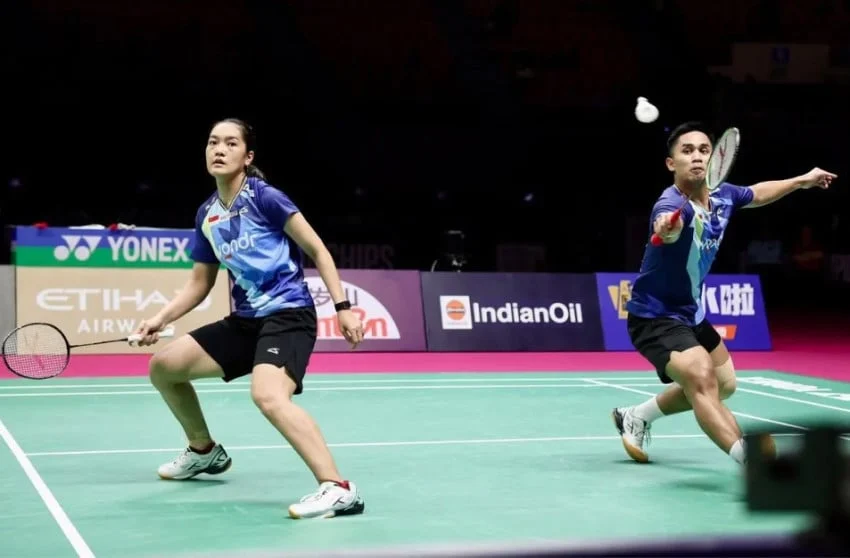
The individual badminton competition at the Aichi-Nagoya 2026 Asian Games delivered contrasting fortunes for the Indonesian contingent during a high-stakes afternoon session on Friday, September 25, 2026. Competing at the Ichinomiya City Municipal Gymnasium in Aichi, Japan, the two remaining Indonesian mixed doubles pairs experienced divergent fates on the international stage. While the newly paired combination of Amri Syahnawi and Nita Violina Marwah demonstrated remarkable resilience to secure a hard-fought comeback victory, their compatriots Nikolaus Joaquin and Siti Fadia Silva Ramadhanti fell short against seasoned opponents, bringing their campaign in the Round of 16 to a premature halt.
These outcomes highlight the unpredictable nature of elite continental multisport events, where partnerships of varying experience levels must navigate intense pressure from Asia’s finest badminton powerhouses. As the tournament progresses past the intermediate rounds, the results carry significant implications for Indonesia’s overarching medal targets in the sport, placing heightened focus on the remaining athletes carrying the nation’s hopes in Aichi.
Opening Dynamics and the Ichinomiya Arena Atmosphere
The Ichinomiya City Municipal Gymnasium provided a vibrant yet demanding backdrop for Friday’s afternoon matches. With packed stands featuring vocal local supporters and travelling contingent members, the atmospheric pressure inside the venue added an extra layer of challenge for the visiting athletes. Badminton has traditionally been one of the crown jewels of the Asian Games program, drawing elite competitors from powerhouse nations including China, Japan, South Korea, Thailand, Indonesia, and Malaysia.
Entering the Round of 16, the margins for error were exceedingly slim. Every rally carried tactical weight, and physical endurance became just as critical as technical proficiency. For the Indonesian coaching staff, overseeing two distinct mixed doubles pairings meant balancing aggressive tactical adjustments for the trailing athletes while maintaining momentum for those establishing an early foothold in their matches.
The Amri and Nita Comeback: Resilience Under Pressure
The afternoon fixtures commenced with Amri Syahnawi and Nita Violina Marwah taking to the court to face the formidable Japanese duo of Maya Taguchi and Yuta Watanabe. Playing on home soil, the Japanese pair entered the contest with substantial tactical backing and immediate crowd engagement, translating into an overwhelming display of dominance in the opening game.
During the first game, Amri and Nita struggled to find their rhythm against the fluid defensive transitions and rapid front-court interceptions orchestrated by Taguchi and Watanabe. The Indonesian pair surrendered the opener with a lopsided scoreline of 9-21, raising concerns regarding their ability to counter the relentless pressure applied by the home favorites.
However, the second game marked a distinct tactical shift. The Indonesian coaching staff’s mid-match guidance proved pivotal as Amri and Nita altered their defensive positioning, restricted unforced errors, and increased the pace of their mid-court drives. By taking the initiative in the service and return exchanges, they disrupted the Japanese pair’s synchronization. Amri utilized his powerful jump smashes from the rear court, while Nita capitalized on loose net returns. This resurgence allowed them to seize control of the tempo, ultimately converting their set points to claim the second game 21-18, thereby forcing a decisive rubber game.
Carrying the momentum into the third and final game, the Indonesian pair exhibited superior physical stamina and mental fortitude. Although the Japanese duo attempted multiple tactical variations to regain the lead, Amri and Nita maintained their defensive discipline and executed clinical counter-attacks. Closing out the third game at 21-15, the Indonesian duo completed a stunning three-game turnaround, securing their progression to the tournament’s next phase with a final scoreline of 9-21, 21-18, 21-15.
Nikolaus and Fadia Bow Out Against Thai Opposition
In a concurrent fixture scheduled during the same afternoon block, the pairing of Nikolaus Joaquin and Siti Fadia Silva Ramadhanti sought to replicate their teammates’ success against the experienced Thai duo of Ruttanapak Oupthong and Jhenicha Sudjaipraparat.
Nikolaus, known for his energetic court coverage, and Fadia, bringing her wealth of international experience from the women’s and mixed doubles circuits, faced a well-drilled Thai pair renowned for their tactical discipline and consistent baseline rallies. From the onset, Oupthong and Sudjaipraparat exposed gaps in the Indonesian defense through sharp cross-court drops and precise flick serves that kept Nikolaus and Fadia on the defensive.
Despite flashes of brilliance in long tactical rallies and successful retrieval sequences from Fadia at the forecourt, the Indonesian duo struggled to establish sustained offensive momentum. The Thai pair’s communication and structured rotation proved superior during crucial scoring intervals. Ultimately, Nikolaus and Fadia were unable to overturn the deficit, succumbing in straight games and bowing out of the individual competition in the Round of 16. The defeat underscores the developmental challenges faced by newly assembled or hybrid partnerships as they attempt to break into the upper echelons of elite continental competition.
Technical Analysis and Strategic Implications
The mixed results in Ichinomiya offer valuable insights into the current landscape of Indonesian badminton at the elite level. The sport’s governing body and coaching directors have increasingly focused on testing versatile combinations to optimize medal prospects across major international competitions, including the Asian Games, World Championships, and the Olympic qualification cycles.
From a tactical perspective, the victory by Amri and Nita illustrates the importance of adaptability against home-court opponents. Overcoming a heavy first-game loss requires immense psychological resilience, a quality that coaching teams continually look to instill in developing national athletes. By successfully altering their defensive depth and minimizing service errors, Amri and Nita proved that strategic discipline can neutralize early deficits.
Conversely, the elimination of Nikolaus and Fadia highlights the relentless competitiveness of Southeast Asian rivals such as Thailand, who have consistently elevated their doubles programs. International badminton analysis indicates that pairings lacking extensive tournament mileage together often struggle under the high-pressure conditions of major multisport games against established, cohesive opponents. The loss serves as a developmental benchmark for the coaching staff regarding necessary adjustments in physical conditioning, rotation awareness, and tactical variation for upcoming international fixtures.
Broader Context of the Aichi-Nagoya 2026 Badminton Tournament
The Aichi-Nagoya 2026 Asian Games represent a critical milestone in the international sports calendar, bringing together thousands of athletes from across the continent to compete in pre-eminent disciplines. Badminton, boasting immense popularity and historic significance throughout Asia, frequently serves as a focal point for national pride and media attention.
For the Indonesian badminton team, maintaining a podium presence across all five disciplines—men’s singles, women’s singles, men’s doubles, women’s doubles, and mixed doubles—remains a core institutional objective. Historically, Indonesia has relied heavily on its rich badminton heritage to secure prestigious medals at the Asian Games. Consequently, every match played at the Ichinomiya City Municipal Gymnasium is subjected to rigorous scrutiny by fans, analysts, and sports administrators alike.
As the tournament moves deeper into the quarter-finals and medal rounds, the remaining Indonesian representatives will face increasingly demanding opposition from traditional powerhouses like China, Japan, South Korea, and Chinese Taipei. The physical toll of rigorous three-game encounters, such as the one endured by Amri and Nita, necessitates immediate recovery protocols and meticulous tactical preparation led by the national coaching staff.
Future Outlook and Next Steps for the Contingent
Following the conclusion of the Round of 16 matches, attention quickly shifts to the subsequent stages of the Aichi-Nagoya 2026 badminton competition. Amri Syahnawi and Nita Violina Marwah face a short turnaround as they prepare for their upcoming quarter-final opponent. Medical staff, physical trainers, and tactical analysts are expected to work closely with the athletes to ensure optimal physical recovery and data-driven preparation ahead of their next international test.
For the wider Indonesian contingent, the mixed outcomes on Friday serve as both a cautionary reminder of the global game’s competitive parity and an inspiring testament to the fighting spirit required to succeed on the multi-sport stage. As the quest for medals continues in Aichi, the nation’s remaining athletes carry the hopes of millions back home, aiming to add further prestigious chapters to Indonesia’s storied badminton legacy.