The political landscape in Indonesia has once again been set in motion following renewed debates surrounding the revision of the Election Law. The People’s Consultative Assembly and the House of Representatives (DPR) find themselves at the center of a brewing controversy as various political factions attempt to navigate the post-Constitutional Court ruling era. At the forefront of the latest dispute is a controversial proposal suggesting that any presidential and vice-presidential candidate pair must secure formal backing from a minimum of two parliamentary factions in the DPR to qualify for a presidential election. This idea, floated amid discussions regarding the implementation of the Constitutional Court’s landmark decisions, has immediately drawn sharp criticism from political parties outside the traditional major coalitions.
Among the most vocal opponents of this newly minted requirement is the Hanura Party (Partai Hati Nurani Rakyat). Through its high-ranking officials, the party has formally and forcefully rejected the proposal, categorizing it as legally flawed, counterproductive, and fundamentally contradictory to the spirit of constitutional democracy. The debate underscores a broader, ongoing tension between the legislative branch’s desire to regulate political stability through threshold mechanisms and the judiciary’s mandate to expand constitutional rights and political participation for all registered political entities.
The Legal Background and the Core of the Controversy
The genesis of the current legislative dispute traces back to the comprehensive legal framework governed by Law Number 7 of 2017 concerning General Elections (UU Pemilu). For years, Indonesian presidential elections were heavily regulated by the presidential threshold (presidential threshold or PT) mechanism. Under this legacy system, political parties or coalitions of parties were required to secure a specific percentage of seats in the DPR or a designated share of the national popular vote in the preceding legislative election merely to nominate a presidential and vice-presidential ticket.
Critics of the traditional presidential threshold have long argued that the system acts as an exclusionary barrier, disproportionately favoring major political dynasties and well-established coalitions while marginalizing smaller or newly established political parties. This discontent culminated in a series of judicial reviews submitted to the Constitutional Court (Mahkamah Konstitusi or MK). In successive rulings, the Constitutional Court systematically dismantled traditional barriers, culminating in a historic legal interpretation that effectively abolished the restrictive presidential threshold, bringing the requirement down to zero percent (0%).
Following this judicial milestone, legal experts and constitutional scholars interpreted the Court’s decision to mean that any political party officially certified as a participant in the general election holds the constitutional right to nominate candidates for the nation’s highest office. However, as parliamentarians embarked on drafting revisions to Law Number 7 of 2017, alternative mechanisms began to surface in parliamentary corridors. The proposal requiring a presidential ticket to be backed by at least two distinct DPR factions emerged as a perceived workaround—a substitute hurdle designed to retain a degree of filtering, preventing what some lawmakers describe as an excessive fragmentation of candidates on the ballot paper.
Hanura’s Stance: A Direct Challenge to Unconstitutional Hurdles
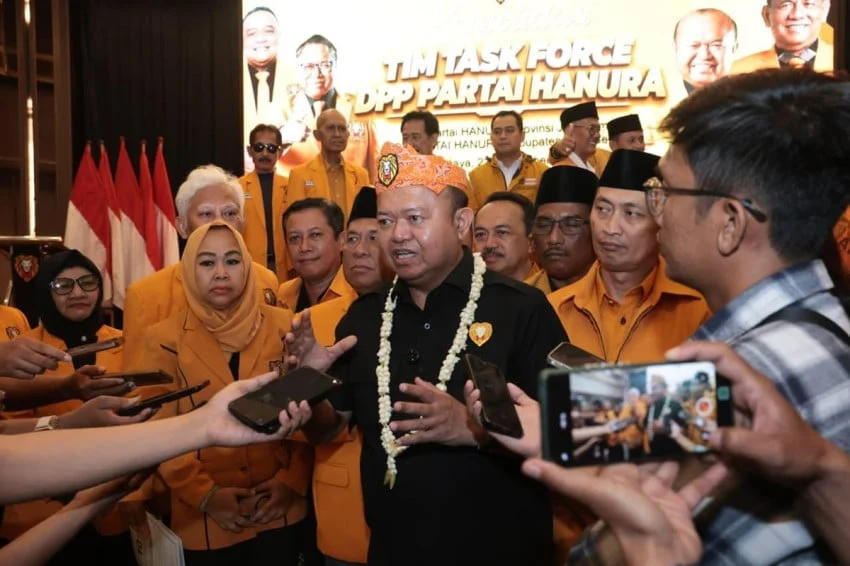
The opposition from the Hanura Party crystallized during a strategic consolidation event held in Surabaya. Speaking to party cadres and media representatives after leading a meeting and consolidation of the Hanura Task Force Team for East Java at the Hotel Platinum Tunjungan, Deputy Chairman of the Hanura Party, Patrice Rio Capella, launched a scathing critique of the two-faction support requirement.
Rio Capella did not mince words when addressing the origins and validity of the proposal. He openly questioned the competence and legal understanding of those advocating for the rule, emphasizing that any policy attempting to reintroduce indirect filtering mechanisms post-Constitutional Court ruling violates the basic principles of constitutional law.
"I do not understand who provided that unintelligent input," Rio Capella stated firmly to journalists following the consolidation meeting. He reiterated that the Constitutional Court has already delivered a definitive and binding legal verdict stating that the presidential threshold is zero percent.
According to Hanura, attempting to mandate support from two parliamentary factions is nothing more than an indirect presidential threshold repackaged under a different nomenclature. The party argues that conflating parliamentary factions (fraksi di DPR) with registered political parties participating in the national election demonstrates a fundamental misunderstanding of the constitutional separation of powers and electoral rights. Factions within the DPR represent parliamentary groupings formed after legislative elections, whereas the right to nominate a president belongs inherently to political parties as electoral vehicles recognized by the state constitution.

Chronology of Events and the Legislative Roadmap
To understand the weight of Hanura’s rejection, it is essential to map out the chronology of events leading up to this political friction point. The trajectory of Indonesia’s electoral reform involves a delicate interplay between judicial mandates and legislative drafting:
- Post-Election Evaluation (Late 2024 – 2025): Following the conclusion of the national elections, political parties and parliamentary commissions initiated a comprehensive evaluation of Law Number 7 of 2017 concerning General Elections. Lawmakers identified numerous overlapping articles, logistical inefficiencies, and areas requiring harmonization with recent judicial reviews.
- Constitutional Court Interventions (2025): The Constitutional Court processed several high-profile petitions challenging the constitutionality of electoral thresholds. The resulting verdicts reinforced the democratization of candidate nominations, ruling that restricting smaller parties infringes upon constitutional equality.
- Parliamentary Debates and Reform Initiatives (Early to Mid-2026): Amid efforts by legislative leaders—such as House Speaker Puan Maharani, who initiated sweeping institutional reforms and cross-factional consolidation meetings to streamline DPR performance—various working committees began drafting amendments to the Election Law.
- Emergence of the Two-Faction Wacana (September 2026): As deliberations intensified, unnamed sources or specific working groups within the legislative bodies floated the idea of requiring a minimum two-faction endorsement for presidential hopefuls to ensure administrative efficiency.
- Direct Pushback from Political Parties (Late September 2026): The Hanura Party became one of the earliest institutional actors to formally reject the concept, issuing public warnings against measures that could disenfranchise smaller political entities and create public confusion.
Implications for Indonesian Democracy and Party Politics
The dispute over the two-faction requirement highlights a profound ideological division regarding the future of Indonesian democratic architecture. On one side, proponents of filtering mechanisms argue that completely open nominations without any structural filter could lead to an unmanageable number of presidential pairs, potentially overwhelming electoral logistics, stretching state resources, and polarizing the electorate across an excessive number of ideological lines. They contend that requiring minimal parliamentary backing ensures that nominated candidates possess a baseline of political legitimacy and negotiation capacity within the legislative branch, which is crucial for effective future governance.
On the other side, opponents like the Hanura Party view such proposals as an undemocratic attempt by incumbent major parties to cartelize political power. By maintaining hurdles that necessitate alliances with established parliamentary giants, smaller parties are effectively reduced to junior partners with little leverage, undermining the pluralistic ideals of a multi-party democratic system.
Legal analysts point out that any legislative product attempting to bypass or dilute a Constitutional Court ruling risks being challenged immediately through a judicial review petition. The Constitutional Court possesses the ultimate authority to review statutory laws against the 1945 Constitution. If the DPR insists on codifying a rule that contradicts the spirit of the zero-percent threshold precedent, it will almost certainly face intense legal scrutiny, neutralizing the regulation before it can be applied in an actual electoral cycle.
Furthermore, the public relations aspect of this debate carries significant weight. In an era where public trust in legislative institutions fluctuates, introducing convoluted administrative barriers for presidential aspirants risks alienating voters who favor straightforward, inclusive democratic participation. As Rio Capella noted, presenting ideas that contradict established judicial norms only serves to confuse the public and cast doubt on the legislative body’s commitment to upholding the rule of law.
Broader Political Reactions and Future Outlook
While Hanura has taken an aggressive stance against the wacana, other political factions within the DPR have yet to formulate a uniform consensus. Major coalition parties holding significant majority seats have traditionally favored mechanisms that stabilize executive-legislative relations, often seeing threshold requirements as a necessary tool for coalition management. However, the vocal resistance mounted by mid-tier and smaller parties signals that the legislative drafting process for the revised Election Law will be fraught with intense negotiation and compromise.
As political consolidation continues across various parties ahead of upcoming regional and national milestones, the debate over candidate eligibility will remain a defining battleground. The Hanura Party’s uncompromising position serves as a bellwether for how non-dominant parties intend to protect their constitutional privileges against perceived legislative overreach.
Ultimately, the resolution of this controversy will depend on whether parliamentary leaders choose to heed constitutional warnings and judicial precedents or press forward with measures that test the boundaries of Indonesia’s legal framework. For now, the pushback led by figures like Patrice Rio Capella ensures that the debate over the two-faction requirement will remain a central fixture of national political discourse, testing the resilience and inclusivity of the nation’s evolving electoral system.