
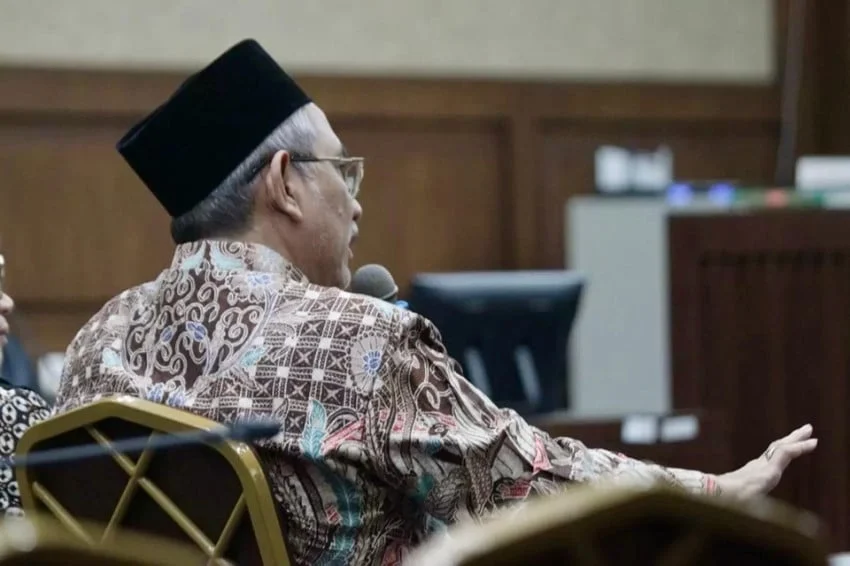
The operational policies governing the organization of the Hajj pilgrimage in 2024, enacted under the leadership of former Minister of Religious Affairs Yaqut Cholil Qoumas—commonly known as Gus Yaqut—were explicitly formulated to prioritize the safety, security, and physical protection of Indonesian pilgrims. This critical assessment was formally presented by KH Miftah Faqih, a seasoned religious affairs official who served as a Hajj Pilgrimage Organizing Committee (PPIH) consultant for the worship division across three consecutive operational years from 2022 to 2024.
His testimony was delivered during a court session held at the Jakarta Corruption Court (Tipikor) on Wednesday, November 4, 2026. The proceedings formed part of an ongoing legal inquiry into alleged irregularities and corruption concerning additional Hajj quotas. The testimony sheds light on the complex administrative, logistical, and humanitarian realities faced by authorities managing millions of pilgrims in the holy sites of Saudi Arabia, offering a defense of the pragmatic measures implemented to safeguard vulnerable populations.
Context and Background of the 2024 Hajj Operations
The 2024 Hajj pilgrimage faced unprecedented logistical hurdles, most notably driven by demographic shifts within the Indonesian pilgrim contingent. For the first time in recent history, the demographic profile of the delegation was heavily skewed toward older adults and individuals with medical vulnerabilities, under the national policy banner of "Hajj Ramah Lansia" (Elderly-Friendly Hajj). Tens of thousands of Indonesian participants were classified as elderly (lansia), and a significant number included citizens with physical disabilities.
This demographic reality forced the Ministry of Religious Affairs to fundamentally rethink traditional operational paradigms. Historically, Hajj management models placed primary emphasis on ritual compliance and administrative throughput. However, the sheer volume of elderly and frail participants necessitated a paradigm shift toward comprehensive health risk mitigation, specialized infrastructure support, and rigorous crowd management protocols.
The defense team representing former Minister Yaqut Cholil Qoumas, led by attorney Melissa Anggraini, called upon KH Miftah Faqih to testify as an expert witness regarding the practical application of these policies. During direct examination, Anggraini requested that the witness detail the operational challenges encountered on the ground in Saudi Arabia, particularly during the critical peak phases of the pilgrimage in Arafah, Muzdalifah, and Mina (Armuzna).
The Crisis at Muzdalifah: Spatial Constraints and Infrastructure Demands
During his testimony before the Jakarta Corruption Court, KH Miftah Faqih provided a detailed, harrowing account of the physical conditions experienced by pilgrims in Muzdalifah during the 2024 Hajj season. Muzdalifah serves as the open-air plain where millions of pilgrims gather overnight to collect pebbles and engage in communal prayers following their departure from Mount Arafah.
According to Miftah, the operational space within Muzdalifah was severely compromised during the 2024 season due to large-scale infrastructure projects aimed at improving long-term sanitation. Approximately two hectares of usable land within the Indonesian sector of Muzdalifah were permanently reallocated for the construction of permanent toilet facilities. While these sanitation upgrades were deemed vital for the long-term hygiene and comfort of pilgrims—particularly the elderly—their immediate consequence was a drastic reduction in available ground space for resting.
In prior operational years, individual pilgrims were allotted an average spatial footprint of approximately 0.8 square meters. Following the land reduction for sanitation infrastructure, this allocation shrank precipitously to less than 0.5 square meters per person. Miftah emphasized that the spatial constraint was so acute that the allocated area was smaller than the footprint of a standard adult shoe. Consequently, millions of pilgrims were physically unable to sit or lie down, forced instead to remain standing or tightly packed in place throughout their stay in the open-air plain.
"The crowding in Muzdalifah was extraordinary," Miftah stated during the court proceedings, reflecting on the situation captured on Friday, November 6, 2026. "Especially in 2024, the conditions in Muzdalifah were constrained because space was carved out for toilet construction. If previously the space for a pilgrim was 0.8 meters, when that land was reduced, the space was no more than 0.5 meters. Practically speaking, my own shoe size took up more room than the available space. Pilgrims could only stand; they could not sit down."
The Mandate of State Protection and Operational Pragmatism
Addressing the broader implications of these spatial and demographic crises, Miftah asserted that the state bears an inescapable moral and legal obligation to intervene proactively on behalf of its citizens. He argued that regulatory compliance and ritual administration cannot be treated in isolation from human security. When environmental conditions or physical capacities threaten the lives and well-being of citizens, administrative flexibility and safety-driven decision-making must take precedence.
Miftah noted that the Ministry of Religious Affairs under Gus Yaqut operated under the guiding principle that the state must have a tangible, protective presence in the field. This meant acknowledging that standard ritual timetables and traditional mass-movement strategies could prove fatal under conditions of extreme heat, spatial compression, and demographic vulnerability.
"The state must be present to provide concrete services," Miftah explained to the court. He cautioned against rigid adherence to bureaucratic routines that disregard ground realities, delivering a stark warning regarding the potential consequences of institutional negligence. "Do not let the state or the ministry become a death machine for its own citizens, in this case, the Hajj pilgrims."
His testimony underscored that the policy adjustments implemented by the ministry were not arbitrary deviations from established norms, but rather calculated interventions designed to prevent mass crush incidents, heatstroke fatalities, and logistical collapses in tightly constrained desert environments.
Systematic Evaluation and Policy Evolution
The judicial inquiry into the 2024 Hajj operations highlights the complex interplay between administrative policy, resource allocation, and legal accountability within Indonesia’s public sector. Throughout the legal proceedings, defense witnesses have consistently maintained that all policy decisions—including the distribution and management of additional Hajj quotas—were formulated through formal inter-institutional coordination and were continuously adapted to meet unexpected operational crises.
The Ministry of Religious Affairs maintains a structured framework for post-operational evaluation. These assessments systematically compile data from field officers, medical teams, transport coordinators, and Saudi Arabian municipal authorities. The findings from these evaluations directly inform subsequent legislative proposals, budgetary allocations, and bilateral negotiations with the Ministry of Hajj and Umrah of the Kingdom of Saudi Arabia.
By contextualizing the decisions of the former minister within the physical realities of the 2024 pilgrimage, the testimony of KH Miftah Faqih attempts to reframe the administrative choices under scrutiny. Rather than viewing policy adjustments through a purely punitive or regulatory lens, the defense presents these measures as emergency adaptations necessitated by spatial deficits and a historic commitment to protecting vulnerable pilgrims.
Broader Implications and Ongoing Judicial Scrutiny
The ongoing proceedings at the Jakarta Corruption Court continue to attract intense public interest and media coverage across Indonesia. The case serves as a focal point for broader discussions regarding transparency, governance, and institutional accountability in the management of religious affairs—a sector involving substantial state funds and profound spiritual significance for millions of citizens.
Legal analysts and governance experts note that the testimony of religious authorities and former operational officials like Miftah Faqih will likely play a decisive role in shaping the court’s understanding of administrative discretion during crises. As the trial progresses, the judicial panel must balance allegations of procedural non-compliance against the documented operational realities, safety constraints, and humanitarian imperatives faced by state administrators on the ground in Saudi Arabia.
Ultimately, the proceedings surrounding the 2024 Hajj policies underscore the delicate balance required in public administration: reconciling rigid adherence to statutory frameworks with the fluid, high-stakes demands of managing human safety on an international scale. The court’s eventual verdict will establish important legal and administrative precedents for the future organization of the world’s largest annual mass pilgrimage.
