
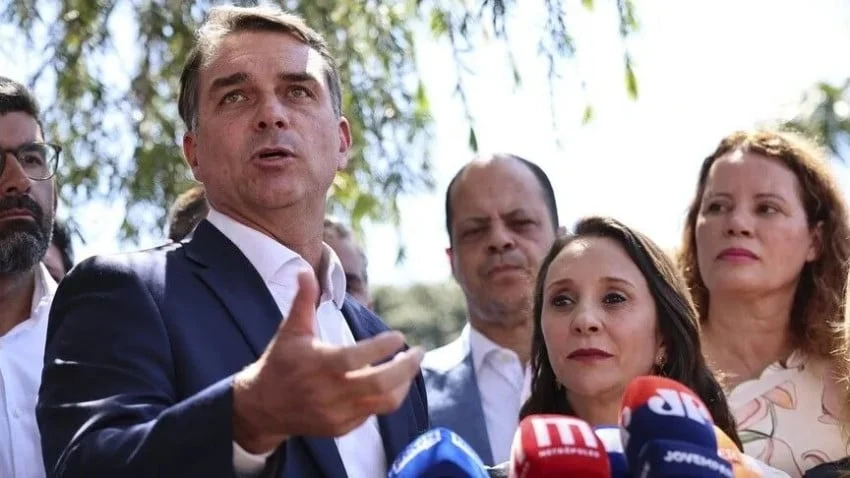
The political landscape of Brazil shifted dramatically this week as Senator Flavio Bolsonaro, the eldest son of incarcerated former President Jair Bolsonaro, reportedly fled to the United States. His departure follows a narrow but decisive electoral defeat in the second round of Brazil’s national elections against incumbent President Luiz Inacio Lula da Silva. The exit of the influential right-wing politician, confirmed by reports from Reuters and the Brazilian broadcaster Jovem Pan on Tuesday, October 27, 2026, marks the latest chapter in the deepening crisis surrounding the Bolsonaro family and their political movement.
The U.S. State Department, speaking through a senior official to the Associated Press on the same day, confirmed that arrangements were being finalized to grant the younger Bolsonaro and his family entry visas. This development comes against a backdrop of intense legal scrutiny, with Flavio Bolsonaro currently facing multiple investigations in Brazil regarding financial irregularities, money laundering, and potential interference in judicial processes.
A Timeline of Political Turmoil
The trajectory of the Bolsonaro family has been defined by a series of legal and electoral setbacks since the conclusion of Jair Bolsonaro’s presidency. The following chronology highlights the key events leading to the current situation:
- January 2023: Jair Bolsonaro leaves Brazil for Florida shortly before the inauguration of President Lula, following a period of civil unrest.
- February 2025: Eduardo Bolsonaro, brother of Flavio and a prominent right-wing politician, departs for the United States, citing fears of political persecution and imminent arrest.
- June 2026: A Brazilian court finds Eduardo Bolsonaro guilty of attempting to obstruct justice by lobbying Washington to impose sanctions on Brazilian judicial officials. He is sentenced to four years and two months in prison.
- October 2026: Flavio Bolsonaro secures the highest number of votes in the first round of the senatorial election but is defeated in the second round by the Lula-aligned coalition.
- October 27, 2026: Following the confirmation of his electoral loss, Flavio Bolsonaro exits Brazil for the United States.
The Legal Web Surrounding Flavio Bolsonaro
The decision to relocate to the United States is widely perceived by legal analysts as a strategic move to insulate himself from a mounting pile of criminal investigations. At the center of the controversy is his alleged involvement in a complex money-laundering scheme. Prosecutors have been investigating financial ties between the Senator and lawyer Willer Tomaz, as well as several business entities allegedly linked to the illegal online gambling industry.
Beyond these financial inquiries, the Senator is embroiled in a separate probe concerning the financing of Dark Horse, a biographical film depicting the life and political career of his father. Investigators are scrutinizing whether funds intended for legitimate political or commercial purposes were diverted to produce the film, which served as a propaganda tool during the elder Bolsonaro’s tenure.
While Flavio Bolsonaro has consistently maintained his innocence, characterizing the investigations as a "witch hunt" orchestrated by the political establishment, the evidence presented by the Public Prosecutor’s Office has led to significant political fallout. The Senator’s supporters argue that the judicial proceedings are politically motivated, intended to dismantle the influence of the right-wing conservative movement in Brazil. Conversely, anti-corruption advocates contend that the investigations are essential for maintaining the integrity of Brazil’s democratic institutions.
The Role of U.S.-Brazil Relations
The migration of the Bolsonaro family to the United States introduces a complex diplomatic challenge for the Washington-Brasilia relationship. As an outspoken ally of former U.S. President Donald Trump, the Bolsonaro clan has maintained a high profile in American conservative circles. The U.S. decision to grant visas to the family has already drawn criticism from some corners of the international community, where observers are questioning the criteria used by the State Department to facilitate the arrival of individuals currently under investigation for serious white-collar crimes.
"The United States has long been a destination for political exiles, but there is a clear distinction between those fleeing legitimate political persecution and those attempting to evade the judicial process," noted Dr. Elena Rodriguez, a senior analyst at the Institute for Latin American Studies. "By facilitating the entry of Flavio Bolsonaro, the U.S. is inadvertently positioning itself at the center of Brazil’s domestic legal battles."
The case of Eduardo Bolsonaro serves as a cautionary tale for the administration. His conviction for attempting to lobby the U.S. government to sanction Brazilian judges created a diplomatic rift that took months to mend. The presence of two high-ranking members of the Bolsonaro family on U.S. soil is likely to increase pressure on Washington to address extradition requests from Brazilian authorities, should they be formally issued.
Broader Implications for Brazilian Democracy
The departure of Flavio Bolsonaro signifies a fractured conservative movement in Brazil. With the patriarch of the movement, Jair Bolsonaro, serving a prison sentence, and his sons now seeking sanctuary abroad, the right-wing opposition is currently without a central leadership figure.
Political analysts suggest that this power vacuum could lead to two distinct outcomes. First, it may allow for the emergence of a new, more moderate conservative leadership that distances itself from the populist rhetoric and legal scandals of the Bolsonaro era. Alternatively, it could lead to increased radicalization among the remaining base, who view the family’s departure as a sign that the Brazilian state has been captured by their political opponents.
"The exit of the Bolsonaros is not just a logistical event; it is a symbolic end to an era," said Marcus Viana, a political scientist at the University of Brasilia. "The challenge now for the current administration is to demonstrate that the justice system works impartially, regardless of a person’s political status or their ability to relocate abroad. If they fail to do so, the narrative of ‘persecution’ will only gain more traction."
Statistical Context of the 2026 Elections
The election that preceded Flavio Bolsonaro’s flight was one of the most contentious in recent Brazilian history. Data from the Superior Electoral Court (TSE) indicated a record voter turnout, reflecting the deep polarization of the electorate.
In the first round, Flavio Bolsonaro had performed strongly, leading in several key states and signaling a potential resurgence of the right. However, the consolidation of the center-left and moderate blocs in the second round proved to be the deciding factor. The narrow margin of defeat—less than two percentage points—highlights that despite the legal controversies, the Bolsonaro brand remains potent among a significant portion of the Brazilian population.
Economic factors also played a pivotal role. During the campaign, voters expressed concerns over inflation, the stability of the real, and the effectiveness of public spending. While the government emphasized social welfare programs, the opposition campaigned on fiscal responsibility and the dismantling of bureaucratic corruption.
Future Outlook and Extradition Prospects
As of late October 2026, there have been no formal requests for extradition issued by the Brazilian judiciary regarding Flavio Bolsonaro. However, legal experts anticipate that such requests are likely to follow, given the progression of the money laundering and financial mismanagement cases.
The process of extradition between the United States and Brazil is governed by a bilateral treaty that requires a showing of "dual criminality"—meaning the acts for which the individual is accused must be crimes in both countries. If Brazilian authorities provide sufficient documentation linking the Senator to criminal conduct, the U.S. Department of Justice may be required to review the status of his visa.
For now, the Brazilian public remains focused on the domestic repercussions of the Senator’s flight. As the nation grapples with the aftermath of the election and the ongoing legal investigations, the story of the Bolsonaro family serves as a testament to the volatility of 21st-century Latin American politics. Whether the family remains in exile or eventually faces the Brazilian courts remains one of the most significant open questions in the region’s current political trajectory.
