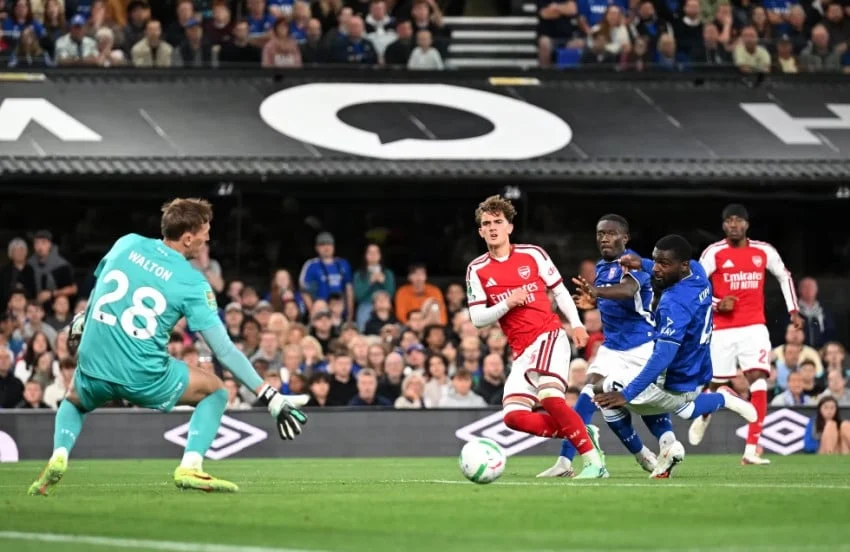
Arsenal Football Club secured their progression to the fourth round of the 2026/2027 EFL Cup with a commanding 4-2 victory over Ipswich Town at Portman Road on Wednesday, September 16, 2026. The match showcased a blend of established first-team regulars and emerging academy talents, highlighted by a standout performance from young forward Max Dowman, who netted twice to guide the North London side through a spirited challenge from the hosts.
The fixture offered Mikel Arteta an opportunity to rotate his squad amidst a demanding fixture calendar, balancing domestic aspirations with European commitments. While the visitors controlled large portions of the match and built a comfortable four-goal cushion, a late surge from Ipswich Town tested Arsenal’s defensive resolve before the final whistle confirmed the visitors’ progression in the historic knockout competition.
Chronology and Match Progression
The contest at Portman Road began at a brisk pace, with Arsenal asserting dominance early in the tactical battle. The breakthrough arrived in the seventh minute through 16-year-old sensation Max Dowman. Demonstrating remarkable maturity, Dowman dispossessed an Ipswich midfielder near the center circle before initiating a crisp one-two passing sequence with attacking midfielder Eberechi Eze. Dowman then surged into the penalty area, evading a recovering challenge, and slotted a precise shot into the bottom-left corner of the net past Ipswich goalkeeper Christian Walton, giving the visitors an early 1-0 lead.
Arsenal continued to press their territorial advantage, capitalizing on defensive lapses from the home side. In the 16th minute, the Gunners doubled their advantage. Noni Madueke collected a pass inside the penalty area, maneuvered space away from his marker, and executed a composed finish into the exact same corner, leaving Walton helpless and establishing a 2-0 cushion for the visitors before the midway point of the first half.
As the second half commenced, Arsenal made tactical alterations, introducing Ezri Konsa in place of Gabriel in central defense. The tactical shift did little to disrupt the visitors’ attacking rhythm. In the 53rd minute, Max Dowman claimed his second goal of the evening. Following neat build-up play, midfielder Martin Zubimendi delivered a measured pass to Dowman, whose low, drilled effort eluded the defense and beat Walton to extend the lead to 3-0.
Merely five minutes later, Arsenal effectively put the game beyond reach. A sustained period of possession ended with a blistering strike from outside the penalty area that clipped the inside of the woodwork before settling in the back of the net, pushing the scoreline to 4-0 in the 58th minute.
Despite facing a seemingly insurmountable deficit, Ipswich Town demonstrated resilience and mounted a response. In the 62nd minute, Anis Mehmeti exploited a pocket of space within Arsenal’s defensive third, capitalizing on a momentary lapse in concentration to fire past Spanish goalkeeper Kepa Arrizabalaga, narrowing the deficit to 4-1. Spurred by the goal, the hosts increased their attacking intensity as Arsenal introduced a wave of substitutes, including Martin Ødegaard and Christos Tzolis, to manage the tempo of the game.
In the dying moments of injury time, Ipswich found a second consolation goal. Substitute Chuba Akpom reacted quickest inside a crowded penalty area to turn the ball home, reducing the deficit to 4-2. However, the late flurry proved too little, too late, as refereeial intervention immediately signaled full-time, sealing Arsenal’s passage to the next round.
Detailed Lineups and Tactical Setup
The team sheets reflected strategic rotation from both managers, balancing the rigors of the EFL Championship and the Premier League against the depth of their respective squads.
Ipswich Town deployed a 4-2-3-1 formation designed to absorb pressure and utilize pace on the counter-attack. Christian Walton started in goal, shielded by a back four consisting of Furlong, Kipre, Greaves, and Ouattara (who was later replaced by Davis in the 68th minute). The defensive midfield pairing featured Florentino (subsequently replaced by Lukic in the 81st minute) and Nunez. The attacking midfield triumvirate comprised McAteer (replaced by Egeli in the 69th minute), Mehmeti, and Philogene (replaced by Clarke in the 61st minute), supporting Cauley Woodrow’s replacement, Flemming, who was withdrawn for Chuba Akpom in the 61st minute.
Arsenal lined up in their customary 4-3-3 tactical blueprint. Kepa Arrizabalaga protected the posts behind a defensive line featuring Martin Zubimendi deployed in an unconventional deeper role (later substituted by Ibrahim in the 85th minute), Salmon, Gabriel (replaced by Ezri Konsa at halftime), and Myles Lewis-Skelly. The midfield engine room featured Bruno Guimaraes (replaced by Julienne in the 64th minute) alongside Mikel Merino. The forward line incorporated Noni Madueke (replaced by Martin Ødegaard in the 76th minute), Max Dowman, Eberechi Eze (replaced by Christos Tzolis in the 76th minute), and central striker Viktor Gyokeres.
Background Context and EFL Cup Significance
The League Cup, officially known as the Carabao Cup for sponsorship reasons, remains a crucial domestic objective for Premier League clubs boasting aspirations of sweeping silverware. For Arsenal, the tournament represents an avenue to secure early-season momentum and provide valuable competitive minutes to squad players and academy graduates who require exposure at the senior professional level.
Ipswich Town, competing in the fiercely contested EFL Championship, entered the fixture aiming to cause a major upset against established elite opposition. Portman Road has historically proven a challenging venue for visiting sides, and manager Kieran McKenna viewed the fixture as a benchmark to measure his squad’s competitiveness against elite Premier League opposition. However, Arsenal’s superior technical quality, particularly during transitional phases of play, ultimately exposed structural vulnerabilities in the home side’s defensive shape.
Managerial Reactions and Tactical Analysis
Speaking in his post-match media obligations, Arsenal manager Mikel Arteta praised the application and professionalism of his squad, placing particular emphasis on the performance of the club’s younger contingent.
"We approached this fixture with the absolute seriousness it demands," Arteta stated. "Playing away from home in a knockout competition against a well-organized side is always a difficult test. I am particularly pleased with how the young players integrated into the system, absorbed the pressure, and executed our tactical instructions. Max Dowman showed exceptional composure and quality throughout his time on the pitch, but this was a collective effort that reflects the depth of our squad."
Conversely, Ipswich Town manager Kieran McKenna offered a balanced assessment of his side’s performance, acknowledging the gulf in individual quality while highlighting the character displayed in the latter stages of the encounter.
"When you make errors against a side of Arsenal’s caliber, you are invariably punished," McKenna noted. "For large spells of the first hour, we struggled to contain their movement between the lines. However, the response from the players in the final thirty minutes demonstrated the character we expect in this squad. Scoring two goals against a top-tier defense provides positives to build upon as we return our focus to the league campaign."
Broader Impact and Implications for the Season
The result carries significant ramifications for both clubs as the 2026/2027 domestic campaign progresses into its autumn schedule. For Arsenal, progression to the fourth round maintains momentum across multiple fronts, validating the club’s recruitment strategy and investment in elite youth development. The emergence of Max Dowman as a viable first-team option provides Arteta with additional tactical flexibility as fixture congestion intensifies with the advent of European group-stage fixtures and domestic league matches.
For Ipswich Town, the elimination allows the club to concentrate fully on their primary objective: mounting a sustained campaign in the EFL Championship. While the defensive frailties exposed during the first hour of the match will require corrective work on the training ground, the spirited late goals offer empirical evidence of attacking capability that can be translated into upcoming league fixtures.
The draw for the fourth round of the League Cup is scheduled to take place following the conclusion of the remaining third-round fixtures, where Arsenal will discover their next opponent in their pursuit of domestic silverware.