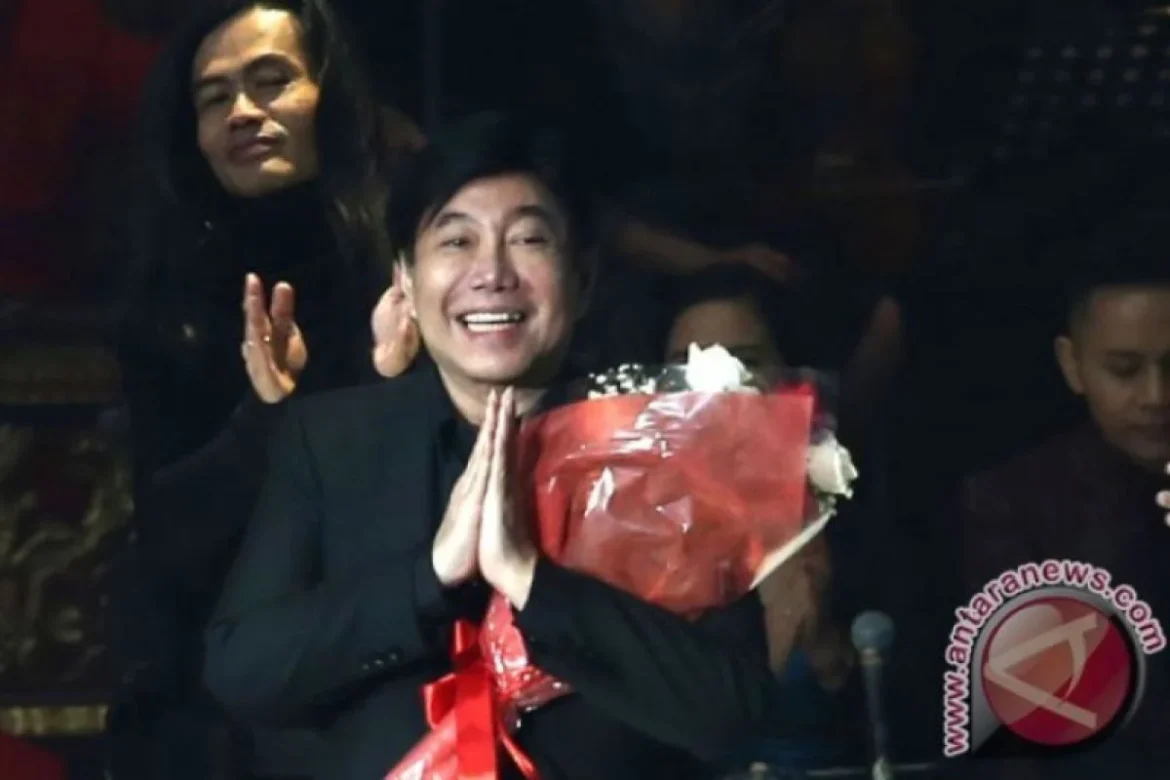
The Indonesian arts community is in profound mourning following the passing of renowned artist and cultural visionary Mohammad Guruh Irianto Soekarnoputra. The esteemed composer, choreographer, and multi-disciplinary artist breathed his last at the MRCCC Siloam Hospitals Semanggi in Jakarta on Saturday at 04:16 Western Indonesia Time (WIB), at the age of 73. His death marks the end of an era for a creative giant who dedicated his entire life to bridging the gap between traditional Indonesian heritage and contemporary global art forms.
The heartbreaking news was officially confirmed to the public through a written statement issued early Saturday morning by Hasto Kristiyanto, the Secretary-General of the Indonesian Democratic Party of Struggle (PDI-P). As the youngest son of Indonesia’s founding father and first president, Sukarno, and former First Lady Fatmawati, Guruh grew up navigating the corridors of political history. However, rather than pursuing a conventional political career, he chose a path less traveled, channeling his lineage, passion, and intellect into the preservation and modern evolution of Indonesian culture. His departure leaves a vast, irreplaceable void not only in his family circle but across the archipelago’s cultural landscape, where his creative footprints have guided generations of artists.
A Lifelong Dedication to the Arts: Formative Years and Early Explorations
Guruh’s immersion in the arts began long before he became a household name. Archival records from the National Archives of Indonesia (ANRI) indicate that his artistic education started in early childhood, where he systematically studied traditional dances from Java, Sunda, Bali, Minangkabau, and various other cultural regions. This early exposure instilled in him a deep reverence for indigenous artistic expressions that would anchor his creative philosophy for the rest of his life.
By the time he was attending elementary school, Guruh’s prodigious talent was already evident as he made several television appearances on TVRI, the nation’s state-owned broadcaster, performing with a musical ensemble he had personally founded. As a teenager in the mid-1960s, his musical horizons expanded with the shifting global tides of rock and roll; in 1965, he formed the band The Beat-G. His experimental streak continued into 1970 with the creation of a subsequent musical outfit, The Flower Poetman.
Simultaneously, Guruh immersed himself deeper into traditional studies. He joined a Balinese gamelan troupe, participated in rigorous theater training, and organized student angklung and Javanese gamelan groups within the Perguruan Cikini educational environment. When he traveled to the Netherlands in the early 1970s to pursue higher education at the Universiteit van Amsterdam, his artistic pursuits crossed international borders. Guruh actively participated in Javanese and Balinese gamelan ensembles at Amsterdam’s Tropen Museum, eventually stepping into the role of an educator teaching Balinese dance and gamelan music to European audiences. This international exposure did not dilute his love for his homeland; instead, it solidified his conviction that modern music and traditional art forms were not mutually exclusive, but rather complementary halves of a richer cultural tapestry.
The Birth of Guruh Gipsy and Revolutionary Musical Experiments
Upon his return to Indonesia in 1975, Guruh embarked on a groundbreaking project that would fundamentally alter the trajectory of Indonesian popular music: the formation of Guruh Gipsy. Teaming up with the legendary progressive rock ensemble Gipsy—featuring Keenan Nasution on drums and vocals, Chrisye on bass and vocals, Roni Harahap on piano and keyboards, Oding Nasution on guitar, and Abadi Soesman on the synthesizer—Guruh spearheaded an audacious fusion of traditional Balinese gamelan and Western progressive rock.
Operating out of a prolonged production phase spanning from 1975 to 1976, the collective released their self-titled debut album, Guruh Gipsy, in 1976. The record featured timeless compositions such as "Geger Gelgel," "Barong Gundah," "Smaradhana," "Indonesia Maharddhika," "Janger 1897 Saka," and "Chopin Larung." Guruh himself contributed significantly to the sonic texture by playing both the piano and gamelan while crafting deeply reflective lyrics.
The album was far more than an avant-garde novelty; it was a profound socio-cultural statement about national identity, heritage, and the anxieties of modernization. Tracks like "Indonesia Maharddhika" became anthems of cultural pride, while "Smaradhana" achieved widespread commercial and critical acclaim, particularly bolstered by the soaring vocals of the late Chrisye.
Decades later, the spirit of this legendary project was reignited when Guruh, alongside surviving members Keenan Nasution and Abadi Soesman, took to the stage at Synchronize Fest 2025. Supported by a new generation of musicians, the performance of "Smaradhana," "Janger 1897 Saka," and "Indonesia Maharddhika" served as a poignant living history lesson and a heartfelt tribute to departed bandmates like Chrisye, Roni Harahap, and Oding Nasution.
Expanding the Repertoire: Pop Hits and National Festivals
Guruh’s creative output extended well beyond progressive rock experiments into the heart of mainstream Indonesian pop music. In 1976, his compositional mastery was recognized nationally when his song "Renjana" won the National Pop Song Festival, subsequently earning Indonesia a spot at the prestigious World Popular Song Festival in Tokyo, Japan.
This success opened the floodgates for a torrent of iconic songs that would define the soundtrack of Indonesian life through the late 1970s and 1980s. Tracks such as "Galih dan Ratna," "Gita Cinta," "Anak Jalanan," "Lenggang Puspita," "Sendiri," and "Marlina" became permanent fixtures in the nation’s musical consciousness. Another career-defining moment arrived with the song "Kembalikan Baliku," performed by Jopie Latul. This track once again propelled Guruh onto the international stage at the Tokyo music festival, showcasing his signature ability to merge traditional Balinese elements with contemporary disco and rock rhythms.
His cinematic contributions were equally impactful. Guruh served as a musical director and composer for classic Indonesian films including Ali Topan Anak Jalanan, Gita Cinta dari SMA, and Puspa Indah Taman Hati. His work on Ali Topan Anak Jalanan earned him the prestigious Best Musical Arrangement award at the Indonesian Film Festival (FFI) in 1977. Beyond his work behind the scenes, he demonstrated his versatility as an actor, portraying the revered historical figure Sunan Muria in the 1985 biographical film Wali Songo.
Swara Maharddhika and the Era of Colossal Stage Productions
In 1977, Guruh established Swara Maharddhika, an organization designed as a creative incubator for Indonesian youth interested in the arts. Through this platform, his artistic vision expanded from individual compositions into massive, synchronized theatrical productions. Guruh pioneered a distinct style of performance art that seamlessly integrated traditional Indonesian dance choreography with modern Western movement, packaging them for contemporary audiences on a grand scale.
This vision materialized in a celebrated series of productions known as the Pergelaran Karya Cipta Guruh Soekarno Putra. Beginning with the inaugural show in 1979, the series continued with "Untukmu Indonesiaku" (1980), "Cinta Indonesia" (1984), and "Gilang Indonesia Gemilang" (1986). These productions were monumental undertakings that harmonized music, dance, intricate costume design, state-of-the-art stage engineering, and theatrical narrative into a unified visual and auditory spectacle. Guruh frequently wore multiple hats as the composer, choreographer, and director of these grand events.
The success of Swara Maharddhika led to high-profile national engagements, including artistic direction for the opening ceremony of the 10th National Sports Week (PON) in Jakarta in 1981, the opening of the Jakarta Fair in 1982, "Gempita Swara Maharddhika" in 1987, and the colossal staging of "JakJakJakJak Jakarta" in 1989.
In 1988, Swara Maharddhika transitioned into a formal foundation, while Guruh established GSP Productions (PT Gencar Semarak Perkasa) to commercialize and professionalize stage arts production. Under his leadership, these troupes performed internationally, bringing Indonesian culture to stages across Singapore, Morocco, Tunisia, Jordan, Germany, Belgium, Denmark, Sweden, Switzerland, and Australia. Furthermore, Swara Maharddhika served as an invaluable training ground that launched the careers of many prominent Indonesian entertainers, including Titi DJ, Deni Malik, Dewi Gita, Memes, Irianti Erningpraja, Euis Dahlia, and Rico Tampatty.
Enduring Legacy and Cross-Generational Appeal
Guruh’s ability to remain relevant across decades is perhaps best demonstrated by how his music has been repeatedly reinterpreted by younger generations of artists. In 2014, a tribute concert titled "Salute to Guruh Soekarno Putra" brought together a diverse roster of musicians to perform 25 of his classic compositions, including "Zamrud Khatulistiwa," "Kembalikan Baliku," and "Galih dan Ratna."
This cross-generational reverence was further cemented in 2020 when Musica Studios released a compilation album titled Puspa Ragam Karya Guruh Sukarno Putra 2020. The album featured modern interpretations of ten classic tracks by contemporary hitmakers such as Noah, Iwan Fals, D’MASIV, Kahitna, Afgan, Geisha, Sheryl Sheinafia, and Vidi Aldiano. Songs like "Kala Cinta Menggoda," "Aji Mumpung," and "Kala Sang Surya Tenggelam" proved that Guruh’s melodic sensibilities transcended generational divides.
Even in his later years, Guruh remained an active voice in cultural advocacy. As recently as January 2026, he appeared at a media briefing for the musical production Bukan Cinta Galih/Ratna, where he passionately underscored the vital role of the arts as an indispensable medium for character-building and instilling national values in the younger generation.
Analysis of Implications: A Blueprint for Cultural Preservation
The passing of Guruh Soekarnoputra closes an extraordinary chapter in Indonesia’s cultural history, prompting a collective reflection on the future of traditional arts integration in modern society. Cultural analysts note that Guruh’s primary intellectual contribution was dismantling the artificial dichotomy between tradition and modernity. By proving that indigenous instruments like the gamelan could converse fluently with electric guitars, synthesizers, and disco beats, he provided a scalable blueprint for cultural preservation through innovation.
His multi-disciplinary approach—spanning music, dance, fashion, film, and large-scale theatrical production—demonstrated that national identity does not need to remain static in a museum exhibit to survive; rather, it can thrive dynamically on commercial stages and mainstream media platforms.
As the Indonesian arts community prepares to bid its final farewell, the legacy left by Mohammad Guruh Irianto Soekarnoputra extends far beyond an extensive catalog of chart-topping songs or breathtaking stage productions. He leaves behind an enduring ideological framework: that the richness of Indonesia’s cultural heritage is a boundless wellspring capable of speaking a universal language, continuously adapting to the changing rhythms of time without ever losing its soul.