
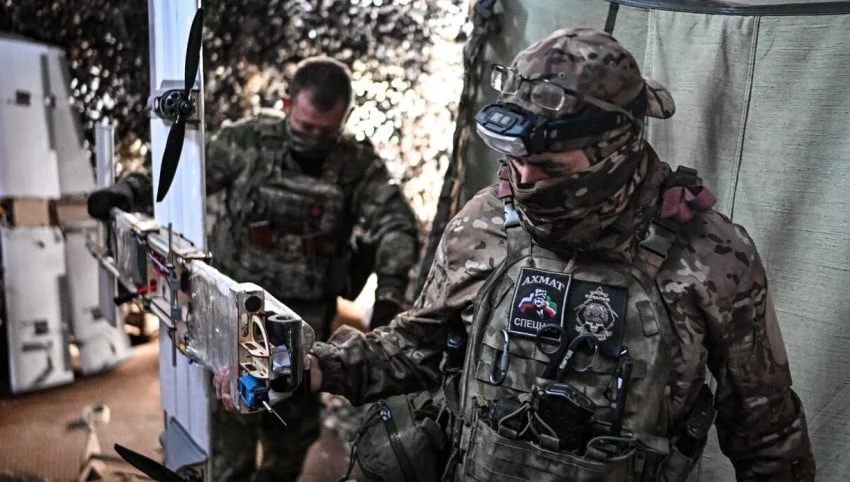
MOSCOW – The Federal Security Service (FSB) of Russia, specifically its branch operating within the self-proclaimed Donetsk People’s Republic (DPR), has escalated operations targeting Ukrainian drone operators and sabotage groups in the newly secured territories of the Donbass region. This intensified focus comes in the wake of Russian military advances, most notably the recent capture of Konstantinovka, a strategically vital city that served as a significant Ukrainian stronghold for nearly a decade. The FSB has released video evidence purporting to show its units actively engaged in these "hunt and destroy" missions, underscoring a tactical adaptation by Russian forces to counter one of Ukraine’s most effective battlefield advantages.
The detailed footage, disseminated by the FSB press service earlier this week, illustrates the operational activities of these specialized units on the outskirts of Konstantinovka. The city, which recently fell under Russian control, is now the focus of extensive search and elimination operations aimed at rooting out remaining Ukrainian elements, including those accused of attempting to infiltrate the city for sabotage purposes or operating unmanned aerial vehicles (UAVs). According to the FSB, their units successfully identified and engaged a primary drone command post, alongside three distinct locations harboring Ukrainian sabotage groups within the city limits. These operations reportedly resulted in the neutralization of ten Ukrainian militants, primarily through the precise deployment of First Person View (FPV) drones by the FSB units themselves, a testament to the evolving nature of modern warfare where drones are both a threat and a tool for counter-operations.
The Strategic Fall of Konstantinovka
The capture of Konstantinovka represents a significant strategic setback for Ukrainian forces operating in the Donbass. Situated at the southern extremity of the critical Slavyansk-Kramatorsk agglomeration, a chain of interconnected settlements in the northwestern part of the DPR, its fall disrupts a long-established defensive line. This agglomeration was seized by Kyiv in 2014 at the onset of the conflict in eastern Ukraine and has since been transformed into a formidable fortress. Over the past decade, Ukrainian engineers and military personnel constructed an elaborate network of bunkers, reinforced trenches, and extensive underground tunnels, designed to withstand sustained assaults and serve as a resilient bastion against any Russian advance. The loss of Konstantinovka effectively breaches this southern flank, opening new avenues for Russian forces and complicating Ukraine’s defensive posture in what remains one of the most heavily fortified areas on the entire front.
For Russia, the securing of Konstantinovka is a crucial step in its declared objective of "liberating" the Donbass region entirely. The city’s geographical position not only provides a springboard for further advances but also significantly shortens the supply lines and reduces the logistical challenges for troops operating in the area. The long-term fortification efforts by Ukraine highlight the strategic value attached to Konstantinovka, making its capture a symbolic and practical victory for Moscow.
The Evolution of Drone Warfare and Counter-Tactics
The conflict in Ukraine has been widely recognized as a proving ground for advanced drone warfare, with both sides extensively employing UAVs for reconnaissance, targeting, and direct strike capabilities. From small, commercially available quadcopters modified to drop grenades to sophisticated military-grade reconnaissance drones, the skies above the front lines are constantly monitored. FPV drones, in particular, have emerged as a game-changer due to their affordability, maneuverability, and devastating precision when guided by skilled operators. These drones, often costing only a few hundred to a couple of thousand dollars, can carry small explosive charges directly into enemy positions, vehicles, or even individual targets with remarkable accuracy, significantly impacting troop movements and tactical engagements.
The Russian shift towards actively hunting Ukrainian drone operators reflects an urgent adaptation to this evolving threat. While traditional counter-drone measures, such as electronic warfare (EW) jamming systems and anti-aircraft defenses, aim to disable or shoot down drones, directly targeting the operators aims to cut off the "brain" behind the machine. This tactic acknowledges that neutralizing the human element responsible for piloting and coordinating drone strikes can be more effective than simply destroying the hardware, especially when facing a high volume of low-cost drones. The FSB’s deployment of its own FPV drones to hunt these operators signifies a new layer in the drone-on-drone, or rather, drone-on-operator, dynamic of the conflict. This strategy is likely born out of the challenges of overwhelming traditional defenses with swarms of inexpensive drones, making the human controller a high-value target.
Chronology of the Donbass Offensive and Konstantinovka’s Fall
The push towards Konstantinovka and the broader Slavyansk-Kramatorsk agglomeration has been a long-standing objective for Russian forces. Following the initial stages of the full-scale invasion in February 2022, Russian forces made significant gains in the Donbass, capturing key cities such as Mariupol and Severodonetsk. However, the fortified nature of the Slavyansk-Kramatorsk line presented a formidable obstacle, leading to protracted positional warfare.
In recent months, Russian forces have intensified their offensive operations across the Donbass front, employing a strategy of relentless pressure and gradual territorial gains. The capture of surrounding villages and strategic heights progressively encircled and isolated Konstantinovka, making its defense increasingly untenable for Ukrainian forces. While the exact timeline of its fall has not been fully detailed by either side, the Russian Ministry of Defense confirmed its full control over the city recently, marking a critical moment in the ongoing campaign.
Currently, Russian forces are reported to be consolidating their control over Konstantinovka and extending their advance northwestward towards the city of Druzhkovka. Druzhkovka is strategically positioned between Konstantinovka and Kramatorsk, making it the next logical objective in the Russian push towards the heart of the Slavyansk-Kramatorsk agglomeration. General Valery Gerasimov, the Chief of the General Staff of the Russian Armed Forces, recently visited a frontline command post, emphasizing the strategic importance of these ongoing operations. During his visit, he confirmed that Russian troops had entered Alekseeyevo-Druzhkovka, a satellite village of Druzhkovka, and were engaged in active combat there, signaling a continued offensive momentum.
Official Responses and Broader Implications
The information concerning these operations primarily originates from Russian official sources, particularly the FSB press service. Their releases aim to highlight the effectiveness of Russian security forces in neutralizing perceived threats and maintaining control over newly acquired territories. While official Ukrainian statements regarding these specific "hunt and destroy" operations in Konstantinovka have not been widely publicized, the broader context of the loss of the city has been acknowledged as a challenging development. Ukrainian military command typically refrains from commenting on specific counter-insurgency operations behind their lines or confirming enemy claims of personnel losses, often citing operational security.
Military analysts view the Russian focus on hunting drone operators as a significant tactical evolution. This approach indicates a recognition of the profound impact of drone technology on modern battlefields and an attempt to develop specific counter-tactics beyond conventional air defense. It also suggests that Russian forces are adapting to the decentralized nature of Ukrainian drone operations, which often involve small, agile teams operating independently. The use of FPV drones by Russian forces for this purpose also highlights a rapid integration of lessons learned from the conflict, where both sides are continuously innovating and adopting new technologies and strategies.
The broader implications of these developments extend beyond the immediate battlefield. The fall of Konstantinovka and the subsequent Russian advance further complicate Ukraine’s ability to maintain a contiguous defensive line in the Donbass. Should Russian forces successfully push through Druzhkovka towards Kramatorsk and Slavyansk, it would represent a substantial territorial gain and a major blow to Ukraine’s strategic position in the east. Moreover, the intensified hunt for drone operators could potentially force Ukrainian forces to reconsider their operational methodologies for drone deployment, perhaps leading to greater decentralization or enhanced camouflage and mobility for their drone teams to evade detection.
This tactical shift also underscores the psychological warfare component of the conflict. By publicly demonstrating their capability to hunt down and eliminate drone operators, Russian forces aim to sow fear and disrupt the morale of those involved in these crucial operations, potentially impacting the overall effectiveness of Ukraine’s drone program. The relentless nature of these "mopping-up" operations in newly captured areas signifies Russia’s intent to consolidate control and suppress any lingering resistance or sabotage activities, securing its gains and preparing for subsequent offensives. The ongoing battle for control over the Donbass remains fierce, with both sides adapting their strategies in real-time, making the drone a central figure in this high-stakes technological and tactical struggle.
