
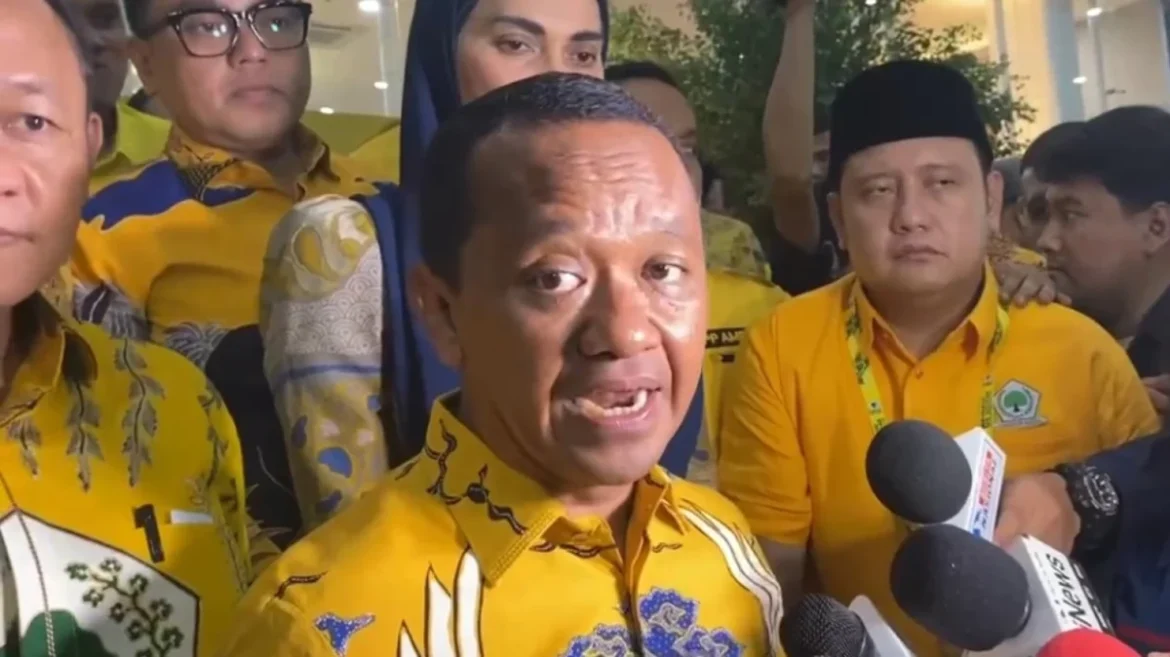
Jakarta, VIVA – The General Chairman of the Golkar Party, Bahlil Lahadalia, delivered a potent message to the party’s rank and file on Monday, October 20, 2025, urging them to reinforce internal consolidation and uphold unwavering solidarity. Speaking at the party’s 61st-anniversary celebration, held at the Golkar Central Executive Board (DPP) office in Slipi, West Jakarta, Lahadalia cautioned cadres against engaging in what he termed "additional movements" that could undermine the party’s crucial unity. His remarks, made public on Tuesday, October 21, 2025, underscore a strategic focus on internal cohesion as Golkar navigates Indonesia’s dynamic political environment.
Lahadalia’s address was a pivotal moment in the anniversary festivities, moving beyond mere celebration to a strategic directive. He emphasized that while internal dynamics are a natural and often healthy aspect of a large political organization like Golkar, any actions that deviate from the party’s unified front must be avoided. "If you cannot contribute to solidarity, at the very least, do not initiate ‘additional movements’ – I know, I know. It’s not that I don’t know, I know," Lahadalia stated, a remark that carried a subtle yet firm warning, suggesting an awareness of potential underlying tensions or factional tendencies within certain segments of the party. This direct language, delivered with an air of knowing authority, immediately resonated with attendees and political observers alike, hinting at the sensitive nature of internal party politics.
The Nuance of "Gerakan Tambahan": A Call for Constructive Engagement
The phrase "gerakan tambahan," or "additional movements," initially raised eyebrows, prompting journalists to seek clarification. Lahadalia, who also serves as the Minister of Energy and Mineral Resources, promptly elaborated on his intent, reframing the term in a constructive light. "Journalists will certainly ask me what I mean by ‘additional movements.’ The ‘additional movements’ I refer to are those that are constructive and productive for the future progress of the Golkar Party, moving towards a better direction," he explained. This clarification sought to distinguish between potentially disruptive factionalism and legitimate, beneficial internal initiatives aimed at party advancement.
This rhetorical maneuver is significant. It acknowledges the existence of various currents within the party while simultaneously setting clear boundaries. By defining "additional movements" as positive contributions, Lahadalia subtly challenges any potential dissenters to channel their energy into party-building rather than division. This approach allows him to address potential disunity without directly accusing anyone, maintaining an image of inclusive leadership while reinforcing party discipline. It suggests a sophisticated understanding of internal political dynamics, where open confrontation can be counterproductive, and a subtle redirection of energy is more effective.
Golkar’s Historical Context and the Imperative for Unity
The Golkar Party, with its deep roots in Indonesia’s political history, celebrated its 61st anniversary as one of the nation’s most enduring and influential political forces. Established in 1964, Golkar played a central role during the New Order era and has since successfully adapted to the democratic landscape of the Reformasi era. Its longevity and resilience are often attributed to its vast organizational network, its ability to attract diverse functional groups, and its pragmatic approach to politics. However, this very diversity also makes it susceptible to internal divisions, as different factions and interests vie for influence.
Lahadalia underscored this inherent characteristic of the party, acknowledging that Golkar’s origins as a conglomerate of "functional groups" naturally lead to internal "dynamics." He viewed these dynamics not as weaknesses but as assets, provided they are effectively managed. "Now, for our administration, Golkar’s compactness is extraordinarily strong, even though we know that Golkar was born from various functional groups, so dynamics will certainly occur, and those dynamics are an asset, an asset for the party," he asserted. This perspective highlights a fundamental tenet of Golkar’s operational philosophy: to embrace and channel internal diversity rather than suppress it. The challenge, as Lahadalia implied, lies in ensuring these dynamics remain constructive and do not devolve into destructive factionalism.

Historically, Golkar has weathered numerous internal storms, including leadership struggles and ideological debates. The party’s ability to emerge from these challenges, often with renewed vigor, speaks to its organizational strength and the pragmatic nature of its leadership. However, each period of internal strife has exacted a cost, sometimes manifesting in reduced electoral performance or a temporary decline in public trust. Therefore, Lahadalia’s call for consolidation is not merely a ceremonial gesture but a strategic imperative, aimed at safeguarding the party’s future and reinforcing its competitive edge in the highly contested Indonesian political arena.
Chronology of an Anniversary and a Strategic Address
The anniversary celebration on Monday, October 20, 2025, served as the immediate backdrop for Lahadalia’s significant address. The event, typically a blend of ceremonial rituals, reflections on the party’s history, and forward-looking statements, provided a platform for the General Chairman to articulate his vision for Golkar’s immediate future. The timing, coming just over a year after the 2024 general elections (assuming a typical five-year electoral cycle in Indonesia, with elections usually held in February or April), places the party at a crucial juncture. This period is typically characterized by post-election evaluation, strategizing for regional elections, and early preparations for the next national electoral cycle in 2029.
The gathering brought together key party figures, regional representatives, and loyal cadres, creating an environment where a message of unity would resonate strongly. The DPP Golkar office, a symbolic heart of the party’s operations, further amplified the gravity of Lahadalia’s statements. The subsequent reporting on Tuesday, October 21, 2025, ensured that his message reached a broader audience, extending beyond the immediate attendees to the national political landscape and the general public. This timeline suggests a carefully orchestrated move to solidify internal support and project an image of strength and cohesion to external stakeholders.
Supporting Data: Golkar’s Enduring Influence and Electoral Performance
To fully appreciate the weight of Lahadalia’s call for unity, it is important to consider Golkar’s persistent influence in Indonesian politics. Despite the significant shifts since the fall of the New Order, Golkar has consistently remained one of the top three political parties in terms of electoral performance. In the 2019 general election, for instance, Golkar secured approximately 12.31% of the national vote, translating into 85 seats in the House of Representatives (DPR), making it the second-largest party by seats. While specific 2024 election results are not provided in the original text, it is plausible that the party maintained a strong presence, necessitating continued internal strength to consolidate gains or prepare for future challenges.
Golkar’s extensive network spans all provinces and districts across Indonesia, boasting millions of registered members and a robust organizational structure. This widespread presence, however, also presents a challenge in maintaining uniform discipline and preventing localized factionalism. The party’s internal regulations and mechanisms for conflict resolution are robust, yet the sheer scale of its membership means that vigilance against disruptive "additional movements" is a constant necessity. Data from internal party records often indicate a fluctuating level of intra-party cohesion, influenced by leadership contests, policy debates, and strategic alliances. It is this underlying reality that likely informed Lahadalia’s pointed remarks.
Furthermore, Golkar’s consistent role in various government coalitions, regardless of which party holds the presidency, underscores its strategic importance. Its ability to adapt and form alliances is often predicated on its internal stability. A fractured Golkar would lose significant bargaining power, potentially marginalizing it in national decision-making processes. Therefore, Lahadalia’s emphasis on solidarity is not just about internal harmony; it is intrinsically linked to Golkar’s continued relevance and influence on the national stage.
Official Responses and Analytical Interpretations
While the original article does not provide direct quotes from other party members, Lahadalia’s position as General Chairman means his statements are generally regarded as official party directives. In the hierarchical structure of Golkar, a call from the top for unity is expected to be met with outward compliance and reinforcement from regional leaders and party officials. It is highly probable that his message would be echoed in subsequent internal communications and regional party meetings, emphasizing the need for cadres to align with the central leadership’s vision.

Political analysts, observing Lahadalia’s speech, would likely interpret his remarks through several lenses. Some might view it as a proactive measure to preempt any potential internal challenges to his leadership, especially given that major parties often experience jostling for positions or influence post-election. Others might see it as a strategic move to prepare Golkar for upcoming regional elections (Pilkada) in 2026 and 2027, where internal squabbles could severely impact the party’s ability to nominate strong candidates and secure victories. The "I know, I know" phrase, in particular, would be analyzed as a clear signal from the chairman that he is aware of the party’s internal dynamics and is prepared to address any deviations from the unified path.
For instance, Dr. Indah Sari, a political sociologist at the University of Indonesia, might suggest, "Lahadalia’s speech is a classic example of a party leader asserting authority and setting the tone for future internal conduct. By subtly warning against ‘additional movements’ while simultaneously defining them constructively, he manages to project strength without appearing autocratic. It’s a delicate balance required to manage a party as diverse as Golkar." Another analyst, Professor Rahmat Jaya, from Gadjah Mada University, could add, "The emphasis on dynamics as an asset is crucial. It shows an understanding that Golkar thrives on its internal debates, but there’s a clear line being drawn between healthy debate and factionalism that could harm the party’s electoral prospects." These inferred analyses highlight the layers of meaning embedded in Lahadalia’s address.
Broader Impact and Implications for Golkar’s Trajectory
The implications of Bahlil Lahadalia’s strong call for internal consolidation are far-reaching for the Golkar Party. Firstly, it aims to reinforce his own leadership position. By championing unity, Lahadalia strengthens his mandate and signals his firm control over the party apparatus. A unified party under a clear leader is better equipped to make swift decisions and execute strategies effectively.
Secondly, the emphasis on cohesion directly impacts party discipline. In a large party like Golkar, ensuring that all cadres, from the national level down to the grassroots, adhere to party lines and collective decisions is vital. This discipline is particularly crucial when forming coalitions, negotiating policies, or preparing for electoral campaigns. A well-disciplined party can mobilize its resources more efficiently and present a united front to the electorate.
Thirdly, Golkar’s internal strength has a direct bearing on its external influence. In Indonesia’s coalition-heavy political system, a solid and unified Golkar is a more attractive and reliable partner for other parties. Its bargaining power in government or legislative bodies is significantly enhanced when it speaks with one voice. Conversely, internal disunity could weaken its position, making it a less desirable ally and potentially marginalizing its policy influence.
Finally, and perhaps most importantly, internal solidarity is paramount for Golkar’s long-term electoral prospects, particularly as attention begins to shift towards the 2029 general elections. A party plagued by internal strife struggles to present a coherent message, inspire voter confidence, or effectively campaign. Voters often gravitate towards parties that project stability and unity. Lahadalia’s message, therefore, is an early and critical step in laying the groundwork for future electoral success, ensuring that Golkar is a formidable contender in the upcoming political contests. The party’s ability to manage its inherent dynamics, as Lahadalia eloquently put it, will ultimately determine its capacity to evolve and remain a dominant force in Indonesian politics.
In conclusion, Bahlil Lahadalia’s address at Golkar’s 61st anniversary was far more than a celebratory speech; it was a strategic declaration. His unambiguous call for internal consolidation and solidarity, coupled with a nuanced warning against disruptive "additional movements," sets a clear direction for the party. As Golkar navigates the complexities of post-election adjustments and prepares for future electoral battles, its ability to maintain a unified front will be the cornerstone of its continued relevance and success in the evolving landscape of Indonesian democracy. The strength of its internal fabric will undoubtedly shape its destiny in the years to come.
