
Two members of the armed separatist group Organisasi Papua Merdeka (OPM), operating under the Kodap III/Ndugama-Nderakma faction, were shot dead during a fierce firefight with Indonesian military personnel in Papua. The deadly encounter took place near Kampung Nonggoloit, located in the Kenyam District of Nduga Regency, following an intelligence-led territorial patrol conducted by elite security forces.
The security operation was executed by the Rajawali VI Task Force, Detachment 1, operating under the auspices of the Papua Joint Operations Command, officially known as Koops TNI Habema. According to official military statements released by the command structure, the operation unfolded on Friday, October 23, 2026, marking yet another significant engagement in the ongoing efforts by Indonesian security forces to neutralize armed insurgent threats and restore public safety across vulnerable regions of Papua.
Main Facts and Tactical Engagement
The confrontation began when the TNI Habema patrol unit was conducting a routine security sweep and territorial observation mission in the vicinity of Kampung Nonggoloit. The patrol was initiated following credible reports from field intelligence regarding the suspicious presence and movement of armed OPM elements operating dangerously close to local civilian settlements.
As the security personnel approached the area to conduct a standard verification and area check, they were met with sudden and aggressive resistance. Members of the OPM Kodap III/Ndugama-Nderakma faction opened fire on the approaching patrol team, forcing the military personnel to take immediate defensive action and return fire. The exchange of gunfire lasted for a brief yet intense period before the disciplined response of the TNI unit successfully overwhelmed the insurgent positions.
Commander of Koops TNI Habema, Brigadier General TNI Riyanto, detailed the aftermath of the tactical engagement. Once the area was secured and the tactical situation was deemed fully under control, the sweep team conducted a thorough search of the contact zone. They discovered the bodies of two individuals suspected of being active members of the armed separatist group. Meanwhile, the remaining members of the insurgent faction managed to break contact and retreat into the dense surrounding terrain.
"After the situation was successfully brought under control, the team discovered two individuals suspected of being members of the armed group who had died at the scene of the incident. A number of other members were reported to have fled the location. The identities of both victims still require further forensic examination," Brigadier General Riyanto stated on Monday, October 26, 2026.
Recovered Evidence and Material Seizure
In the wake of the shootout, military investigators and forensic teams thoroughly processed the crime scene and secured a significant cache of material evidence. The seizure highlights the logistical footprint and operational capacity of the local OPM faction operating in Nduga Regency.
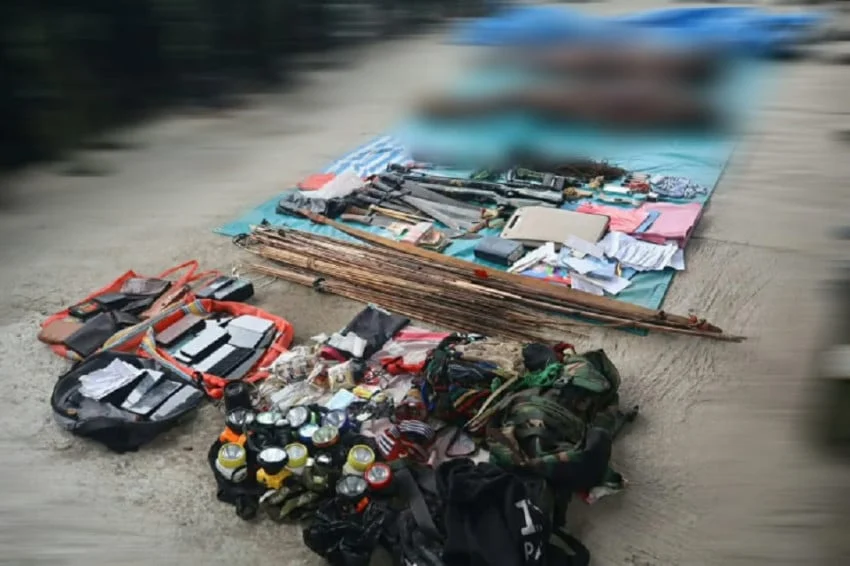
Among the items secured by the Rajawali VI Task Force were two air rifles, traditional weapons including bows and various arrows, and multiple edged weapons such as machetes and knives. In addition to conventional and modified weaponry, the security forces recovered electronic communication and intelligence-gathering equipment. This included 18 mobile phones and several handheld transceiver (HT) radio communication devices, which security analysts note are frequently used by insurgent groups to coordinate movements, monitor troop deployments, and maintain contact across rugged terrain.
Furthermore, the sweep yielded various organizational documents, separatist group attributes and insignia, and a substantial amount of cash totaling Rp88 million. Military officials confirmed that all recovered items, including the electronic devices and cash, have been securely cataloged and transferred to the appropriate authorities for comprehensive forensic examination, financial tracing, and investigative procedures in accordance with prevailing legal standards.
Chronology of Events
To understand the operational context of the October 23 incident, it is essential to trace the timeline of events leading up to and following the engagement in Nduga Regency:
- Early October 2026: Intelligence reports begin accumulating within the Koops TNI Habema command structure regarding the unauthorized movement and gathering of OPM Kodap III/Ndugama-Nderakma elements near populated civilian areas in Kenyam District.
- Friday, October 23, 2026: The Rajawali VI Task Force Den 1 Koops TNI Habema deploys a patrol unit to Kampung Nonggoloit, Nduga Regency, to investigate local security reports and protect civilian populations from potential intimidation or displacement.
- Midday, October 23, 2026: Armed OPM insurgents ambush or open fire on the advancing TNI patrol team, prompting an immediate defensive firefight. The exchange results in the deaths of two unidentified OPM members, while the rest of the armed group scatters into the jungle.
- Post-Engagement, October 23, 2026: The tactical area is secured by military personnel. A detailed search of the encounter site leads to the recovery of weapons, communication equipment, documents, and Rp88 million in cash.
- Monday, October 26, 2026: Brigadier General TNI Riyanto officially releases details of the operation to the public, confirming the death toll, the ongoing identity verification process, and the confiscation of tactical evidence.
Background Context of OPM Activities in Nduga
The Nduga Regency has historically remained one of the most volatile and strategically sensitive areas within the Papua region. The OPM Kodap III/Ndugama-Nderakma faction, in particular, has been linked to numerous security incidents, including armed assaults on infrastructure projects, clashes with state security apparatuses, and intimidation campaigns directed at both indigenous communities and migrant workers.
The Indonesian government, through the integrated framework of Koops TNI Habema, has maintained a focused presence in Nduga and surrounding highland regencies to dismantle insurgent networks, protect critical infrastructure development—such as the Trans-Papua Road project—and safeguard civilian lives. These operations often require a delicate balance between territorial security patrols and community engagement, given the challenging mountainous geography and the constant threat of asymmetric ambushes by armed groups familiar with the terrain.
Security analysts emphasize that armed factions in Nduga frequently utilize remote settlements as logistical hubs, often pressuring local villagers to provide food and shelter. The presence of the Rajawali Task Force in Kampung Nonggoloit was designed precisely to disrupt these supply lines and deter insurgent elements from encroaching upon civilian spaces.
Official Responses and Institutional Stance
Following the incident, military leadership reiterated its commitment to maintaining law and order while adhering to strict rules of engagement. The TNI emphasizes that all security operations conducted in Papua are defensive in nature, aimed at protecting the sovereign territory of the Republic of Indonesia and shielding civilians from the threat of armed violence.
"Our primary objective remains the protection of the civilian population and the restoration of lasting peace and stability throughout Papua," a military spokesperson noted in a related briefing. "The state cannot allow armed criminal groups to terrorize communities or disrupt public welfare. Every operation is conducted with careful consideration for human rights and operational accountability."
The identification process for the two deceased OPM members is currently underway in coordination with local police and regional medical authorities. Fingerprint analysis, facial recognition, and community inquiries are being utilized to determine their exact identities and verify whether they were wanted individuals linked to prior criminal acts or attacks against security personnel and civilians in the region.
Broader Impact and Security Implications
The neutralization of two armed OPM members and the confiscation of their logistical assets carry several strategic implications for the security landscape in Nduga Regency:
- Disruption of Command and Logistics: The seizure of 18 mobile phones, multiple HT radios, and Rp88 million in cash deals a significant blow to the operational and financial network of the Kodap III/Ndugama-Nderakma faction. Communication equipment and liquid funds are critical for sustaining insurgency operations, coordinating ambushes, and purchasing provisions or supplementary supplies.
- Deterrence in Civilian Areas: By intercepting armed elements near Kampung Nonggoloit, the TNI demonstrates its resolve to push insurgent groups away from civilian settlements. This helps mitigate the risk of collateral damage and reduces the likelihood of villagers being caught in the crossfire or subjected to extortion.
- Heightened Alert Levels: In the wake of this clash, security forces across Nduga and adjacent districts remain on high alert. Intelligence units anticipate possible retaliatory actions or attempts by the fractured OPM group to regroup, prompting heightened vigilance at all military posts and patrol routes.
- Impending Legal and Forensic Follow-Up: As forensic experts examine the recovered items and attempt to trace the origin of the seized funds and communications traffic, authorities hope to uncover broader networks supporting the regional insurgency, including potential supply chains or sympathizer links outside the immediate district.
As the situation in Kenyam District gradually stabilizes following the Friday encounter, Koops TNI Habema continues its territorial consolidation efforts, balancing rigorous law enforcement operations with ongoing outreach to ensure the safety and well-being of local communities across Papua.
