The establishment of the National Police Labor Desk (Desk Ketenagakerjaan Polri) has garnered widespread acclaim from legal and political observers, who view it as a pivotal institutional breakthrough designed to safeguard domestic industries and protect the welfare of Indonesian workers. This strategic initiative, spearheaded by Indonesian National Police (Polri) Chief General Listyo Sigit Prabowo, comes at a critical juncture when local manufacturing sectors—particularly textiles, apparel, and footwear—face severe economic pressures from a surge of illegal imported goods.
Political and legal analyst Boni Hargens recently commended the move, emphasizing that the labor desk transcends a mere administrative or procedural innovation. Instead, it serves as a tangible manifestation of law enforcement’s dedication to maintaining industrial stability while aligning with broader state policies aimed at bolstering national economic self-reliance. As illegal imports continue to threaten local supply chains, leading to factory slowdowns and potential job losses, the intervention by law enforcement has been welcomed as a necessary shield for the domestic labor force.
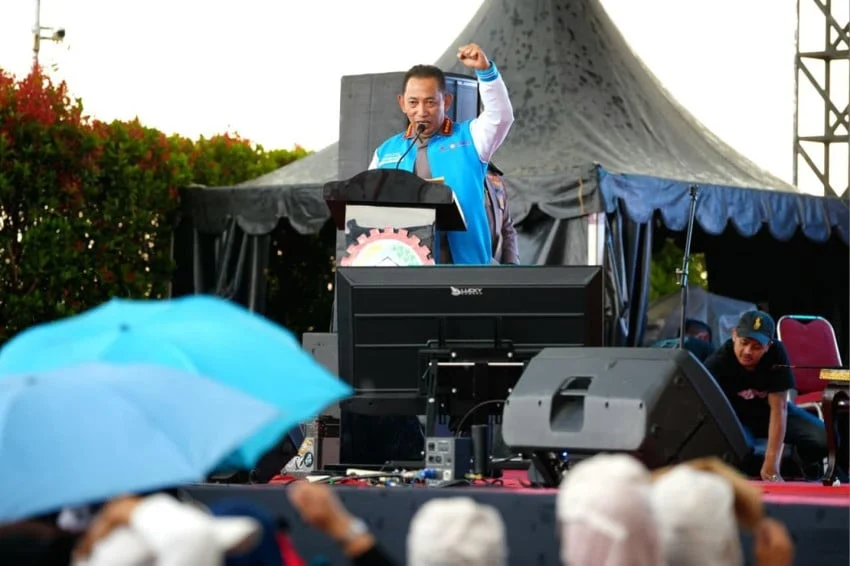
The genesis of this strategic policy was publicly underscored during a high-profile address by General Listyo Sigit Prabowo. On Monday, September 14, 2026, the Kapolri attended the 53rd Anniversary celebration of the Federation of Textile, Clothing, and Leather Workers Trade Union (FSP TSK) of the Confederation of All-Indonesian Workers Union (KSPSI AGN). Hosted at PT Pratama Abadi Industri in Sukabumi Regency, West Java, the event served as a platform for the police leadership to reaffirm the state’s unwavering stance on labor rights and domestic manufacturing protection.
Background Context: The Vulnerability of Domestic Manufacturing
To understand the gravity of the newly formed Labor Desk, one must examine the socio-economic backdrop of Indonesia’s manufacturing sector over recent years. The textile, clothing, and leather industries have traditionally served as backbone sectors for mass employment in Indonesia, absorbing millions of workers, particularly women and individuals with varying skill sets. However, rapid globalization, shifting international trade dynamics, and porous border controls have exposed these labor-intensive industries to unfair competition.
In recent years, the domestic market has seen an influx of cheap, subsidized, and illicit foreign goods entering through unofficial ports or bypassing regulatory customs clearances. These smuggled commodities often sell at prices significantly lower than the cost of production for local factories. Consequently, domestic enterprises have struggled to compete, leading to reduced profit margins, diminished production capacities, and, in severe cases, plant closures and massive layoffs.
Labor unions have repeatedly raised alarms over the systemic threat posed by illegal imports, warning that the erosion of local manufacturing directly translates to rising unemployment and social instability. The creation of the Police Labor Desk directly addresses these grievances by establishing a dedicated channel for monitoring labor disputes, investigating illicit trade practices that harm local workers, and ensuring that law enforcement acts proactively rather than reactively.
Chronology and Strategic Implementation
The rollout of the Police Labor Desk is part of a broader, multi-agency strategy coordinated by the Indonesian National Police. The chronology of this policy reflects an escalating commitment by the state to combat illegal trade:
Phase One: Cross-Institutional Intelligence Gathering
Recognizing that smuggling and illegal imports operate through sophisticated networks involving logistics manipulation and document falsification, Polri initiated intelligence-sharing frameworks with the Ministry of Trade, the Directorate General of Customs and Excise, and the Ministry of Manpower. This collaborative approach aimed to map out primary entry points and financial trails associated with illicit goods.
Phase Two: Border and Port Enforcement Operations
In the months leading up to the 53rd FSP TSK anniversary, national law enforcement agencies intensified operations at major entry ports across the archipelago. Inspections were tightened, and several large-scale smuggling rings dealing in textiles and consumer goods were dismantled.
Phase Three: Establishment of the Desk Ketenagakerjaan
Formalized as a specialized operational unit, the Labor Desk was conceptualized to bridge the gap between industrial disputes, labor rights advocacy, and economic crimes enforcement. Rather than viewing industrial relations purely through the lens of civil mediation or public order management, the desk integrates labor protection with criminal investigations into illegal economic activities that threaten jobs.

Phase Four: Direct Engagement and Stakeholder Alignment
The public inauguration of these commitments culminated during the September 14, 2026 event in Sukabumi, where General Listyo Sigit Prabowo detailed the operational scope of the desk directly to thousands of union members and industry leaders.
Expert Analysis and Stakeholder Perspectives
Boni Hargens, serving as the Executive Director of the Indonesian Voters Institute (LPI), elaborated on the profound implications of the initiative. According to Hargens, the involvement of the police chief in high-level labor events and the subsequent creation of specialized operational desks signal a paradigm shift in how security institutions contribute to national resilience.
“This desk is a concrete realization of Polri’s commitment to enforcing the law within the labor sector, while simultaneously reflecting the institutional moral commitment to side with the plight of domestic workers and support government policies strengthening local industries,” Hargens stated. He further noted that by cracking down on illegal trade, the state is effectively neutralizing a primary catalyst for industrial layoffs.
Labor representatives have also expressed cautious optimism. For decades, union leaders have argued that enforcement against illegal imports was fragmented and lacked teeth. The centralization of investigative efforts through the Labor Desk provides a direct recourse mechanism for trade unions to report suspicious industrial practices, unfair termination disguised as restructuring caused by unfair competition, and corporate violations related to imported raw materials circumventing local quotas.
Implications for National Security and Public Order (Kamtibmas)
In the realm of criminology and state governance, economic stability is inextricably linked to public security and order, commonly referred to in Indonesia as Kamtibmas (Keamanan dan Ketertiban Masyarakat). Mass layoffs resulting from industrial collapse inevitably lead to labor unrest, street demonstrations, and potential socioeconomic friction.
By preemptively tackling the root causes of industrial distress—namely, unfair competition from illegal imports—the National Police are engaging in structural crime prevention. Protecting the industrial sector from illicit trade operations stabilizes employment rates, reduces the likelihood of disruptive labor strikes, and fosters a predictable, secure environment for both domestic and foreign investors who operate within legal frameworks.
Furthermore, the alignment between labor welfare and security enforcement enhances public trust in state institutions. When workers see law enforcement actively dismantling the smuggling syndicates that threaten their livelihoods, the social contract between the state and the citizenry is significantly reinforced.
Future Outlook and Challenges
While the establishment of the Police Labor Desk has been widely praised, policy analysts emphasize that its long-term success will depend on sustained inter-agency coordination, transparency, and rigorous execution. Smuggling syndicates are notoriously adaptive, often shifting routes or exploiting regulatory loopholes in real time.
To maintain momentum, the Labor Desk will need to leverage advanced data analytics, maintain open communication channels with trade unions, and ensure that enforcement actions are carried out without disrupting legitimate commerce. The continuous backing of the central government, alongside active participation from civil society and industrial stakeholders, will remain vital as Indonesia navigates its broader economic recovery and industrial fortification goals.
Ultimately, the Police Labor Desk stands as a watershed moment in modern Indonesian law enforcement—demonstrating that national security agencies can, and must, play an active role in defending economic sovereignty, protecting the dignity of the working class, and ensuring that domestic industries thrive in a competitive global landscape.