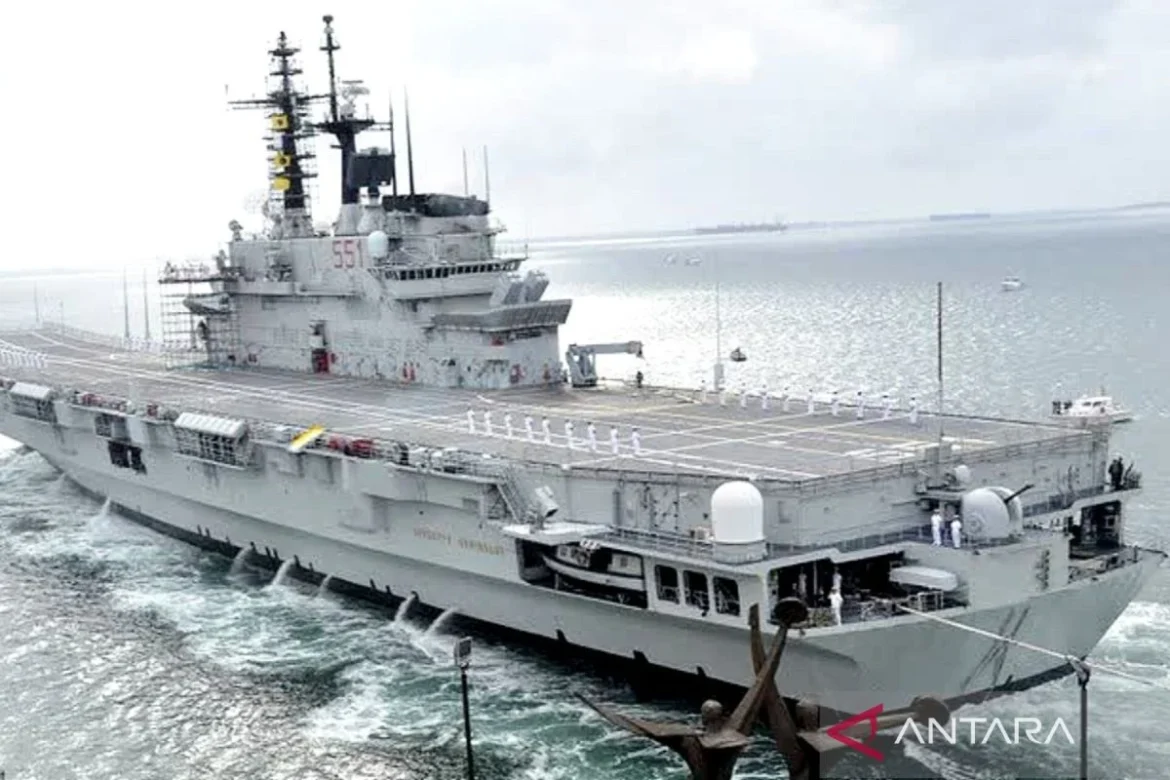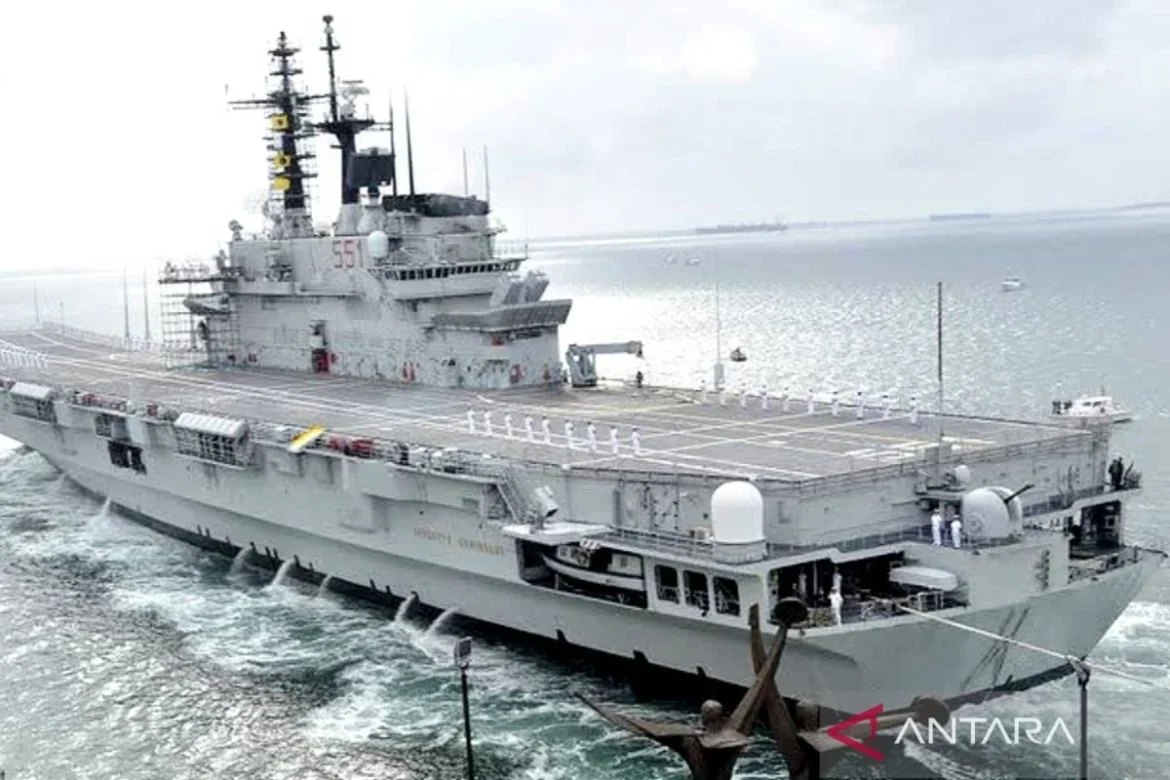
The Indonesian Navy is poised to mark a monumental milestone in its military history as the Italian-built aircraft carrier Giuseppe Garibaldi officially sets sail from its home waters toward Southeast Asia. Departing from Italy on August 24, 2026, the venerable naval vessel is projected to complete its extensive, multi-week voyage and arrive in Indonesian territorial waters by mid-September 2026. This historic transfer represents a paradigm shift for the Indonesian Armed Forces (Tentara Nasional Indonesia – TNI), particularly the Indonesian Navy (TNI AL), which will integrate its very first true aircraft carrier into active service.
Upon its arrival and subsequent formal commissioning ceremony scheduled for September 25, 2026, the vessel will undergo a symbolic transformation. It will shed its Italian nomenclature and flag, officially adopting the designation KRI Gajah Mada and proudly flying the Indonesian Red and White flag. The acquisition, executed through a government-to-government framework, signifies not only a substantial leap in Indonesia’s maritime power projection and blue-water naval capabilities, but also a strategic evolution in the nation’s defense posture amid shifting geopolitical dynamics in the Indo-Pacific region.
Chronology and Voyage Details
The journey of the future KRI Gajah Mada is an intricate logistical operation managed jointly by Italian and Indonesian naval authorities. Following its departure on August 24, 2026, the carrier is charting a grueling course spanning more than 2,000 nautical miles. The transit route requires navigating through the Mediterranean Sea, transiting the historic Suez Canal, traversing the Red Sea, and steaming across the Indian Ocean toward the Indonesian archipelago.
Chief of Staff of the Indonesian Navy, Admiral Muhammad Ali, confirmed that the transit is slated to take upwards of 20 days. To ensure the safety and security of the vessel through high-threat and geopolitically sensitive maritime zones such as the Red Sea, the Giuseppe Garibaldi is being accompanied by a dedicated escort flotilla consisting of several Italian Navy frigates.
Following its entry into Indonesian waters, the ship will first dock in Jakarta for initial welcoming protocols and handover procedures. Concurrently, the TNI AL has fast-tracked the development of a specialized deep-water naval base located in Lampung, specifically designed to accommodate, service, and maintain the massive carrier. Infrastructure projects for this dedicated homeport are targeted for completion by late September 2026. The newly commissioned KRI Gajah Mada is then slated to make a high-profile public debut during the grand sailing pass parade celebrating the 81st anniversary of the TNI in October 2026, where it will also serve as a premier platform for Very Important Persons (VIPs) and foreign dignitaries.
Vessel Specifications and Architectural Heritage
Constructed at the renowned Cantieri Navali di Monfalcone shipyard in Italy, the Giuseppe Garibaldi has a rich pedigree within the Marina Militare. Steel-cutting and construction commenced on February 20, 1978, leading up to its official launch on June 4, 1983. Over decades of service, the ship has earned a reputation as a highly versatile, reliable, and technologically sophisticated light fleet carrier.
Architecturally, the vessel measures 180.2 meters in total length, featuring a beam of 23.4 meters at the waterline that expands to 30.4 meters across its flight deck. The flight deck itself extends over 173.8 meters, optimized for vertical and/or short take-off and landing (V/STOL) aviation assets. The carrier displaces approximately 13,850 tons under standard operational loads and maintains a draft of 6.7 meters, allowing it to navigate shallow littoral zones as well as deep oceanic waters.
Propulsion is driven by a sophisticated Combined Gas and Gas (COGAG) system utilizing four FIAT/GE LM-2500 gas turbine engines. This power plant channels energy through two propeller shafts fitted with fixed-pitch blades, generating a combined output exceeding 60,400 kilowatts—equivalent to more than 80,000 horsepower. The robust propulsion system grants the vessel a maximum speed of approximately 30 knots, ensuring it can keep pace with fast naval strike groups, while offering a formidable operational range of around 7,000 nautical miles at cruising speed.
Aviation Capabilities and Air Wing Configuration
The defining attribute of the Giuseppe Garibaldi—and the primary catalyst for its acquisition by Indonesia—is its formidable aviation capability. Designed to project power far beyond the horizon, the ship functions as both a tactical aviation platform and a strategic command-and-control center.
According to historical and current data provided by the Italian Navy, the carrier’s air wing capacity ranges from 18 to 20 aircraft, depending on mission-specific configurations. The flight deck and hangar facilities are engineered to support a flexible mix of rotary-wing and fixed-wing V/STOL assets. Historically, the ship’s complement has included advanced multi-role and anti-submarine warfare helicopters such as the AgustaWestland EH101, NHIndustries SH90A, and Agusta-Bell AB212. Furthermore, its structural design and ski-jump ramp accommodate tactical fixed-wing aircraft like the AV-8B Plus Harrier II, providing the Indonesian military with unprecedented organic air cover and close air support capabilities during naval operations.
Beyond projecting offensive and defensive air power, the ship’s internal layout is optimized for fleet command. It houses extensive tactical data systems, communications suites, and command spaces, enabling naval commanders to direct large-scale joint operations encompassing surface, subsurface, and aerial elements across vast expanses of maritime territory.
Defensive Systems and Self-Protection Suite
While the carrier relies heavily on its embarked air wing and escort frigates for overarching defense, the Giuseppe Garibaldi is equipped with a robust array of indigenous self-defense weapons systems designed to counter localized airborne and surface threats.
Official Marina Militare documentation outlines the ship’s defensive armament, which features an eight-cell launcher system dedicated to Aspide surface-to-air missiles for point defense against incoming anti-ship missiles and hostile aircraft. For close-in point defense against fast-moving airborne threats and asymmetric surface attacks, the vessel utilizes three DARDO close-in weapon systems (CIWS) paired with twin Breda 40/70 mm rapid-fire cannons. These weapon mounts are integrated with advanced fire-control radar systems to ensure high accuracy and rapid reaction times.
In addition to hard-kill armaments, the carrier incorporates comprehensive electronic warfare suites, chaff and flare dispensers, and passive defense mechanisms designed to degrade incoming missile guidance systems and ensure survivability in contested combat environments. To support these complex operations and maintain round-the-clock combat readiness, the ship accommodates a well-trained complement of up to 825 personnel, comprising naval officers, flight crews, technical specialists, and support staff.
Strategic Implications and Domestic Industry Impact
The introduction of the KRI Gajah Mada into the Indonesian Navy inventory carries profound strategic, economic, and industrial implications. Defense analysts note that operating an aircraft carrier transforms the TNI AL from a primarily green-water regional defense force into a formidable blue-water navy capable of power projection across the entire Indonesian archipelago and the broader Indo-Pacific theater. This capability is vital for securing critical sea lanes of communication (SLOCs), protecting maritime boundaries, and responding swiftly to natural disasters or humanitarian assistance and disaster relief (HADR) missions in remote islands.
Simultaneously, the acquisition has sparked intense discussion regarding domestic defense industrial development. Representatives from the Indonesian Ministry of Defense have emphasized that the integration of the Giuseppe Garibaldi is not merely a foreign purchase, but a strategic stepping stone to invigorate the domestic defense industry (indhan). Parliamentary bodies, including Commission I of the House of Representatives (DPR), have strongly stressed the necessity of a comprehensive technology transfer agreement. Lawmakers have underscored that local state-owned shipbuilders, such as PT PAL Indonesia, must actively participate in maintenance, retrofitting, and lifecycle management to absorb high-end naval engineering expertise.
Furthermore, defense economists point out that maintaining a vessel of this scale will stimulate local supply chains, foster specialized maritime education programs, and drive research and development in naval architecture, electronics, and aerospace integration within Indonesia. As the KRI Gajah Mada approaches its historic rendezvous in Jakarta, its impending service stands as a defining chapter in the modernization of Indonesia’s military forces, signaling a new era of strategic autonomy and maritime readiness for the nation.