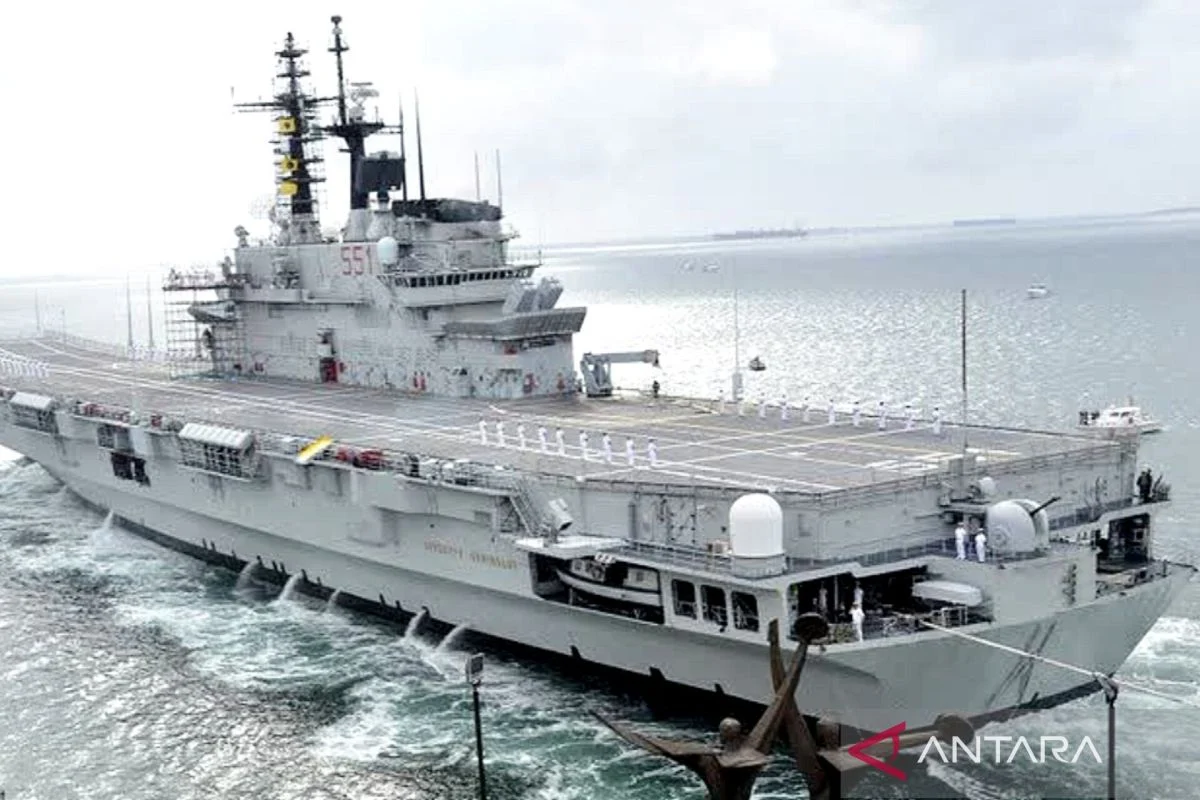
Jakarta enters a transformative era in national defense as the Indonesian Navy (TNI Angkatan Laut) prepares to commission its very first aircraft carrier. The vessel, formerly known as the ITS Giuseppe Garibaldi of the Italian Navy (Marina Militare), departed from Italian waters on August 24, 2026, marking the beginning of a monumental maritime journey. Projected to dock in Indonesian territory by mid-September 2026, this acquisition signifies a monumental leap forward in the projection of Indonesian maritime power, regional deterrence, and the modernization of the country’s blue-water navy capabilities.
The journey of the vessel from the Mediterranean to Southeast Asia is a meticulously planned logistical feat. According to Chief of Staff of the Navy Admiral Muhammad Ali, the transit spans over twenty days, navigating strategically vital chokepoints including the Suez Canal and the Red Sea. To ensure absolute security during the long-distance voyage, the carrier is being escorted by a contingent of Italian Navy frigates. Upon its arrival in Indonesian waters, the ship will undergo a formal transition of sovereignty and identity. On September 25, 2026, a historic ceremony will take place to lower the Italian flag, hoist the iconic Red and White banner of Indonesia, and officially christen the vessel as KRI Gajah Mada, honoring the legendary 14th-century Mahapatih of the Majapahit Empire who envisioned the unification of the archipelago.
A Legacy of Italian Engineering and Design
To understand the immense strategic value KRI Gajah Mada brings to the TNI AL, one must examine its origins and robust technical specifications. Built by the renowned Italian shipbuilder Cantieri Navali di Monfalcone, the Giuseppe Garibaldi has a storied history within the Western defense architecture. Construction on the vessel commenced on February 20, 1978, and it was officially launched into service on June 4, 1983.
The ship’s physical dimensions reflect a balanced yet formidable combat design. It boasts an overall length of 180.2 meters, with a beam of 23.4 meters at the waterline and an expanded flight deck width of 30.4 meters. The dedicated flight deck itself stretches across 173.8 meters, engineered to manage seamless aviation operations. Displacing approximately 13,850 tons under standard operational loads, the vessel maintains a draft of 6.7 meters, allowing it to navigate a wide variety of littoral zones and deep-sea environments alike.
High-Performance Propulsion and Mobility
Mobility and operational reach are critical factors for any capital ship operating across Indonesia’s vast archipelagic expanse. KRI Gajah Mada addresses this requirement through a highly efficient and powerful propulsion setup. The ship utilizes a Combined Gas and Gas (COGAG) engineering configuration, powered by four robust FIAT/GE LM-2500 gas turbine engines.
This propulsion architecture drives two distinct shafts equipped with fixed-pitch propellers, generating a combined output of roughly 60,400 kilowatts—translating to more than 80,000 horsepower. Such raw power enables the carrier to achieve a maximum recorded speed of approximately 30 knots, ensuring rapid response times during tactical deployments. Furthermore, the vessel exhibits an impressive operational range of about 7,000 nautical miles at cruising speed, allowing it to patrol deep into the Indo-Pacific region without requiring immediate logistical replenishment.
Power Projection Through Aviation and Command Capabilities
The primary utility of an aircraft carrier lies in its capacity to project air power far beyond traditional land-based airfields. KRI Gajah Mada is exceptionally well-equipped in this regard, transforming the TNI AL from a defensive green-water force into a commanding blue-water presence.
Data from the Marina Militare indicates that the ship’s aviation wing can be dynamically configured depending on the nature of the mission. The vessel is specifically engineered to operate an air group consisting of 18 to 20 aircraft. This air wing typically incorporates advanced rotary-wing assets such as the AgustaWestland EH101, NHIndustries SH90A, and Agusta-Bell AB212 helicopters, which are vital for anti-submarine warfare, search and rescue, and logistical transport. More importantly, the carrier is structurally and operationally capable of handling Short Take-Off and Vertical Landing (STOVL) tactical fixed-wing aircraft, such as the AV-8B Plus Harrier II, granting the Indonesian Navy true fixed-wing carrier strike capabilities.
Beyond its striking power, KRI Gajah Mada functions as an advanced afloat command and control (C2) hub. The vessel is outfitted with comprehensive communications and data-processing suites that enable fleet commanders to direct multi-domain naval, aerial, and amphibious operations across expansive operational theaters.
Layered Self-Defense and Survivability
While aircraft carriers naturally rely on an accompanying strike group for broad protection, KRI Gajah Mada is thoroughly outfitted with integrated organic self-defense systems to counter incoming aerial and surface threats.
According to official Italian naval records, the ship’s defensive armament includes an eight-cell launcher system dedicated to the Aspide surface-to-air missile, providing reliable point defense against incoming enemy aircraft and anti-ship missiles. Additionally, the vessel features three DARDO close-in weapon systems (CIWS), each centered around twin Breda 40/70 naval guns capable of delivering a high volume of rapid-fire suppression against low-flying threats. These active measures are complemented by sophisticated electronic warfare suites and passive decoy systems designed to deceive incoming radar-guided and infrared-seeking munitions.
Complement and Personnel Capacity
Operating a sophisticated capital ship requires a highly trained and disciplined crew. KRI Gajah Mada is designed to accommodate a full complement of approximately 825 personnel. This figure encompasses the core ship’s company, marine detachments, aviation maintenance crews, and specialized staff officers required to manage complex fleet command tasks. Since the announcement of the acquisition, the TNI AL has initiated intensive training programs to ensure Indonesian sailors and aviators are fully prepared to absorb the technical nuances of operating a former NATO-standard carrier.
Strategic Infrastructure Development and Domestic Defense Implications
The arrival of KRI Gajah Mada is not merely an isolated procurement event; it has catalyzed massive infrastructure investments and strategic shifts across Indonesia’s defense ecosystem.
To support the home-porting and continuous maintenance of the nation’s first aircraft carrier, the Indonesian government and the Ministry of Defense have fast-tracked the construction of a dedicated naval base in Lampung. Strategic planners anticipate that all necessary port infrastructure, dry-docking facilities, and logistics depots at the Lampung base will be completed and fully operational by late September 2026. This location provides an optimal geographic posture for power projection across both the Indian Ocean and the South China Sea flanks.
Furthermore, Ministry of Defense officials have emphasized that the integration of KRI Gajah Mada serves as a catalyst to invigorate the domestic defense industry (indhan). While the platform itself is acquired through a government-to-government (G-to-G) transfer scheme from Italy, the long-term sustainment, maintenance, repair, and overhaul (MRO) processes are slated to leverage local defense enterprises, thereby boosting technological self-reliance.
Parliamentary oversight and public discourse have also highlighted the importance of this acquisition. Members of Commission I of the House of Representatives (DPR RI) have stressed that the presence of a capital ship must be accompanied by comprehensive technology transfer agreements. Lawmakers argue that Indonesian state-owned defense contractors, such as PT PAL, must actively participate in the lifecycle management and future upgrades of the ship to absorb critical naval engineering expertise.
Upcoming Milestones and National Pride
The timeline for KRI Gajah Mada is packed with high-profile national events. Following its arrival in late September 2026, the ship is slated to make its grand public debut during the grand sailing pass parade celebrating the 81st anniversary of the Indonesian National Armed Forces (TNI) in October 2026. Defense analysts project that the vessel will also serve as a floating presidential or VIP venue during major international maritime summits hosted by Indonesia.
Beyond its undeniable military utility, government officials and humanitarian agencies have underscored the dual-purpose nature of the vessel. With its massive flight deck, extensive hangar space, and internal medical facilities, KRI Gajah Mada is inherently suited for humanitarian assistance and disaster relief (HADR) operations. In an archipelago frequently battered by natural disasters, the ship can act as a floating hospital and logistics command center, capable of delivering rapid relief to isolated disaster-stricken zones.
As KRI Gajah Mada cuts through the waves toward the Indonesian archipelago, it carries with it the aspirations of a rising maritime nation. By bridging historical legacy with modern naval warfare technology, the vessel stands ready to redefine Indonesia’s standing as a formidable guardian of global trade routes and regional stability in the Indo-Pacific.