
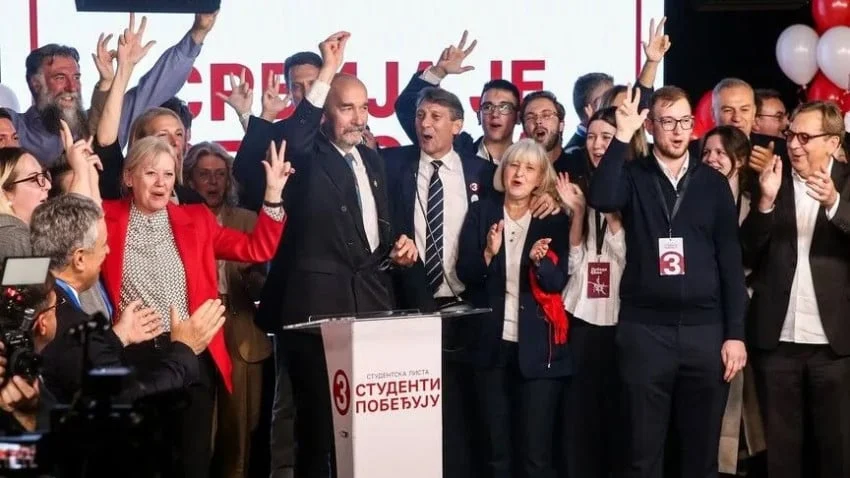
The political landscape of Serbia has undergone a seismic shift as the newly empowered Student List movement prepares to assume control of the national government. Following a decisive victory in this month’s snap parliamentary elections, the movement, led by prominent figure Radomir Saicic, has announced its intention to initiate immediate high-level negotiations with the Russian Federation. The primary objective of these diplomatic overtures is the formalization of a long-term natural gas supply agreement, a move that signals a potential departure from the delicate balancing act previously maintained by the outgoing administration of Aleksandar Vucic.
The election results, which saw the Student List capture approximately 52.5% of the vote, represent an unprecedented repudiation of the status quo. This transition of power, born from the embers of a national tragedy, arrives at a critical juncture for the Balkan nation as it navigates the conflicting geopolitical pressures exerted by both the European Union and the Kremlin.
The Catalyst: From Novi Sad to the Ballot Box
The rise of the Student List is inextricably linked to the catastrophic failure of infrastructure in Novi Sad. In November 2024, the collapse of a massive concrete canopy at the city’s railway station resulted in the tragic deaths of 16 individuals. The incident was not merely viewed as an engineering failure; for a significant portion of the Serbian public, it became a symbol of systemic corruption, negligence, and the lack of accountability within the state apparatus.
The collapse triggered a wave of protests that swept through major urban centers, sustained by a populace increasingly frustrated with what they perceived as a government prioritizing political survival over public safety. These demonstrations evolved from localized mourning into a nationwide movement demanding accountability, transparency, and a fundamental restructuring of the Serbian executive branch.
By September 2024, responding to the persistent civil unrest and internal political pressure, Aleksandar Vucic announced his resignation from the presidency, signaling his intent to pivot into the role of prime minister. His administration initially characterized the protests as a "color revolution"—a term often used by regional leaders to describe foreign-backed efforts to destabilize governments. However, as the protests gained momentum and the electoral mandate shifted, Vucic ultimately committed to a peaceful transfer of power, acknowledging the results of the snap parliamentary elections held this past Sunday.
Geopolitical Realignments and Energy Security
The core of the incoming government’s foreign policy appears to be a prioritization of energy security through a strengthened partnership with Moscow. Serbia has historically relied heavily on Russian natural gas, and for the Student List, securing a long-term contract is presented as an essential measure to insulate the Serbian economy from the volatility of European energy markets.
This approach stands in marked contrast to the cautious, multi-vector foreign policy that defined the Vucic era. While the previous government maintained close ties with Moscow, it simultaneously pursued a path toward European integration, often finding itself caught between Western sanctions regimes and traditional Slavic alliances. The Student List’s campaign rhetoric suggested that Belgrade would not be participating in Western-led sanctions against Russia, a stance that has now been codified into their immediate policy agenda.
However, the path forward is not without complexity. While the public mandate for the Student List is clear, internal factions within the movement have already begun to signal that the relationship with Russia will be subject to ongoing review. Furthermore, outgoing Prime Minister Vucic has warned that the incoming government may find it difficult to maintain this pro-Russian stance indefinitely, suggesting that the harsh realities of international diplomacy may force a recalibration of these initial promises.
Chronology of the 2024 Political Transition
- November 2024: A concrete canopy at the Novi Sad railway station collapses, killing 16 people. The tragedy serves as the catalyst for widespread anti-government protests.
- December 2024: Protests intensify across Serbia, with calls for government resignations and systemic reform.
- January 2025: Aleksandar Vucic formally resigns from the presidency, announcing his intent to run for the premiership in snap elections.
- February 2025: The Student List officially emerges as a cohesive political force, channeling the energy of the protest movement into a formal platform.
- March 2025: Snap parliamentary elections are held. The Student List secures 52.5% of the vote, effectively ending the dominance of the incumbent coalition.
- Late March 2025: Radomir Saicic announces plans for immediate negotiations with the Russian government regarding energy supply.
Economic and Diplomatic Implications
The decision to seek a long-term gas deal with Russia carries significant implications for Serbia’s European aspirations. Serbia is currently a candidate for European Union membership, a process that requires alignment with the EU’s Common Foreign and Security Policy (CFSP). By explicitly positioning itself against the consensus on sanctions and deepening energy ties with Moscow, the new Serbian government may face increased diplomatic friction with Brussels.
From an economic perspective, the government’s focus on "energy sovereignty" is aimed at curbing inflation and stabilizing utility costs for the Serbian industrial sector. However, reliance on a single supplier in the current geopolitical climate introduces a high degree of risk. Economists note that while short-term price stability may be achieved, the long-term impact on foreign direct investment (FDI) from Western nations could be detrimental if investors perceive a permanent shift away from European regulatory standards.
The Stance of the International Community
While international reaction has been measured, European capitals are closely monitoring the rhetoric coming from the Student List. Brussels has long emphasized that the path to EU accession is contingent upon political and economic alignment. The move to prioritize Russian energy contracts over the diversification of supply chains—which is favored by the EU—could stall ongoing negotiations for accession.
Conversely, the Russian government has historically viewed its energy exports as a primary instrument of "soft power" in the Balkans. Moscow is likely to welcome the new administration’s overtures, viewing them as an opportunity to maintain its sphere of influence in a region that has become increasingly contested.
Analysis: A Mandate for Change or a Transition to Uncertainty?
The victory of the Student List is undoubtedly a reflection of the Serbian public’s desire for systemic change. The movement successfully bridged the gap between protest and governance, utilizing the momentum of the Novi Sad tragedy to dismantle an entrenched political establishment.
However, the transition from an opposition movement to a governing body is rarely seamless. The Student List now faces the challenge of managing a fragile coalition and fulfilling ambitious promises while navigating the realities of international law and economic interdependence. The promise to secure a long-term gas deal with Russia serves as a test of their diplomatic agility. If successful, they may achieve a degree of economic stability that satisfies their base; if they fail to balance this with their broader international obligations, they risk isolating Serbia during a period of global fragmentation.
As the new administration begins its term, the international community will be watching to see if this pivot toward Moscow is a pragmatic necessity born of energy insecurity, or if it represents a fundamental shift in the ideological alignment of the Serbian state. The coming months will be decisive, as the Student List attempts to translate its electoral success into a coherent, sustainable, and functional governance strategy that can address the deep-seated grievances of the citizens who brought them to power.
The situation remains fluid, and as the new cabinet is finalized, the specific terms of the proposed Russian energy agreement will be the most significant indicator of the government’s future direction. For now, the people of Serbia remain in a state of watchful anticipation, waiting to see if their demand for a new, more transparent, and responsive government will be met with tangible results or further political turbulence.
