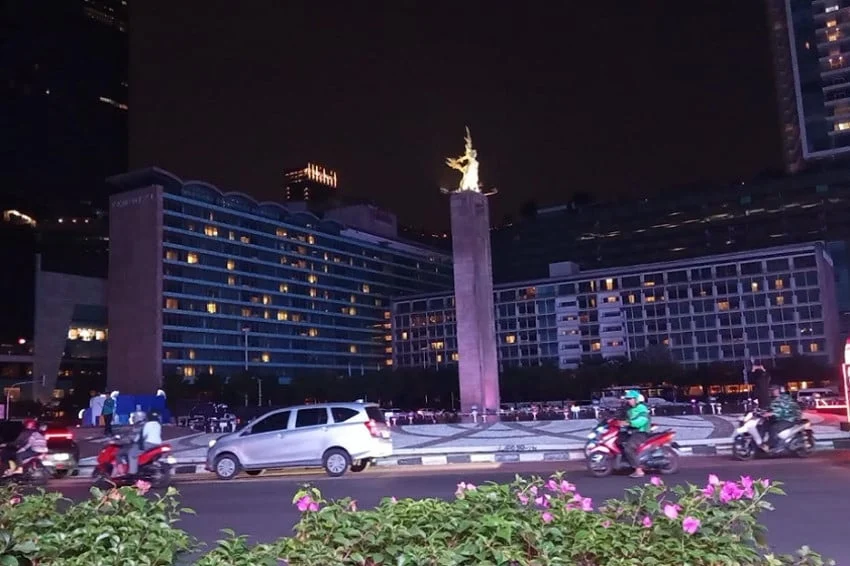
The glittering skyline of Indonesia’s capital experienced a rare and deliberate blackout on Saturday night as Jakarta participated in a global environmental initiative by plunging major commercial and historical zones into darkness for precisely sixty minutes. Stretching from the historic National Monument (Monas) to the bustling corridors of the Bundaran Hotel Indonesia (HI) in Central Jakarta, the one-hour lights-out demonstration formed the centerpiece of the city’s official observance of World Ozone Day. Despite the sudden curtailment of urban illumination beginning at 8:30 PM local time, thousands of residents and weekend visitors refused to let the darkness deter them, transforming a symbolic act of energy conservation into an impromptu social gathering.
The strategic blackout, coordinated by local municipal authorities in collaboration with environmental agencies and state-owned utility providers, was designed to raise public awareness regarding atmospheric preservation, climate change mitigation, and the ongoing global commitment to healing the Earth’s fragile ozone layer. As the monumental skyscrapers, towering digital billboards, and streetlamps along Jakarta’s primary thoroughfares faded into shadow, the iconic Bundaran HI water fountain and its surrounding statues were cast in a dramatic, minimalist silhouette. Far from emptying the streets, the subdued lighting conditions created an unorthodox atmosphere that captivated onlookers, drawing crowds who utilized the unique nocturnal environment to document a rarely seen side of Southeast Asia’s largest metropolis.
A Novel Urban Experience Amid Minimal Illumination
As the clock struck 8:30 PM, the sudden cessation of electrical power across the designated zones marked the formal commencement of the World Ozone Day lights-out campaign. Observers at the scene noted that while traffic management personnel and municipal officers maintained order along the darkened perimeters, the pedestrian zones quickly filled with curious citizens. Stripped of its usual kaleidoscope of neon commercial advertisements and intense floodlighting, the Bundaran HI area offered a stark contrast to the sensory overload that typically defines Jakarta’s nightlife.
Instead of retreating indoors or seeking illuminated venues, crowds of families, young professionals, and photography enthusiasts lingered in the subdued environment. Armed with smartphone cameras and portable recording devices, visitors eagerly captured the altered landscape, snapping selfies and group photographs against the darkened backdrop of premier hotels and corporate high-rises. The absence of ambient glare allowed amateur and professional photographers alike to experiment with low-light compositions, capturing the illuminated silhouettes of city landmarks against the nocturnal sky.
Beyond digital documentation, the darkened public spaces fostered a sense of communal relaxation. Pedestrians occupied stone seating areas around the fountain, engaging in casual conversations, while others strolled leisurely along the pathways that are ordinarily choked with the sensory distractions of urban traffic and blinding illumination. The stark reduction in energy consumption for that single hour transformed a utilitarian transit hub into a temporary communal plaza, demonstrating how urban spaces can be reimagined when freed from the relentless demands of commercial lighting.
Chronology and Implementation of the Jakarta Ozone Blackout
The initiative to darken Jakarta’s central commercial and administrative arteries was the culmination of weeks of cross-sector planning between the Jakarta Provincial Government, the Ministry of Environment and Forestry, and PT PLN (Persero), the state electricity company. The timeline of the event unfolded through a carefully coordinated sequence of operational adjustments:
- Late August to Early September: Municipal authorities and environmental advocacy groups launched a public awareness campaign across digital and traditional media channels, informing residents, business owners, and building managers about the impending one-hour blackout scheduled for September 19.
- Days Prior to the Event: Building management teams of major commercial skyscrapers, shopping complexes, and state-owned facilities along the Monas-Thamrin-Sudirman-Bundaran HI corridor finalized protocols to manually or digitally shut down non-essential exterior lighting, aesthetic facade illuminations, and massive LED billboard screens.
- 8:00 PM – 8:30 PM (Pre-Event Phase): Traffic police and municipal transportation officers (Dishub) deployed to strategic intersections along the designated blackout route to ensure public safety, manage vehicular flow, and assist pedestrians navigating the transitioning zones.
- 8:30 PM (The Blackout Commences): Utility controllers executed the scheduled reduction in load distribution, plunging the designated landmarks into darkness. Simultaneously, participating commercial buildings cut their exterior power feeds.
- 8:30 PM – 9:30 PM (The One-Hour Window): Residents congregated in public areas such as Bundaran HI and the Monas perimeter, engaging in low-impact recreational activities, capturing photographic documentation of the darkened skyline, and participating in localized environmental discussions.
- 9:30 PM (Restoration of Power): Utility systems systematically restored standard electrical distribution, signaling the conclusion of the formal observance as commercial facades and streetlamps flickered back to life.
Background Context: The Significance of World Ozone Day
World Ozone Day, officially designated by the United Nations General Assembly as the International Day for the Preservation of the Ozone Layer, commemorates the date of the signing of the Montreal Protocol on Substances that Deplete the Ozone Layer in 1987. Over the past three decades, the Montreal Protocol has stood as one of the most successful international environmental treaties in history, uniting nearly every nation on Earth to phase out the production and consumption of ozone-depleting substances, primarily chlorofluorocarbons (CFCs) and halons.

While international treaties focus heavily on industrial chemicals, urban centers worldwide have increasingly adopted symbolic actions—such as strategic power-downs and architectural blackouts—to engage the general public in broader conversations concerning energy efficiency, carbon footprints, and climate resilience. For a rapidly developing megacity like Jakarta, which grapples with significant energy demands and urban heat island effects, participating in such global environmental dates serves a dual purpose: educating the populace on resource conservation and demonstrating municipal commitment to sustainability goals.
Energy consumption in dense urban environments contributes heavily to greenhouse gas emissions, particularly when power generation remains reliant on fossil fuels such as coal and natural gas. By voluntarily shutting down non-essential electrical loads for a designated period, cities not only achieve measurable, albeit temporary, reductions in power demand but also provoke critical public reflection on daily energy consumption habits. The visual impact of a darkened skyline provides a powerful metaphor for resource scarcity and environmental stewardship, translating abstract scientific concepts into tangible, localized experiences.
Official Responses and Municipal Perspectives
Environmental officials and municipal leaders emphasized that the Saturday night blackout was intended to be more than a mere visual spectacle. Representatives from the Jakarta Environmental Agency noted that symbolic actions play a vital role in shifting public consciousness regarding energy waste. In official statements released ahead of the event, authorities stressed that urban dwellers must recognize the direct correlation between intensive electricity usage and carbon emissions that exacerbate both local air pollution and global climate change.
PT PLN, the state electricity provider, reported that the temporary cessation of power along the Monas-to-Bundaran HI corridor resulted in a noticeable drop in localized energy load during the sixty-minute window. While the absolute megawatt-hour savings from a single hour in a specific corridor represent a modest fraction of the capital’s total daily consumption, utility executives highlighted the educational dividend of the exercise. Engineering teams utilized the event to monitor grid stability during sudden load shifts, proving that the infrastructure can safely accommodate targeted demand-response protocols.
Civic organizations and urban planning experts have offered generally favorable evaluations of the event, though many suggest that such initiatives must serve as a precursor to permanent structural reforms. Analysts point out that while turning off lights for an hour creates powerful imagery and temporary engagement, Jakarta’s long-term environmental viability depends on deeper structural transformations—such as accelerating the transition to renewable energy sources, expanding public mass transit networks, enforcing stringent green building codes, and curbing vehicular emissions that persistently plague the capital’s air quality.
Broader Implications for Jakarta’s Urban Future
The successful execution of the World Ozone Day blackout in central Jakarta underscores the growing appetite among urban residents for public spaces that prioritize human interaction over relentless commercial stimulus. The unexpected vibrancy of the crowds at Bundaran HI during the blackout revealed a latent desire for pedestrian-friendly environments where the sensory assault of modern advertising and hyper-illumination is temporarily lifted.
Furthermore, the event aligns with Jakarta’s broader ambitions to transform into a sustainable, resilient megacity as the administrative capital gradually transitions to the Nusantara region in East Kalimantan. With the local government focusing increasingly on revitalizing downtown Jakarta, reducing carbon emissions, and expanding green open spaces, events that blend civic participation with environmental education are expected to become recurring features of the city’s calendar.
As the lights flickered back on at 9:30 PM, illuminating the towering monuments and corporate facades once more, the crowds gradually dispersed into the restored glare of the metropolis. Yet, the brief interlude of darkness left a lasting impression on the thousands who gathered—demonstrating that even in a city defined by relentless motion and relentless light, a moment of purposeful shadow can inspire unity, reflection, and a renewed dialogue about the future of the urban environment.