
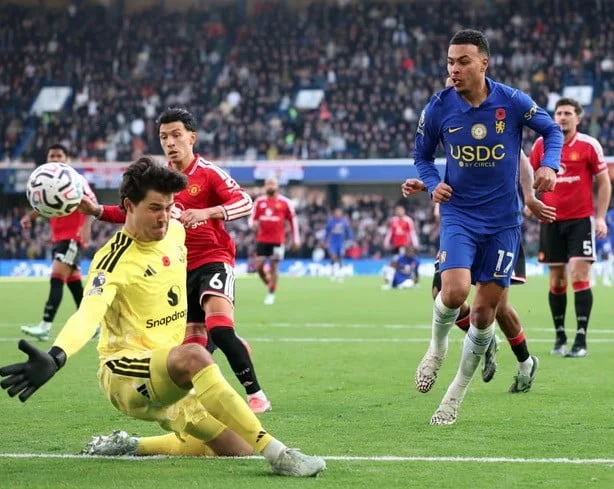
The 2026/2027 Premier League season reached another dramatic inflection point on Saturday, October 31, 2026, as Manchester United fell to a 2-0 defeat against Chelsea at Stamford Bridge. A closely contested first half gave way to a turbulent second period defined by defensive lapses, clinical finishing from the hosts, and a pivotal red card shown to Manchester United center-back Lisandro Martinez. The result deals a significant blow to the visitors’ ambitions in the upper echelons of the league table, while continuing Chelsea’s robust run of form under their tactical setup.
Despite arriving in West London with a proactive game plan that yielded early dominance, Manchester United was once again undone by efficiency in both boxes. The fixture, steeped in historic rivalry, lived up to its billing in terms of intensity and physical engagement, but ultimately underlined the ongoing vulnerabilities that continue to plague the Red Devils during high-stakes away fixtures.
First-Half Stalemate Masks United Dominance
The opening forty-five minutes painted a picture of promise for Manchester United. Operating with a high defensive block and quick transitions through the central corridors, the visiting side managed to dictate the tempo of the match for large portions of the first half. Chelsea, traditionally formidable on their home turf, struggled to find a cohesive rhythm in possession, often forced into hasty clearances and defensive scrambles.
Statistical metrics from the interval heavily favored the visitors. Manchester United carved out a series of promising openings, generating an expected goals (xG) figure of 1.01 by the time the referee blew the whistle for halftime. In stark contrast, Chelsea managed a meager 0.28 xG, struggling to test the Manchester United defensive structure or trouble the visiting goalkeeper, Senne Lammens.
Yet, for all their territorial advantage and creative output in the final third, Manchester United lacked the clinical edge required to break the deadlock. Strikers and supporting midfielders alike squandered half-chances, misplacing final passes or failing to direct headers on target. As the teams walked down the tunnel at 0-0, a sense of foreboding lingered among the traveling supporters—a recognition that failing to capitalize on dominant periods often invites punishment against elite opposition.
The Turning Point: Rogers Breaks the Deadlock
That foreboding materialized barely five minutes into the second half. The deadlock was shattered in the 50th minute, courtesy of a swift transition initiated in the midfield. Romeo Lavia, displaying sharp anticipation, dispossessed a Manchester United midfielder in the center circle before launching a rapid counter-attack.
Lavia threaded a precise, incisive pass into the path of Morgan Rogers. The midfielder exploited a pocket of space, driving directly at the heart of the Manchester United defense. With veteran central defender Harry Maguire backpedaling, Rogers demonstrated exceptional composure. As Maguire attempted to close down the shooting angle, Rogers shifted the ball and executed a delicate, audacious chipped finish over the advancing Senne Lammens. The ball nestled gently into the back of the net, stunning the visiting bench and erupting Stamford Bridge into celebration.
The goal fundamentally altered the tactical landscape of the match. Chelsea, hitherto cautious, dropped into a more compact, defensive block designed to absorb pressure and hit on the break, while Manchester United was forced to chase the game, stretching their lines and exposing themselves to further vulnerabilities.
Martinez Sent Off as Palmer Seals the Win from the Spot
Any hopes of a Manchester United comeback were systematically dismantled just past the hour mark. In the 63rd minute, a Chelsea attacking thrust into the penalty area resulted in chaos within the United defense. Lisandro Martinez, attempting to neutralize an advancing Wesley Fofana, mistimed his challenge and brought the French defender down inside the eighteen-yard box.
The referee initially paused play before consulting the Video Assistant Referee (VAR) monitor pitch-side. Following a review of the replay, the official confirmed the severity of the foul, pointing directly to the penalty spot. Compounding the misery for the visitors, Martinez, who had already been booked earlier in the encounter, was shown a second yellow card, resulting in an automatic red card and his dismissal from the pitch.
Cole Palmer stepped up to take the resulting penalty kick in the 64th minute. Though Senne Lammens guessed correctly and managed to get a hand to the firmly struck effort, the sheer power behind Palmer’s shot carried it through the goalkeeper’s gloves and into the net, doubling Chelsea’s advantage to 2-0.
Down a goal and a man, Manchester United’s tactical discipline dissolved. The remaining twenty-plus minutes saw the Red Devils struggle to string together meaningful sequences of play, as Chelsea comfortably managed the remainder of the fixture to secure a clean sheet and all three points.
Broader Implications and Tactical Analysis
The defeat at Stamford Bridge shines a harsh light on the structural inconsistencies within the Manchester United squad under their current technical direction. While the first-half performance offered undeniable evidence of tactical potential and progressive ball movement, the inability to convert dominance into goals remains a glaring deficiency. Furthermore, the defensive fragility exposed during high-pressure moments—typified by the midfield turnover leading to the first goal and the rash challenge resulting in the penalty and red card—underscores a persistent lack of emotional and structural discipline away from home.
For Chelsea, the victory represents a masterclass in opportunistic efficiency and resilience. Managerial staff and analysts will undoubtedly praise the team’s ability to weather early pressure, capitalize on transitional moments, and effectively close out the match once numerical and scoreline advantages were secured. The result solidifies Chelsea’s standing among the league’s top contenders, validating their tactical pragmatism in high-profile fixtures.
As the Premier League season progresses past its initial third, the implications of this match will resonate deeply within both clubs’ dressing rooms. Manchester United faces an urgent need to address their conversion rate in the final third and eliminate catastrophic individual errors before winter congestion sets in. Meanwhile, Chelsea can use this foundational victory to build sustained momentum as they navigate the rigorous demands of domestic and potentially European campaigns.
