
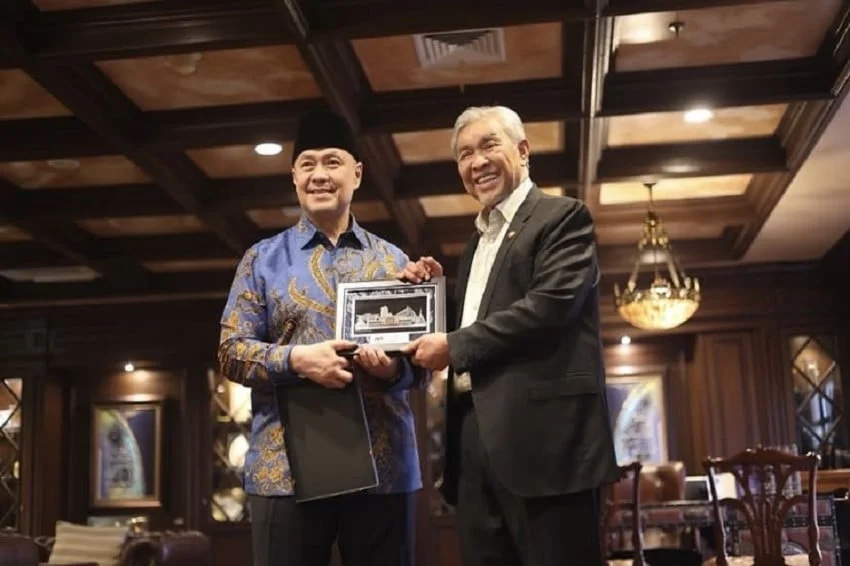
In a significant display of personal diplomacy that underscores the enduring strength of the Indonesia-Malaysia relationship, Deputy Prime Minister of Malaysia Dato’ Seri Ahmad Zahid Hamidi paid a high-level visit to the Menara 165 in Jakarta on Monday, September 21, 2026. The meeting, held with the Founder of ESQ Group and Ary Ginanjar University, Dr. Ary Ginanjar Agustian, served as more than a casual reunion between two long-standing friends; it acted as a symbolic reaffirmation of the deep-seated cultural and political ties that bind the two Southeast Asian neighbors. Amidst an era of complex geopolitical challenges, the interaction highlighted how interpersonal trust can serve as a vital conduit for stabilizing relations between sovereign nations.
A Two-Decade Legacy of Friendship
The bond between Dato’ Seri Ahmad Zahid Hamidi and Ary Ginanjar Agustian spans over twenty years, originating during the early 2000s when Zahid served as the Minister in the Prime Minister’s Department responsible for Islamic Affairs. Since that period, the trajectory of Zahid’s career has seen him occupy some of the most influential positions in the Malaysian cabinet, including Minister of Defence, Minister of Home Affairs, and his current tenure as Deputy Prime Minister.
Throughout these political transitions, the relationship with Ary Ginanjar remained a constant. Speaking from his office in Jakarta on Tuesday, September 22, 2026, Dr. Ary Ginanjar reflected on the nature of their connection. "Our friendship does not operate on the basis of titles or political hierarchy; it is a friendship of the heart. Whether in times of prosperity or amidst the challenges of public life, this bond has remained steadfast," he stated. This sentiment underscores a recurring theme in Southeast Asian diplomacy: the "soft power" of personal relationships often facilitates the "hard power" of state-to-state negotiations.
Historical Context: Diplomacy During Times of Tension
The visit to Menara 165 was particularly poignant given the historical backdrop of the bilateral relationship. During the height of the maritime border disputes in the Ambalat region—a period that tested the diplomatic mettle of both Jakarta and Kuala Lumpur—Ahmad Zahid Hamidi, then serving as Malaysia’s Minister of Defence, maintained his engagement with Indonesian civil society through his connection with Ary Ginanjar.
Historical records indicate that even during the most sensitive phases of the Ambalat dispute, when public sentiment in both countries was volatile, the communication channel between Zahid and Ary Ginanjar remained open. Ary recalled that the Menara 165 venue often functioned as an informal "neutral ground" where high-level defense officials and policy stakeholders from both nations could engage in quiet, off-the-record dialogues. By facilitating these interactions, the duo utilized a spiritual and values-based approach to de-escalate tensions, proving that human-to-human connectivity is a potent tool in conflict resolution.
The Strategic Importance of the Indonesia-Malaysia Relationship
To understand the weight of this meeting, one must consider the sheer magnitude of the partnership between Indonesia and Malaysia. As two of the most influential members of the Association of Southeast Asian Nations (ASEAN), their cooperation is pivotal for regional stability.
- Economic Integration: Malaysia consistently ranks as one of the top foreign investors in Indonesia, particularly in the sectors of banking, telecommunications, and plantation industries. Conversely, Indonesia provides a substantial portion of the labor force that sustains various sectors of the Malaysian economy.
- Security Cooperation: The two nations share a vast maritime border and collaborate closely on the Malacca Strait security, one of the world’s most critical shipping lanes.
- Cultural Affinity: The shared linguistic and cultural heritage creates a "brotherly" dynamic, often referred to in diplomatic circles as serumpun. However, this closeness can also lead to unique challenges, making the role of personal mediators like Ary Ginanjar essential for managing sensitivities.
Analysis: The Role of Non-State Actors in Diplomacy
The interaction between the Malaysian Deputy Prime Minister and a leader of an educational and spiritual institution like the ESQ Group represents an evolving trend in international relations known as "Track II Diplomacy." While official state-to-state relations (Track I) are often bound by strict protocols and public scrutiny, Track II diplomacy involves non-governmental, informal, and academic actors who can explore solutions to sensitive issues without the pressure of immediate public disclosure.
By meeting at an institution dedicated to leadership development and character building, both parties signaled a commitment to long-term stability rather than short-term political posturing. The focus on "spiritual and personal approaches" suggests a move toward value-based diplomacy, where common moral foundations are leveraged to bridge differences in national interest.
Institutional Growth: The Legacy of Menara 165
The choice of venue—Menara 165—is itself symbolic. As the headquarters for the ESQ Group and the base for the Ary Ginanjar University, the building represents an intersection of education, modern management, and traditional values. Since its establishment, the ESQ movement has aimed to harmonize intellectual quotient (IQ), emotional quotient (EQ), and spiritual quotient (SQ).
The visit of a high-ranking foreign official to this specific location serves to validate the international reach of Indonesia’s civil society organizations. It demonstrates that Indonesian institutions are increasingly recognized as influential hubs capable of contributing to regional peace-building efforts.
Future Implications and Bilateral Outlook
As the world approaches the latter half of the 2020s, the challenges facing the ASEAN region are shifting from traditional border disputes to issues of economic resilience, digital transformation, and climate change. The meeting between Zahid Hamidi and Ary Ginanjar is likely to set a precedent for how future cross-border issues will be handled.
Observers note that by nurturing such deep, long-term friendships, political leaders ensure that when formal negotiations hit a deadlock, there is a pre-existing layer of trust to rely upon. This "diplomatic insurance policy" is perhaps the most significant outcome of the meeting. As both nations continue to navigate the complexities of the 21st century, the ability to prioritize the human element of diplomacy remains a key advantage.
Official Responses and Public Sentiment
While no formal government communique was issued regarding the specific political agenda of the September 21 meeting, analysts suggest that such visits are typically used to "take the pulse" of the relationship. By engaging with an influential public figure like Ary Ginanjar, the Malaysian Deputy Prime Minister gains a unique, grassroots perspective on Indonesian public sentiment that might not always be reflected in official diplomatic reports.
Public reaction in both Malaysia and Indonesia to this visit has been largely positive. Social media discourse and local press coverage have highlighted the longevity of the friendship, contrasting it with the often fickle nature of political alliances. For the general public, the sight of a Deputy Prime Minister choosing to spend time with a mentor and friend reflects a humanized approach to governance that is highly valued.
Conclusion
The meeting between Dato’ Seri Ahmad Zahid Hamidi and Dr. Ary Ginanjar Agustian at Menara 165 is a testament to the power of personal integrity in the professional sphere. By maintaining a friendship that has weathered two decades of political shifts, regional tensions, and the pressures of high office, the two men have demonstrated a model of engagement that transcends the limitations of formal politics.
As Indonesia and Malaysia look toward a future of closer integration, the lessons learned from their interaction—that trust is the foundation of all successful negotiation—remain as relevant as ever. The visit was not merely a trip to Jakarta; it was a strategic investment in the long-term health of the relationship between two of Southeast Asia’s most important nations, reminding all observers that even in the highest echelons of power, the most enduring bridges are those built on the strength of character and the sincerity of friendship.
