
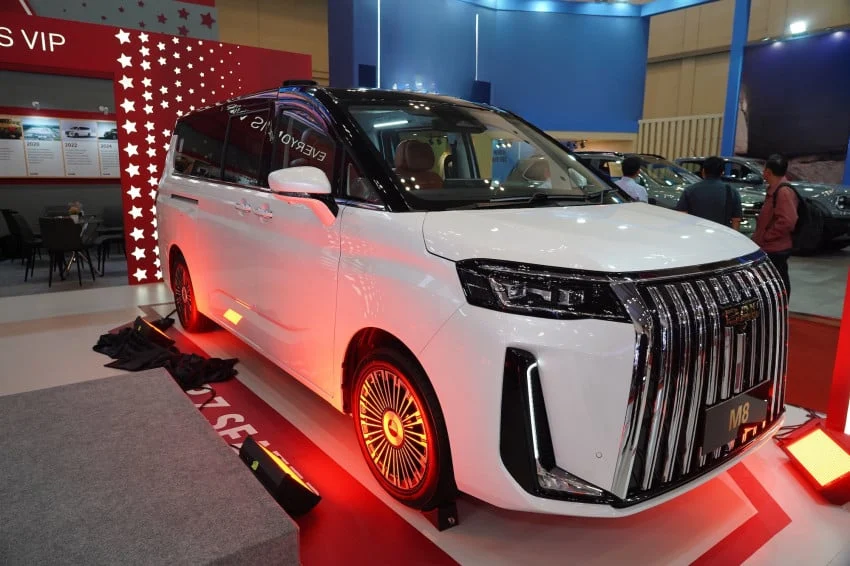
The Indonesian electric vehicle landscape has witnessed yet another strategic incursion from a Chinese automotive manufacturer, as Beijing Automobile Works (BAW) officially marked its entry into the fiercely competitive multi-purpose vehicle (MPV) segment. Unveiled at the Gaikindo Indonesia International Auto Show (GIIAS) series event—specifically the Gaikindo Auto Week (GAW) 2026 held at ICE BSD, Tangerang Selatan, on Friday, November 20, 2026—the newly introduced BAW M8 aims to carve out a distinct niche. Priced starting at Rp699 million on-the-road Jakarta, this battery-electric MPV enters a crowded arena dominated by established Chinese brands, bringing with it a unique value proposition centered on high-capacity seating and aggressive financial incentives.
BAW has positioned the M8 as a pioneer in a specific category, claiming it to be the first nine-seater electric MPV available in the Indonesian market. While the local automotive sector has grown accustomed to the rapid influx of electrified vehicles from mainland China, the timing and positioning of the BAW M8 reflect an increasingly sophisticated market segmentation strategy. Rather than targeting the entry-level domestic buyer or competing directly at the ultra-luxury tier, BAW has chosen to drop the M8 into the narrow middle ground between mass-market family haulers and high-end executive shuttles.
The competitive pressures defining the Indonesian passenger vehicle market in 2026 are profound. According to wholesale distribution data from the Association of Indonesian Automotive Industries (Gaikindo), the electric MPV category has experienced explosive growth, largely catalyzed by aggressive pricing and rapid technological adoption. In the first five months of 2026 alone, the BYD M6 recorded a formidable sales volume of 5,017 units, establishing itself as a dominant force in the lower-to-mid electric MPV tier. Following closely behind, the Wuling Cortez Darion EV secured 2,765 units during the same January-to-May timeframe, while the more luxurious Denza D9 accounted for 2,359 units, capturing the upper echelon of executive buyers.
This crowded field operates against the backdrop of a broader structural shift within the Indonesian automotive ecosystem. Data compiled by Gaikindo for retail sales between January and October 2026 highlights a dramatic surge in the market share of Chinese automotive brands, which climbed from 12.3 percent to 18.1 percent. This upward trajectory underscores a fundamental transformation in consumer perception regarding Chinese manufacturing prowess, supply chain reliability, and technological integration. Furthermore, by August 2026, the cumulative presence of Chinese automotive brands operating within the Indonesian archipelago had reached 17 distinct marques—surpassing the numerical footprint of traditional Japanese legacy manufacturers who have historically commanded the domestic market for decades. It is within this hyper-competitive, fast-evolving ecosystem that BAW has chosen to introduce the M8.
Chronology of the Launch and Strategic Rollout
The genesis of the BAW M8 launch event at GAW 2026 on November 20 was the culmination of months of regulatory preparation, logistics planning, and dealer network establishment. Industry watchers had anticipated BAW’s strategic move into the passenger electrification space, given the brand’s legacy in commercial and utility vehicle sectors. The unveiling ceremony at ICE BSD drew considerable attention from industry analysts, prospective fleet operators, and family buyers alike, primarily due to the vehicle’s unconventional seating configurations and pricing strategy.
Following the initial reveal on Friday, November 20, 2026, BAW wasted no time in detailing the commercial structure for the M8 lineup. The vehicle is offered in three distinct variants tailored to varying consumer preferences and commercial applications. The entry-level model within this tiered structure is the Premium 7-Seater, tagged at Rp699 million. For buyers prioritizing maximum passenger capacity, BAW introduced the Premium 9-Seater variant, priced at Rp729 million. At the pinnacle of the lineup sits the Flagship 7-Seater, retailing at Rp749 million. All stated figures reflect on-the-road (OTR) Jakarta pricing, establishing a clear pricing bracket that sits comfortably above mainstream compact electric choices while undercutting ultra-luxury imports.
Comparative Pricing and Market Positioning Analysis
To fully comprehend the market implications of the BAW M8 pricing strategy, one must examine its position relative to its closest rivals. At the lower end of the electrification spectrum, the BYD M6 commands a price range spanning from Rp385 million to Rp433 million, making it significantly more accessible to average households and ride-hailing fleets. Conversely, at the high end, the premium Denza D9 commands approximately Rp950 million, appealing heavily to corporate fleets, hospitality operators, and affluent families seeking executive-level amenities.
Positioned precisely between these two bookends, the BAW M8 Premium 7-Seater at Rp699 million is roughly Rp266 million to Rp314 million more expensive than a top-trim BYD M6. However, when compared against the executive-class Denza D9, the M8 presents a substantial cost advantage, undercutting the D9 by Rp201 million to Rp251 million depending on the chosen variant. This pricing architecture creates a unique dilemma and opportunity for consumers: buyers who find the BYD M6 too compact or basic, yet consider the Denza D9 financially prohibitive, now have a middle-ground alternative that emphasizes expansive interior volume and high-density seating.

To bridge the psychological gap of entering a crowded market against established heavyweights, BAW has formulated a comprehensive financial and after-sales support package designed to mitigate consumer hesitation regarding a relatively new passenger vehicle brand. Recognizing that traditional financing structures can deter fence-sitting buyers, BAW’s promotional framework includes a zero percent financing interest rate option, an initial down payment starting at a competitive 15 percent, a two-month installment holiday program, and a complimentary wall-mounted home charging unit.
In addition to financial cushioning, long-term ownership security has been heavily emphasized to instill confidence. The standard vehicle warranty spans 5 years or 100,000 kilometers, whichever comes first. More critically for an electric vehicle, the battery pack and electric motor assemblies are backed by an extensive warranty coverage of 8 years or 200,000 kilometers. Complementing these assurances, BAW has included a complimentary periodic maintenance package covering 3 years or 60,000 kilometers, effectively insulating early adopters from initial operational overheads.
Technical Specifications and Engineering Architecture
Beneath its sizable exterior styling, the BAW M8 incorporates modern electric vehicle engineering tailored to accommodate both passenger comfort and heavy-duty utility demands. The vehicle is powered by a robust 81 kWh lithium iron phosphate (LFP) battery pack paired with a rear-wheel-drive (RWD) configuration. LFP chemistry has become increasingly favored across the industry for its thermal stability, enhanced safety profile, and prolonged lifecycle compared to traditional nickel-manganese-cobalt (NMC) alternatives.
In terms of operational range, the BAW M8 delivers up to 505 kilometers on a single charge under the China Light Duty Vehicle Test Cycle (CLTC) standards. While real-world driving conditions in congested urban centers such as Jakarta will inevitably yield varying metrics, the CLTC figure places the M8 well within acceptable thresholds for daily intercity commuting and regional family travel. Recharging capabilities are equally critical for modern EV adoption; the M8 supports fast-charging infrastructure capable of replenishing the battery state from 30 percent to 80 percent in approximately 35 minutes. According to manufacturer data, this half-hour charging session delivers an additional cruising range of roughly 252 kilometers, minimizing downtime during long-distance journeys.
Dimensionally, the BAW M8 is built to command a substantial road presence. The vehicle boasts an overall body length of 5,317 millimeters and a generous wheelbase stretching 3,200 millimeters. These expansive proportions are what enable the cabin to comfortably accommodate up to nine occupants in the higher-tier variant without compromising legroom or cargo utility. The interior layout is anchored by a contemporary infotainment setup, highlighted by a prominent 14,6-inch central touchscreen interface that controls climate, media, and vehicle diagnostics. Furthermore, the M8 incorporates Vehicle-to-Load (V2L) technology capable of outputting up to 3.3 kW of electrical power, transforming the MPV into a mobile power bank capable of running external appliances, electronic devices, or equipment during outdoor excursions or emergency scenarios.
Broader Industry Implications and Future Outlook
The entry of the BAW M8 into Indonesia’s evolving automotive landscape carries several broader implications for both consumers and industry stakeholders. First, it signals that competition within the electric vehicle sector is shifting away from mere price wars in the entry-level hatchback and compact SUV segments toward lifestyle, utility, and multi-passenger space configurations. As families, commercial fleet operators, and tourism businesses increasingly evaluate electrification, the demand for high-capacity electric people-movers is expected to expand exponentially.
Second, the aggressive after-sales incentives deployed by BAW—ranging from zero-percentage financing to extensive component warranties and free maintenance—demonstrate the playbook that newer international market entrants must utilize to challenge entrenched competitors. Brands entering Indonesia can no longer rely solely on product novelty; they must provide robust risk-mitigation packages to convince risk-averse consumers to transition away from internal combustion engine (ICE) vehicles or dominant EV pioneers like BYD and Wuling.
Finally, the success or failure of the BAW M8 will serve as an important barometer for market saturation. With 17 Chinese brands actively vying for consumer attention as of late 2026, showroom real estate, consumer mindshare, and localized service infrastructure are becoming critically scarce commodities. If the M8 successfully captures the specific demand for high-capacity electric transport, it could pave the way for further commercial diversification by BAW and pressure existing market leaders to expand their own multi-row, high-occupancy EV portfolios. As the Indonesian automotive market marches deeper into its electrification timeline, the arrival of vehicles like the BAW M8 ensures that the transition will be characterized by intense consumer choice, aggressive technological advancement, and continuous commercial adaptation.
