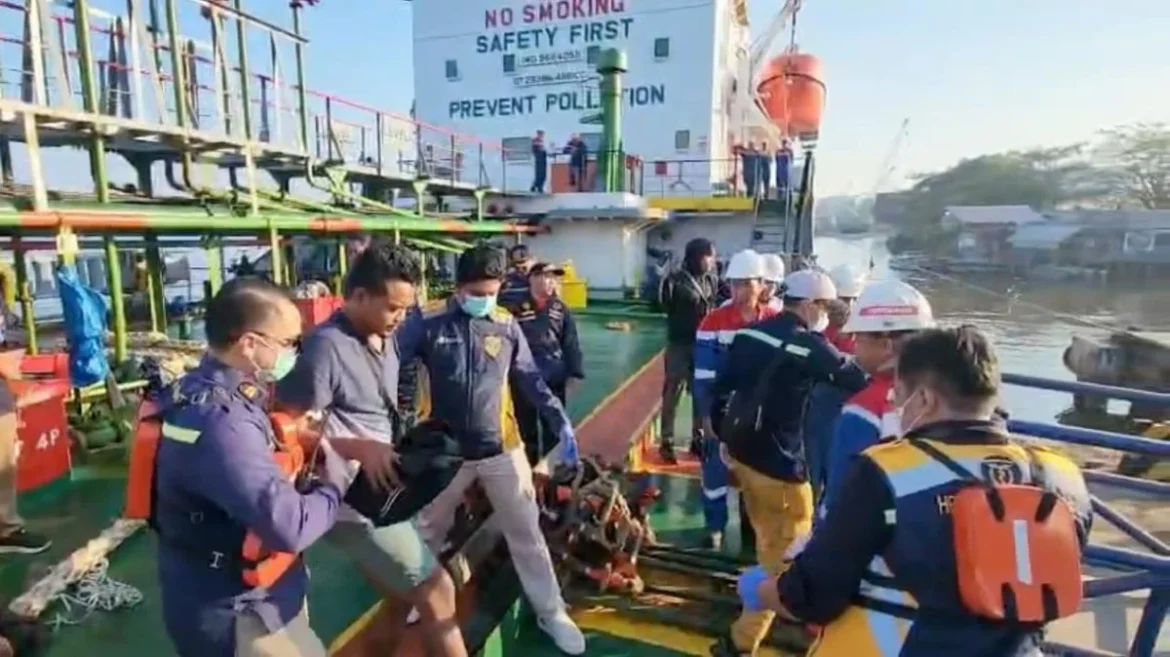
The maritime landscape of the Java Sea witnessed a display of rapid emergency response and humanitarian solidarity on September 14, 2026, as the Pertamina Patra Niaga tanker, MT Mauhau, successfully concluded a rescue mission involving the crew of the ill-fated vessel MV Virgo Transport 8. The operation, which spanned several hours across the early morning, culminated in the safe arrival of 16 individuals at the Trisakti Port in Banjarmasin, where they were transferred to the custody of the National Search and Rescue Agency (Basarnas) for professional medical evaluation and further processing.
The incident, which resulted in 15 survivors and one fatality, highlights the critical role played by commercial vessels in supporting the global maritime safety net. Despite the inherent dangers of nighttime operations in open waters, the crew of MT Mauhau demonstrated adherence to international maritime protocols, specifically those regarding the duty to render assistance to vessels in distress.
Chronology of the Maritime Rescue
The sequence of events began on Sunday, September 13, 2026, while MT Mauhau was conducting its routine transit toward the port of Tuban. At approximately 03:00 local time, the tanker’s bridge received an urgent distress signal via VHF radio originating from the MV Virgo Transport 8, which was reporting a critical situation involving the vessel taking on water and subsequently sinking.
Upon receiving the signal, the Master of MT Mauhau immediately initiated emergency protocols. The tanker diverted from its planned course, navigating toward the coordinates provided by the distressed vessel, which were situated approximately 10 nautical miles away. The efficiency of the response was further bolstered by the presence of visual indicators, as the crew of MT Mauhau successfully spotted a parachute flare launched by the survivors of the MV Virgo Transport 8.
By the early hours of Sunday, the crew of the tanker had successfully brought 16 people aboard, including the captain of the sunken vessel. Upon boarding, the survivors were provided with immediate humanitarian assistance, including emergency medical care, food, and basic supplies. Despite these efforts, one individual, who had sustained severe injuries during the sinking, succumbed to their condition at approximately 10:16 local time.
The tanker continued its transit toward the nearest port, arriving at the Trisakti Port in Banjarmasin on Monday, September 14, at 06:10 WITA. The formal handover to Basarnas was conducted shortly thereafter, ensuring that the survivors received specialized care and that the proper authorities could commence an investigation into the cause of the sinking.
Official Statements and Organizational Response
The successful rescue operation has drawn commendations from the leadership of PT Pertamina Patra Niaga. Kitty Andhora, the Vice President of Corporate Communication, underscored the significance of the event, framing it as a testament to the organizational culture of safety and preparedness maintained by the company’s maritime division.
“Upon receiving the distress notification, the crew of MT Mauhau did not hesitate to prioritize the preservation of human life,” Andhora stated on September 14, 2026. “The swift transition from standard operations to an active rescue mission is a clear reflection of the commitment held by Pertamina’s personnel to assist the community whenever and wherever the need arises. While we mourn the loss of one individual, we are relieved that 15 others were brought to safety.”
The coordination between private commercial entities and national rescue agencies is a cornerstone of effective maritime safety. In this instance, the communication between the tanker’s bridge and the Basarnas command center served to streamline the handover process, allowing for a seamless transition of care once the vessel reached the port. This level of cooperation is essential in the Java Sea, a high-traffic maritime corridor where rapid response times are the primary determinant between a successful rescue and a secondary disaster.
Safety Implications and Maritime Protocol
The incident involving the MV Virgo Transport 8 serves as a stark reminder of the unpredictable nature of maritime travel and the importance of adhering to the International Convention for the Safety of Life at Sea (SOLAS). The SOLAS convention dictates that the master of a ship at sea, which is in a position to be able to provide assistance on receiving information from any source that persons are in distress at sea, is bound to proceed with all speed to their assistance.
By diverting its course and coordinating with local authorities, the crew of MT Mauhau performed a duty that is both legal and ethical. Maritime analysts often point out that while modern vessels are equipped with sophisticated navigation and distress communication technology, the human element—the ability of a crew to identify, respond to, and manage an emergency—remains the most vital link in the safety chain.
Furthermore, the operational continuity of MT Mauhau was maintained with professional precision. Following the successful handover in Banjarmasin, the vessel departed for its original destination of Tuban on September 14 at 13:30 local time. The company confirmed that all 21 crew members of the MT Mauhau remained in good health and high spirits throughout the aftermath of the rescue operation.
Broader Context of Maritime Safety in the Java Sea
The Java Sea is one of the busiest shipping lanes in Southeast Asia, connecting the major industrial and agricultural centers of the Indonesian archipelago. The high volume of traffic, combined with varying weather conditions and the presence of both large commercial tankers and smaller, often less-regulated vessels, creates a complex environment for search and rescue operations.
Statistics from regional maritime authorities indicate that the majority of maritime incidents in the region involve mechanical failures or hull breaches in smaller transport vessels. The incident with the MV Virgo Transport 8 underscores the necessity for regional operators to ensure that their vessels are equipped with functional communication equipment, such as VHF radios, and that their crews are trained in emergency signaling, such as the use of parachute flares.
The response from the maritime community has been one of collective relief, noting that the timely intervention of MT Mauhau prevented a potentially much larger tragedy. As the investigation into the sinking of the MV Virgo Transport 8 begins, focus will likely turn toward the structural integrity of the vessel and the environmental conditions that may have contributed to the sinking.
Conclusion and Future Outlook
As of the latest updates, the focus of the authorities has shifted to the medical and psychological support of the 15 survivors. Basarnas is expected to conduct a full debriefing of the crew to determine the sequence of events leading up to the distress call.
For PT Pertamina Patra Niaga, the event reinforces their commitment to maintaining high standards of fleet management and crew training. The company has stated that it will continue to prioritize safety as a fundamental pillar of its operations, emphasizing that investment in emergency response training is as vital as investment in the infrastructure of their tankers.
The safe arrival of the MT Mauhau in Tuban, expected on September 15 at 16:00, will mark the official end of this mission. The incident serves as a benchmark for maritime cooperation in the region, illustrating that when commercial shipping and emergency response agencies operate in tandem, the safety of lives at sea remains the highest priority. The resilience displayed by the crew of the MT Mauhau provides a reassuring example of the dedication found within the maritime industry, where the professional duty to reach a destination is always secondary to the humanitarian duty to save lives.