
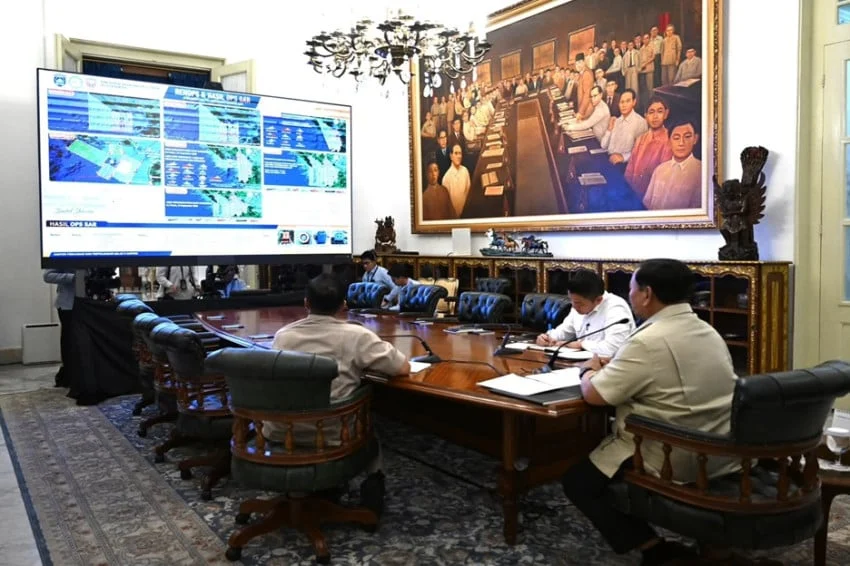
JAKARTA — In a decisive stance against environmental degradation, Indonesian President Prabowo Subianto has issued a stern ultimatum to corporate entities involved in deliberate forest and land fires, commonly known as karhutla. Speaking before a high-level assembly of cabinet ministers and state officials, the head of state emphasized that his administration would extend no leniency to companies that prioritize short-term commercial gains over public health, ecological stability, and national law. The presidential directive highlights a zero-tolerance policy toward systematic environmental crimes that have historically plagued parts of the archipelago during the dry seasons.
The uncompromising remarks were delivered during a Cabinet Limited Meeting convened at the State Palace in Jakarta. While forest fires formed a central pillar of the agenda, the high-stakes gathering also addressed concurrent national crises, including disaster management efforts following the earthquake in East Nusa Tenggara (NTT), the maritime incident involving the Virgo vessel, and the mysterious disappearance of a journalist. However, it was the President’s hardline approach to corporate negligence and arson in forested zones that dominated political and environmental discourse following the meeting.
Escalating Government Response to Recurrent Ecological Crises
Forest and land fires have long posed a complex socioeconomic and environmental challenge for Indonesia, frequently resulting in transboundary haze, severe respiratory illnesses among citizens, substantial economic disruption, and massive releases of carbon emissions into the atmosphere. Despite years of preventative campaigns and regulatory frameworks, illegal land-clearing practices utilizing fire—often favored due to their low cost—persist among certain agricultural and forestry enterprises.
During the State Palace proceedings, President Prabowo instructed relevant ministries and law enforcement agencies to elevate their vigilance and enforcement mechanisms. He argued that superficial administrative reprimands or minor financial penalties are wholly insufficient to deter wealthy corporations. Consequently, the government is shifting toward maximum deterrence, combining severe criminal indictments with administrative paralysis of offending entities.
Central to the President’s directive is the immediate revocation of business licenses for corporations found culpable of igniting fires. Rather than protracted administrative reviews that have historically allowed errant companies to exploit bureaucratic loopholes, Prabowo demanded expedited revocations. By stripping businesses of their legal operating credentials, the state aims to dismantle the commercial viability of enterprises that systemically violate environmental protection statutes.
Data and Enforcement Context: The Scale of Legal Action
The presidential warning coincides with intensifying legal scrutiny across the forestry and plantation sectors. Law enforcement and environmental agencies have ramped up investigations into corporate misconduct linked to recent ecological disasters. According to recent institutional disclosures, approximately 95 corporate entities are currently navigating various stages of formal legal processing, ranging from preliminary investigation to active judicial prosecution.
These numbers reflect a mounting pressure campaign by the Ministry of Environment and Forestry, the Indonesian National Police, and the Attorney General’s Office. Investigators are utilizing advanced satellite telemetry, thermal hotspot mapping, and forensic soil analysis to trace the exact origins of blazes and link them directly to corporate land-management concessions. The intersection of strict political will from the executive branch and heightened investigative rigor points toward a watershed moment in Indonesian environmental jurisprudence.
Furthermore, environmental advocacy organizations and legal watchdogs have long pointed out that corporate impunity remains the primary bottleneck in resolving the annual haze crisis. By targeting the legal entities and corporate ownership structures—rather than merely arresting low-level field workers who physically ignite the brush under orders—the government’s current strategy targets the financial apex of illicit operations.
Chronology of the Policy Shift and Institutional Coordination
The trajectory toward this aggressive enforcement posture has evolved over several legislative and administrative cycles, culminating in the current administration’s aggressive consolidation of environmental laws.
In the weeks leading up to the State Palace meeting, regional disaster mitigation agencies and meteorological authorities reported an uptick in localized dry conditions, heightening the risk of combustible terrain across Sumatra and Kalimantan. Recognizing the early indicators of potential seasonal escalation, the central government initiated preemptive coordination meetings.
The timeline of the recent government response underscores a synchronized inter-agency approach:
- Early Phase: Meteorological monitoring agencies detect anomalies in rainfall patterns, prompting early warnings regarding high-risk provinces susceptible to rapid vegetation drying.
- Mid Phase: Investigative bodies initiate proactive sweeps of industrial forest concessions and palm oil plantations, auditing fire management infrastructure and compliance with zero-burning policies.
- Current Phase: The National Cabinet Meeting chaired by President Prabowo solidifies the political mandate, transitioning from standard regulatory oversight to punitive enforcement, characterized by threats of corporate license revocation and stringent criminal prosecution.
This chronological progression demonstrates a strategic pivot from reactive firefighting to pre-emptive deterrence and systemic corporate accountability.
Reactions from Government Ministries and Civil Society
The President’s unambiguous stance has elicited varied responses from government stakeholders, legal experts, and civil society organizations, all of whom recognize the profound implications of executing such a hardline policy.
Law enforcement agencies, including the Indonesian National Police, have signaled their readiness to accelerate dossiers involving corporate suspects. Interior and forestry ministries have likewise begun reviewing the legal mechanisms required to streamline the revocation of operational permits without violating administrative law or triggering protracted commercial arbitration disputes that corporations often utilize to stall state actions.
Meanwhile, environmental non-governmental organizations (NGOs) have cautiously welcomed the announcement, viewing it as a long-overdue alignment of executive authority with ecological preservation. Representatives from civil society coalitions emphasized that while verbal commitments and policy directives are vital, the ultimate test lies in transparent execution and the successful prosecution of high-profile corporate actors without political interference. Analysts note that previous administrations occasionally threatened license revocations, but subsequent follow-through varied widely depending on commodity market pressures and legal challenges filed by affected conglomerates.
Broader Economic and Geopolitical Implications
The enforcement of stringent criminal penalties and rapid permit revocations carries significant economic reverberations for Indonesia’s vital agribusiness sectors, particularly palm oil and pulp and paper industries. Indonesia remains the world’s leading producer of palm oil, a commodity deeply integrated into domestic economic growth and global supply chains.
From an economic perspective, stringent crackdowns introduce temporary market adjustments. Investors and corporate boards are being forced to internalize environmental risk management as a core operational requirement rather than an administrative afterthought. Companies with robust sustainability frameworks, traceable supply chains, and advanced fire-prevention technologies stand to gain a competitive advantage, while recalcitrant operators face existential business risks.
Internationally, Indonesia’s commitment to curbing forest fires and reducing greenhouse gas emissions is closely monitored by global trade partners and international climate bodies. Strict enforcement mechanisms serve to bolster the nation’s credibility in international climate negotiations, addressing longstanding criticisms regarding deforestation and peatland degradation. By demonstrating tangible punitive actions against domestic and transnational corporate offenders, Jakarta reinforces its adherence to international environmental commitments and sustainable development goals.
Ultimately, President Prabowo Subianto’s directive marks a critical juncture in Indonesia’s environmental governance. By marrying executive resolve with strict penal and administrative consequences, the administration is signaling that environmental degradation will no longer be treated as a routine cost of doing business, but as a severe criminal offense carrying irreversible consequences for corporate violators.
