
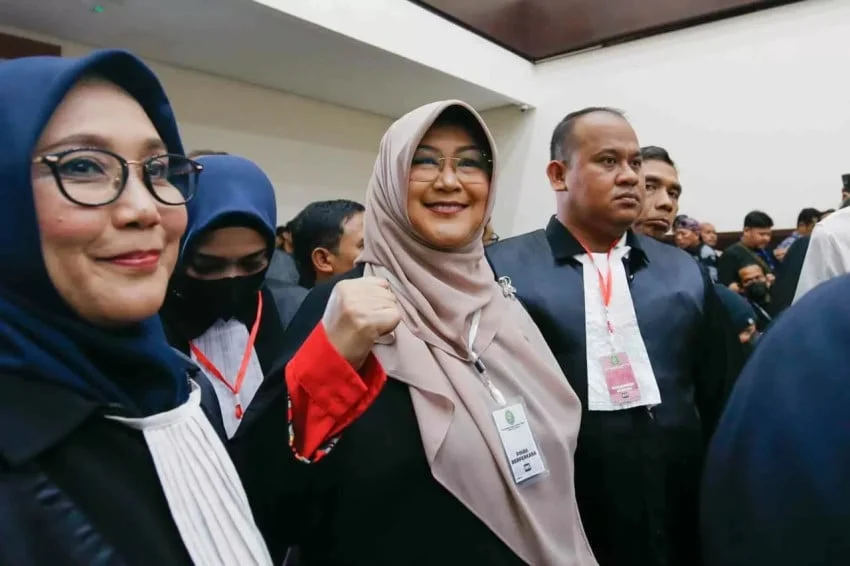
The legal proceedings involving Tifauzia Tyassuma, widely known as Dokter Tifa, reached a pivotal juncture on Thursday, September 17, 2026, as the East Jakarta District Court convened to hear the defense’s formal objection, known as an eksepsi. This session marks the continuation of a high-profile legal battle that has polarized public discourse regarding the authenticity of academic credentials belonging to Indonesia’s seventh president, Joko Widodo. The court session, scheduled to commence at 09:00 WIB in the Main Courtroom, represents a critical phase where the defense aims to challenge the structural integrity of the prosecution’s indictment.
Chronology of the Legal Conflict
The controversy surrounding Tifauzia Tyassuma’s public statements began years prior, fueled by repeated social media posts that challenged the legitimacy of President Joko Widodo’s educational history. These allegations, which gained significant traction on platforms like X (formerly Twitter), eventually transitioned from online discourse to formal legal scrutiny.
On August 27, 2026, the Public Prosecutor (JPU) formally leveled multiple charges against Tifauzia Tyassuma at the East Jakarta District Court. The indictment centers on accusations of defamation, slander, and the dissemination of false information via electronic media. According to the court’s Case Tracking Information System (SIPP), the prosecution relies on a robust set of charges, specifically invoking the recently enacted Law Number 1 of 2023 concerning the Criminal Code (KUHP).
The primary charge brought by the state falls under Article 434, paragraph (1) in conjunction with Article 441, paragraph (1) of the 2023 KUHP. This primary charge is supported by a subsidiary indictment under Article 433, paragraph (1) in conjunction with Article 441, paragraph (1) of the same law. These statutes specifically address crimes against public order and the dissemination of materials that could be classified as malicious misinformation regarding individuals in positions of public trust.
The Defense Strategy: Understanding the Eksepsi
In the Indonesian legal system, an eksepsi is a procedural mechanism that allows the defendant to argue that the indictment is flawed, incomplete, or outside the jurisdiction of the court. By filing this motion, Dokter Tifa’s legal team is signaling their intent to challenge the validity of the charges before the court proceeds to the evidentiary stage of the trial.
Observers of the Indonesian judicial system note that the filing of an eksepsi is a standard defensive maneuver in cases involving complex digital evidence and defamation claims. The defense is expected to argue that the defendant’s actions constituted protected speech or that the prosecution’s interpretation of the 2023 KUHP in this specific context is overly broad. The court’s ruling on this objection will determine whether the trial continues on its current trajectory or if the prosecution must revise its formal charges.
Contextualizing the Allegations: The Jokowi Ijazah Dispute
The academic records of President Joko Widodo have been a recurring point of contention among critics since his tenure as Mayor of Surakarta. The specific claim that the President’s university diploma from Universitas Gadjah Mada (UGM) was fraudulent has been debunked multiple times by official academic records, university statements, and judicial rulings.
Despite these clarifications, the narrative has persisted within certain online communities. Tifauzia Tyassuma emerged as one of the most vocal proponents of the "fake diploma" theory. Her continued dissemination of these claims, even after official verification by the university, led to several police reports filed by parties who deemed her statements to be defamatory and damaging to the reputation of the head of state.
Legal analysts suggest that the state’s decision to prosecute these claims under the 2023 KUHP indicates a stricter stance toward digital disinformation. The new criminal code provides clearer definitions for electronic crimes, making it easier for prosecutors to pursue individuals who spread claims that are deemed to have no factual basis and cause public unrest.
Supporting Data and Legislative Framework
The legal framework governing this trial, specifically the 2023 KUHP, represents a significant evolution in Indonesian jurisprudence. Articles 433 and 434, which deal with offenses related to the "honor and dignity" of individuals, are designed to balance freedom of speech with the right of individuals to be protected from malicious character assassination.
Data from the Ministry of Communication and Informatics (Kominfo) indicates that the frequency of disinformation cases involving public figures has seen a marked increase since 2022. This case serves as a benchmark for how the judiciary intends to handle high-profile digital defamation in the post-pandemic era. The prosecution’s reliance on these specific articles suggests that the state is viewing this not merely as a private defamation matter, but as a case of public interest involving the stability of state institutions.
Official Responses and Public Reaction
While the government has generally maintained a policy of not engaging directly with conspiracy theories regarding the President’s credentials, the legal action taken by the Prosecutor’s Office serves as the state’s definitive response. By utilizing the formal court process, the administration has shifted the burden of proof onto the defendant, requiring her to substantiate her claims in a court of law.
Public reaction remains deeply divided. Supporters of Tifauzia Tyassuma characterize the trial as an attempt to silence dissenting voices, framing the legal action as a form of judicial overreach. Conversely, legal experts and proponents of judicial integrity argue that the trial is a necessary step to curb the spread of misinformation that erodes public trust in democratic institutions.
Broader Impact and Implications for Digital Discourse
The trial of Tifauzia Tyassuma holds significant implications for the future of digital expression in Indonesia. If the court finds the defendant guilty, it will reinforce the legal boundaries for public figures and influencers when discussing sensitive political topics. It serves as a stark reminder that the digital space is subject to the same legal standards as traditional media.
Furthermore, the case highlights the risks associated with "information laundering," where unsubstantiated claims are repeatedly shared on social media until they are perceived as facts by segments of the population. The court’s ultimate decision will likely influence how similar cases are handled in the future, potentially setting a precedent for how the state enforces the 2023 KUHP in the digital age.
As the proceedings continue at the East Jakarta District Court, all eyes remain on the bench. The court’s decision regarding the eksepsi will be the first major indicator of how the judiciary views the limits of public scrutiny versus the protection of individual reputation in an increasingly polarized digital landscape. The trial is expected to continue for several weeks, with experts anticipating that the evidentiary phase—should it proceed—will involve forensic digital analysis and expert testimony regarding the authenticity of academic records.
This legal drama serves as a microcosm of the broader challenges facing Indonesian democracy: the struggle to maintain an open, transparent, and critical public sphere while simultaneously ensuring that the digital commons are not poisoned by persistent, factually incorrect narratives that undermine the legitimacy of state governance. As the court processes the arguments presented by both the prosecution and the defense, the verdict will likely resonate far beyond the confines of the courtroom, influencing the discourse on accountability and digital ethics for years to come.
